A Syrian poet, publisher, and nationalist who helped forge Arab-American literary identity — and who died four days before his only book of poems reached print.
By Francesco Medici
• ❧ KGC ❧ •
KAHLIL GIBRAN COLLECTIVE
By Francesco Medici · Kahlil Gibran Collective · 2026 · kahlilgibran.com
Since the late nineteenth century, numerous Arabic-language periodicals flourished within the Christian Syrian-Lebanese immigrant communities in the United States of America. On April 15, 1892, the brothers Ibrāhīm and Naǧīb ʿArbīlī were the first to establish the weekly newspaper Kawkab America (“Kawkab Amīrikā” in Arabic, meaning ‘The Star of America’) in New York. In 1898, it became a daily newspaper, and its publication continued until 1908. Other noteworthy New York newspapers aimed at readers of Arab origin include Mirʼāt al-ʻArab (‘The Mirror of the Arabs,’ 1893), al-Ayyām (‘The Days,’ 1897), and Al-Mohajer (“al-Muhāǧir” in Arabic, meaning ‘The Emigrant,’ 1903). The first English-language Arab-American monthly magazine, The Syrian World, published from 1926 to 1932, was founded by Salloum Mokarzel (Sallūm Mukarzil, 1881–1952).
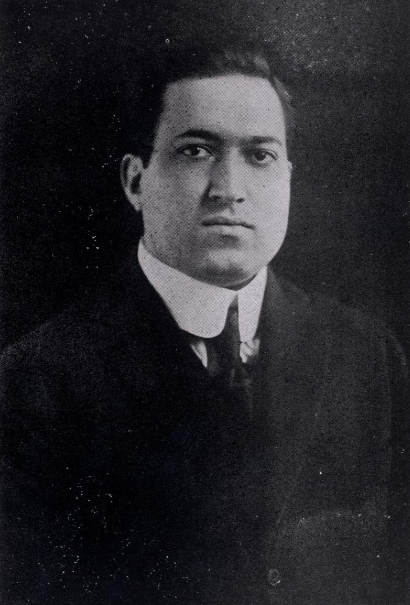
One of the leading figures in the development of Arab journalism in the United States was the Syrian poet, writer, literary critic, and nationalist Naseeb Arida (Nasīb ʿArīḍah). Born in Homs on August 17, 1887, to Orthodox Christian parents, he attended Russian missionary schools for five years, first in his hometown and later in Nazareth, Palestine, where he met the Lebanese Mikhail Naimy (Mīḫāʼīl Nuʻaymah, 1889–1988), his fellow student, who would likewise become another prominent Arab intellectual of the diaspora. Owing to his outstanding academic performance and excellent command of the Slavic language, he was awarded a scholarship to spend a year in Tsarist Russia; unfortunately, however, he lost the opportunity to travel there because of the outbreak of the Russo-Japanese War (1904–1905).

In 1905, he emigrated to New York to work in a cousin’s textile factory, initially as an employee and later as its owner. It was during this period that he began collaborating with newspapers such as al-Hoda (“al-Hudà” in Arabic, meaning ‘The Guidance’), founded in 1898 by Naoum Mokarzel (Naʻūm Mukarzil, 1864–1932), and Meraat-ul-Gharb (“Mirʼāt al-Ġarb” in Arabic, meaning ‘The Mirror of the West’), founded in 1899 by Nageeb Moussa Diab (Naǧīb Mūsà Diyāb, 1870–1936), of which Arida would become editor-in-chief beginning in 1937.
In 1912, in New York, Arida founded his own publishing house Al-Atlantic Publishing Co. (renamed Al-Funoon Publishing Co. in 1916), and in April of the following year he published the first issue of his cultural monthly Al-Funoon (“al-Funūn” in Arabic, meaning ‘The Arts’), which survived until August 1918. Although published rather irregularly, the magazine produced a total of twenty-nine issues before its definitive and painful closure, reportedly due to a combination of factors such as the rising cost of paper, a shortage of subscriptions, limited labor availability, and finally the outbreak of the First World War. Arida himself published numerous short stories, poems, translations from Russian, and articles of literary criticism in its pages.

Many of his other contributions also appeared in the biweekly As-Sayeh (“al-Sāʼiḥ” in Arabic, meaning ‘The Traveler,’ 1912–1958), founded in New York by the brothers Abdulmassih Abdo Haddad (ʿAbd al-Masīḥ Ḥaddād, 1890–1963) and Nadra Haddad (Nadrah Ḥaddād, 1881–1950), fellow Syrians from his hometown, whose sister Najeebi (Nağībah, 1886–1976) he married in 1923. The author was accustomed to signing his contributions with various pseudonyms, such as Alīf, Mālik, or al-Ġarīb al-Sākit (The Silent Stranger).1 A refined connoisseur of Arabic literature, his essays focus primarily on the classical poets of his homeland, such as Dīk al-Ǧinn al-Ḥimṣī (777–849). The novel Asrār al-Balāṭ al-Rusī (‘Secrets of Russian Royalty’), a translation or adaptation from Russian of an original work that has not been clearly identified, had already been published serially in Al-Funoon beginning in 1913 and was collected into a single volume twenty years later.2

• ❧ KGC ❧ •
I
From its very inception in 1916, Arida played a leading role within al-Rābiṭah al-Qalamiyyah (or simply “Arrabitah,” meaning ‘The Pen League’), the most important circle of Arab-American writers in New York, officially re-founded on April 28, 1920, in the studio apartment of Kahlil Gibran (Ǧubrān Ḫalīl Ǧubrān, 1883–1931), who also drew a charcoal portrait of him. That same year, he became a member of the Syrian-Mount Lebanon Relief Committee, established in New York to send humanitarian aid to the Syrian-Lebanese region, devastated by famine and by the repeated atrocities perpetrated by the Ottoman Empire.


In 1917, he also became actively involved in the Syrian-Lebanese League of Liberation, also known as the Syrian-Mount Lebanon Volunteer Committee, whose aim was to promote the voluntary enlistment of Syrian Americans alongside the Allied forces in order to fight the Turks in the Arab territories. On January 24, 1921, accompanied by a delegation from the Syrian-Lebanese League of North America (including Naimy and Abdulmassih Haddad), he went to the White House to personally present President Woodrow Wilson (1856–1924) with a gold-and-diamond plaque as a token of gratitude for his efforts in defense of the Syrian-Lebanese region and of all oppressed nations during the world conflict.

• ❧ KGC ❧ •
II
Although they had no children, Naseeb and Najeebi meanwhile enjoyed a serene married life in Brooklyn. However, a few years after their marriage, Nora (Nūrah, 1914–2001), the daughter of ʿAbd al-Mağīd Ḥaddād, another of Najeebi’s brothers, was left motherless. The young niece, immediately welcomed into the couple’s home, was raised as though she were their own daughter.

In his autobiography Sabʻūn: Ḥikāyat ʻUmr (‘Seventy: Story of a Lifetime,’ Beirut, 1959–1960), Mikhail Naimy thus remembered his dear friend and colleague:
Naseeb Arida […] was of medium height and a rather full man whose calm eyes displayed depth, dejection, and gentleness. His movements were slow and mature, and his thoughts and speech were serious and clear. He was faithful as a friend, and he loathed chattering, gossiping, arguing, and imposing himself as the head of a group session or a meeting. He always underestimated his worth although he was overgenerous, peaceful, and easy going. He was shy in unfamiliar settings. He was unpretentious and modest, and he disliked boasting and bragging. Among all the members of Arrabitah he was the most informed about the history of the Arabs and their literature.
Naseeb enjoyed a well-cooked meal and a full glass to accompany it. He was fond of Poker and of a good cigar, and before he got married, Gibran, Abdulmassih [Haddad], and I spent memorable nights at his house which were full of wonderful memories. He used to be the cook, a role which he mastered and excelled at […] While Naseeb used to drink whisky glass after glass, and Gibran and Abdulmassih followed suit with him, I used to pour a little in a small glass, fill the glass with water, and take my time sipping it slowly like a little bird until we finished our meal. After the formation of Arrabitah, Naseeb married the sister of Abdulmassih, and both of them remained childless. Naseeb produced one volume of poetry which he called “The Perplexed Spirits,” but he also left many manuscripts in both poetry and prose.3

• ❧ KGC ❧ •
III
During the Second World War, Arida worked for a couple of years as an editor in the Arabic section of the American Military Information Office.


Counted among the leading exponents of Arab Romanticism, he died suddenly on March 25, 1946, four days before the publication of al-Arwāḥ al-Ḥāʼirah (‘The Perplexed Spirits’), his only dīwān.4 The poetry collection comprises nearly one hundred poems ranging from the most varied intimate and existential themes to the anguish felt for one’s distant homeland, from the evocation of the glorious past of Arab civilization to the most fervent nationalist pride. The tones are contemplative, sorrowful, and nostalgic, often pessimistic, yet at times also elegiac and epic.

In the celebrated poem ʻAlā ṭarīq Iram (‘On the Road to Iram’), the legendary lost city of the Arabian Peninsula — the ‘Atlantis of the Sands,’ as Lawrence of Arabia (1888–1935) called it — becomes a metaphor for the refuge of the spirit, where, beyond material existence, true knowledge resides. Arida himself, in an explanatory note, offers the reader the interpretative key to the text:
In the Arab tradition, Iram Ḏāt al-ʻImād (Iram of the Pillars) is a marvellous city that the legendary Šaddād Bin ʻĀd built out of blocks of gold and diamonds. It was a wonder to behold […] Then this city of wonders declined and was swallowed by the sands. Yet it still exists, in a hidden place, filled with magical palaces and unguarded treasures. No one, however, can approach it. Many have attempted to find it, but they either died or lost their way in the desert, or else returned empty-handed. […] But the city to which the poet alludes is the dwelling place of the spirit. He therefore undertakes a long quest with his caravans and describes, stage by stage, the road he has traveled. At the end of the journey, the author imagines that he has caught a distant glimpse of its splendor.5
In the collection, the city of New York thus emerges as a kind of anti-Iram, the archetype of the kingdom of material — and therefore illusory — goods. The sprawling American metropolis, with its skyscrapers and its frenetic pace, seeks to crush and engulf him; yet the exiled poet, though dazzled by its deceptive lights, does not forget the winding alleyways and the “black stones” of his beloved Homs. The disorientation and turmoil dwelling within his soul are the same as those experienced by all Syrian-Lebanese who immigrated overseas, themselves “perplexed spirits” who nevertheless refuse to renounce either their origins or their identity.

Despite his desire to be buried in his native soil, the remains of Naseeb Arida rest in Brooklyn’s Green-Wood Cemetery alongside those of his wife and adopted daughter. Inscribed on the gravestone are the verses of one of his short poems, whose opening lines read: “Place a doll upon my stone grave / It shall be a symbol of life after my death.”

❁
1 For a complete bibliography of Naseeb Arida’s contributions published in Al-Funoon and As-Sayeh, see al-funun.org. ↩
2 Nasīb ʿArīḍah, Asrār al-Balāṭ al-Rusī, New York: al-Hudà, 1933. ↩
3 Mikhail Naimy, Sabʻun (Seventy): An Autobiography, Selections Translated into English with an Introduction by George Nicolas El-Hage, Ph.D., 2020, pp. 228–230. ↩
4 Nasīb ʿArīḍah, al-Arwāḥ al-ḥāʼirah, New York: Maṭbaʻat Ğarīdat al-Aḫlāq, 1946. ↩
5 The mythical city of Iram and its destruction are also mentioned in the Qur’an: “Have you not seen what your Lord did to the people of ʻĀd? To the city of Iram with many pillars? Nothing like it was created amongst the other cities” (89:6–8). ↩
All Rights Reserved © Copyright Francesco Medici 2026