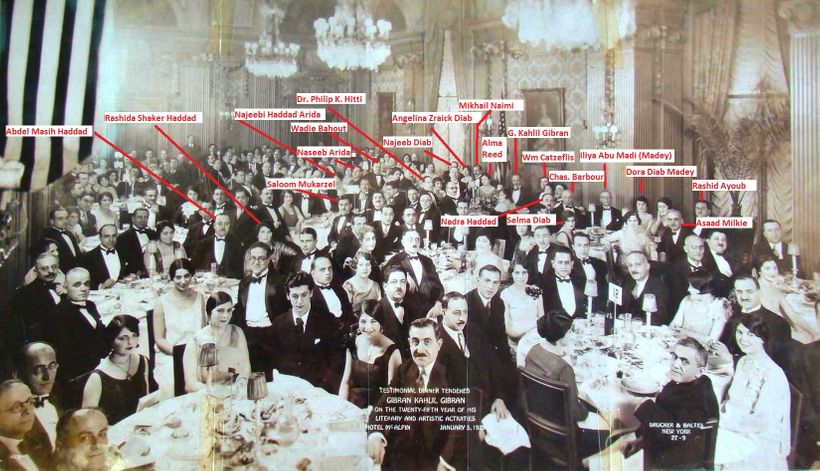
On 5 January 1929 the Pen League gave a dinner for Kahlil Gibran at the McAlpin Hotel. A hundred people came. Robert Goodhouse and his colleagues have spent years putting names to the faces in the one photograph that survives.
By Todd Fine · Originally published on HuffPost, 15 June 2017
• ❧ KGC ❧ •
KAHLIL GIBRAN COLLECTIVE
By Todd Fine · Kahlil Gibran Collective · 2019 · kahlilgibran.com
• ❧ KGC ❧ •
I
The field of Arab American studies is being revolutionised by a movement of independent scholars leveraging the new accessibility of genealogical information and newspapers in digital databases. Important topics like the history of the Syrian quarter in Lower Manhattan and the biographies of key Arab American political and literary figures are finally being written — by scholars such as Linda Jacobs, Jean Gibran, Charles Malouf Samaha, Francesco Medici, Mary Ann DiNapoli, Gregory J. Shibley, and Robert Goodhouse.
Robert Goodhouse, vice president of Rapiscan Systems, is an enthusiastic and friendly member of this historical community, and has focused especially on topics related to his own ancestors: the prominent early publisher Najib Diab and the writer Elia Abu Madi. Goodhouse has published thorough biographical articles online, constructed elaborate family trees, and served as an avid conduit of information for the larger group of independent scholars. Most recently, he and a number of colleagues have been analysing and labelling a fascinating photograph of a dinner party held in 1929 for Kahlil Gibran. Given that New York City is now building a memorial to the Arabic-language writers shown in that photograph, it seemed a good time to interview him about the project and about his work.
What do you find exceptional about this photograph? What was the importance of this gathering?
The 1920s were years of prodigious output for a group of around ten writers who formed a literary society in New York called the Pen League. Kahlil Gibran led the group, and on 5 January 1929 the organisation honoured him with a dinner party. The society's members and their guests were joined by notable Arab American leaders in business, journalism and academia — about a hundred people in all. This photograph was taken at the dinner, and my colleagues and I have been able to identify most of the Pen League members pictured in it. I'm unaware of any other photo that shows most, if not all, of this famed cohort of writers together.
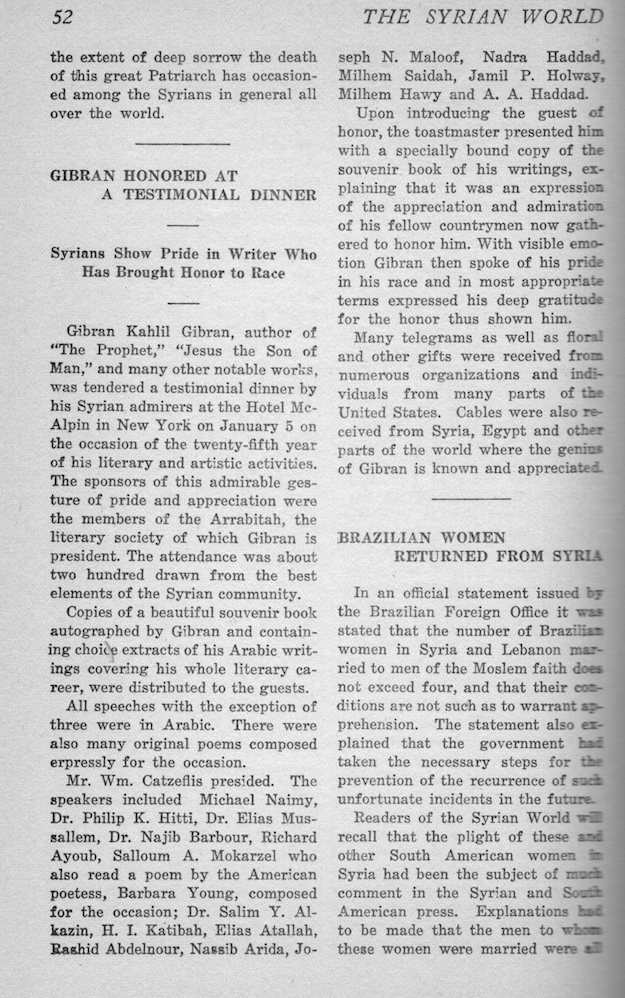
The League members largely wrote in Arabic, although one of the most famous works to emerge from its membership is Gibran's 1923 English-language book The Prophet, already a huge best-seller by 1929. Most of the League members were poets, and many of their poems are still memorised by students in the Arab world today. Some have even been set to popular Arabic music.
This dinner was held the day before Gibran's forty-sixth birthday, and celebrated a quarter-century since his first art exhibition in Boston in 1904 and the publication of his first poems in Manhattan in 1905. To me the photo represents more than an evening celebrating Gibran. It captures the vitality and sophistication of the early Arab American immigrant leaders, revealing their accomplishments in all fields and showing the solidarity among a diverse group of different religious backgrounds, all bound by the Arabic language.
In historical memory Kahlil Gibran often seems to emerge as an isolated individual — disconnected from time and place — who offered wisdom to the world from on high. What does this photograph say about his embedding within an actual community?
I believe the 1974 work Kahlil Gibran: His Life and World by Jean Gibran and Kahlil G. Gibran, recently revised as Kahlil Gibran: Beyond Borders, provides the best insight into his complex character. All his life he was a joiner. From 1913 he was on the board of, and a major contributor to, Al-Funoon (The Arts), published by another League member shown in the photograph, Naseeb Arida. He was also involved with several Syrian and Lebanese relief organisations before and during the First World War. The photograph shows the breadth of his Arab American friendships and acquaintances, and he maintained close friendships with non-Arabs such as the journalist Alma Reed — identified in the photo — the Indian political activist Sarojini Naidu, and many American and international literary and artistic figures.
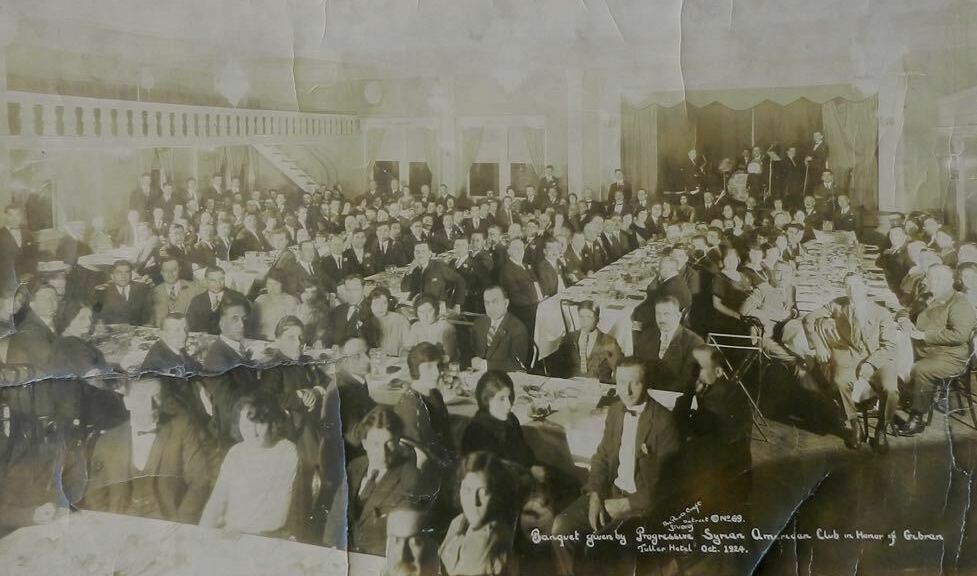
Gibran considered New York his home; he hosted a fairly constant stream of friends at his Greenwich Village studio, and wrote and spoke regularly on topical issues in the 1910s and 1920s. From 1904 to 1920 he published over 140 Arabic-language poems in four New York journals alone, many of them dealing with political issues. So the mystical nature of The Prophet, with its universal audience, was an important part of his personality — but as the photograph shows, in the New York Arab community he was admired, well-liked for the most part, and certainly appreciated as a key member.
How does the project of identifying the individuals in this photograph connect to your own research interests?
The history of the Middle East has been a personal interest of mine since my college days. My business work has been based on the belief that commerce between the United States and the Middle East could encourage improved mutual understanding of East and West. In that respect I have remained an optimist.
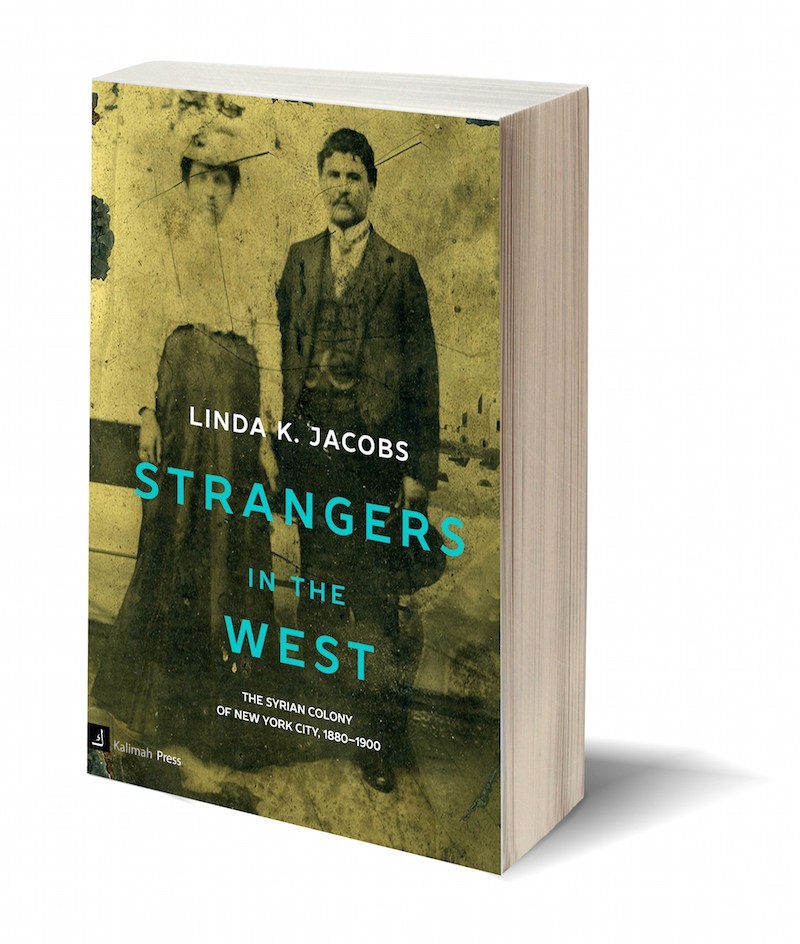
I have also had a long-term interest in my own ancestry, starting with my father's German family. Then, after being exposed to Dr. Linda Jacobs's research for her seminal work on early Syrian and Lebanese immigration to the United States, Strangers in the West, a long-nascent interest in my own Syrian-Lebanese ancestry became recast in real documents and facts. I began to learn that many of the stories I had heard as a teenager from a great-aunt — also in the photograph — were true and verifiable. I had seen photos of some of my own family as children and teenagers around 1905, but this banquet photo shows some of them at an elegant social event in adulthood.
I believe the key to the study of family, and especially family histories in this important period for Arab Americans, is rigorous confirmation of facts. We can't just repeat family lore. As in any historical writing, beginning with original sources helps us reach our own conclusions. It is our conclusions, not the data itself, that are ultimately subject to debate and interpretation. We are still in the early days of discovery for this period of Arab American history — so important in its literature and its politics.
❁
Todd Fine is president of the Washington Street Advocacy Group, a non-profit advocating for the physical preservation of the Lebanese neighbourhood of downtown Manhattan associated with Kahlil Gibran. He successfully campaigned for the City of New York to approve a public art memorial for the Arabic-language literary figures, Gibran among them. In 2011 he directed Project Khalid, the campaign marking the centenary of Ameen Rihani's The Book of Khalid (1911), the first Arab-American novel in English, with events at the Library of Congress and the New York Public Library. He edited the critical edition of The Book of Khalid published by Syracuse University Press in 2016, and is a PhD candidate in history at the Graduate Center, CUNY.
Originally published on HuffPost, 15 June 2017. Republished with acknowledgement to the author.
All Rights Reserved © Copyright Kahlil Gibran Collective 2019