As The Prophet marked its centenary in 2023, a quiet but remarkable discovery emerged from the archives: Kahlil Gibran was not only the first author in the history of Alfred A. Knopf to design his own publisher's colophon — he was, as far as the record shows, the only one.
By Glen Kalem-Habib and Francesco Medici · 13 November 2023
• ❧ KGC ❧ •
KAHLIL GIBRAN COLLECTIVE
By Glen Kalem-Habib & Francesco Medici · Kahlil Gibran Collective · 2023 · kahlilgibran.com
As The Prophet celebrates its 100th year of publication, many will once again acknowledge its well-deserved accolades and records. Yet the enigma surrounding its enduring popularity persists - and even after a century of readership and publishing, we continue to uncover its secrets.
This article was inspired by Francesco Medici's earlier research, which led to the publication of "Translating Gibran's Early Arabic Books: An Unpublished Letter of Mikhail Naimy to Alfred Knopf" - revealing some fascinating details in an extraordinary letter that Gibran's close friend and biographer Mikhail Naimy wrote to the esteemed publisher Alfred Knopf. Surprisingly, Knopf had been entirely unaware of Gibran's Arabic works translated into English until the 1950s, at which point he eagerly sought Naimy's expertise to produce improved translations and publish them under his own firm.
The fact that Gibran had the freedom to create his own book cover and even the publisher's colophon piqued our interest, and led us into what proved to be immensely fulfilling uncharted research territory - examining the relationship between Gibran and his English publisher Knopf. Today, we can illuminate this matter and proudly unveil a newfound revelation: Gibran stands as the first, and quite possibly the sole, A.A. Knopf author ever to be granted the exceptional privilege of designing his own Borzoi.
• ❧ KGC ❧ •
I
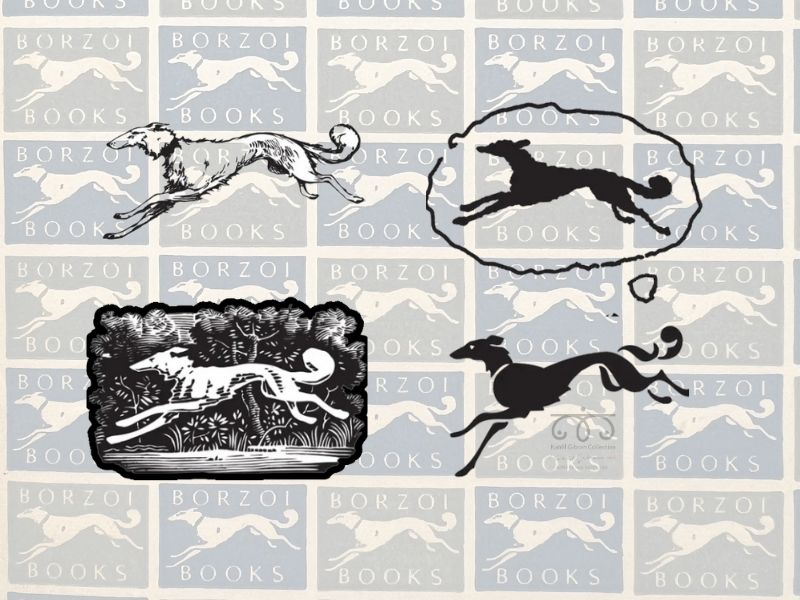
The story of the Borzoi - the Russian sighthound that became synonymous with Knopf's prestigious legacy, adorning all A.A. Knopf books as their trademark emblem to this day - carries a distinct historical narrative when it intertwines with Gibran.
With assistance from our friends at Knopf-Doubleday and the ever-helpful archivist at the Harry Ransom Center at the University of Texas, we can now confirm that Gibran's own illustration of the publisher's insignia was uniquely his own. Not only was he the first author to be afforded this privilege - in his publication of Twenty Drawings (1919), just a few short years after Knopf was founded - but as it turns out, no other author in the history of the publishing firm has been afforded the same honour since.
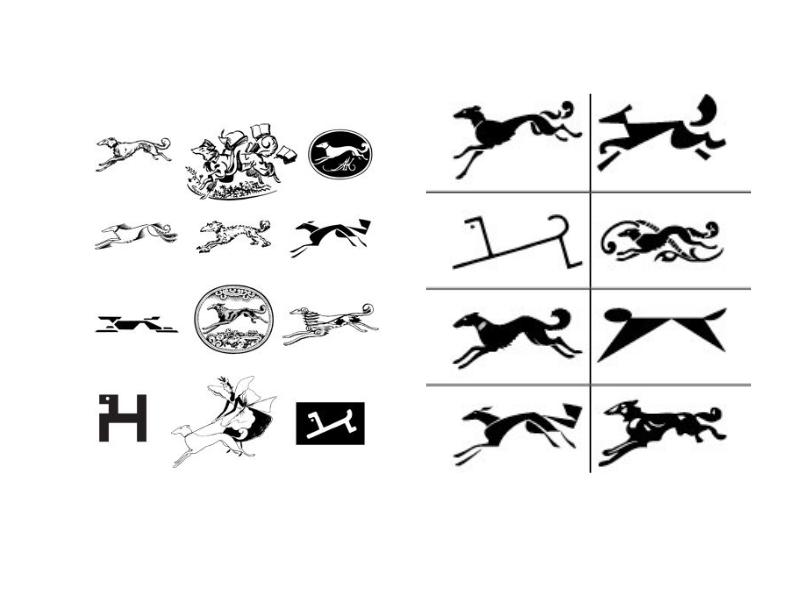
According to the Harry Ransom Center, there are nearly 150 recorded Borzoi designs in their library, and the vast majority were designed by the publisher or by contract designers - not by authors. This makes Gibran's Borzoi a singular achievement. And if that were not distinction enough, he was also the first author to design and illustrate his own book covers - another first in the history of one of the most successful publishing companies in the world, now owned by Penguin Random House.
• ❧ KGC ❧ •
II
Alfred Knopf and his wife Blanche - née Wolf - co-founded the publishing company together in 1915. Blanche, often considered the soul of the firm, had been promised by her then-courting husband that her maiden name would be associated with the publishing house. The promise was never kept. Coming from a well-established publishing family herself, Blanche was a superb editor, a visionary for new authors, a chic dresser, and a devoted dog lover. It is she who is credited with choosing and designing the Borzoi - the Russian wolfhound imprint that marks all Knopf titles to this day.
It is not at all surprising, then, that the recent memoir by Laura Claridge, The Lady with the Borzoi, also reveals and credits Blanche - and not Alfred - as the one who discovered Kahlil Gibran:
"The books that kept Knopf afloat through the years were The Prophet, Kahlil Gibran's collection of uplifting spiritual koans, Dashiell Hammett's detective novels, and Julia Child's Mastering the Art of French Cooking - all brought in primarily by Blanche."
- Joanna Scutts, New Republic, April 2016
The memoir also touches on Alfred Knopf's lack of confidence in Gibran's poetry and its likely readership. Considering the disappointing early sales of Gibran's first Knopf publication, The Madman (1918), the ambitious young publisher might well have begun questioning whether signing the poet had been a worthwhile gamble. His decision to persist was very likely shaped by Blanche, as well as by other Knopf writers of the time - Witter Bynner and Claude Bragdon - who were mutual friends of Gibran.
• ❧ KGC ❧ •
III
The full extent of the gamble - and the extraordinary commercial outcome it ultimately produced - is perhaps best captured in a remarkable email I received exclusively from Robert Gottlieb, the former Editor-in-Chief and President of A.A. Knopf from 1968 to 1987.
Robert Gottlieb, Editor-in-Chief & President, A.A. Knopf (1968–1987)
400,000
copies of The Prophet sold annually at the peak of what Gottlieb called the "Gibranmania" craze
$0
spent on advertising - the book never ran a single advertisement in its entire publishing history
"a few
hundred
dollars"
the rumoured acquisition price - paid on the basis of a tip, for a book that would sustain one of the world's great publishing houses
Gottlieb recalled that during his entire tenure at Knopf, he never had any direct contact with anyone from what he called "Gibran-land" - a name that speaks volumes about the phenomenon Gibran had become.
• ❧ KGC ❧ •
IV
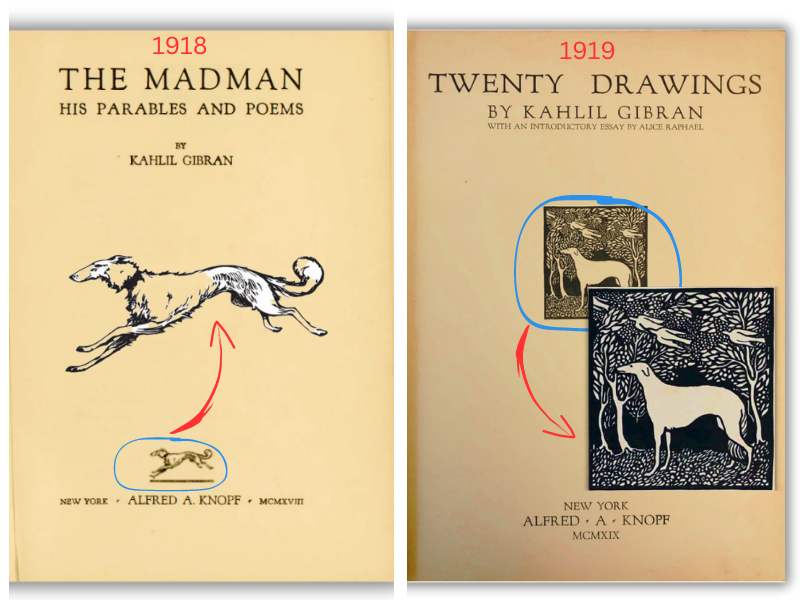
Observing the evolution of Gibran's Borzoi colophon, one can trace a clear artistic progression. In his first Knopf publication, The Madman (1918), the colophon resembled those of other authors of the period - a standard Knopf Borzoi. But with the release of his second Knopf book, Twenty Drawings (1919), Gibran introduced his own interpretation: a serene, stationary creature with its tail gently pointed downwards, nestled among trees, gazing at birds soaring above. It was a world away from the dynamic, dashing version that appeared on most Knopf books - and it subsequently appeared in all his future Knopf publications.
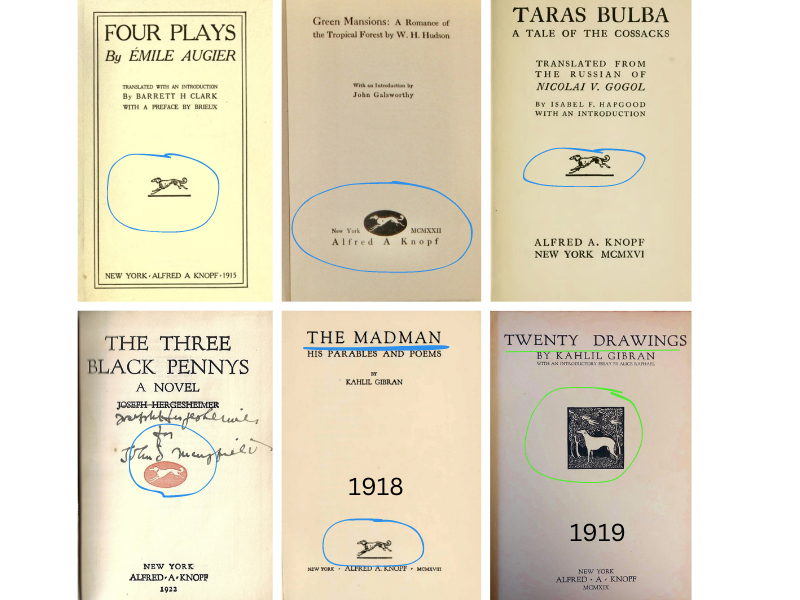
The precise origins of how this came about remain somewhat obscure. Regrettably, an office relocation in 1945 accelerated the destruction of many older files, leaving scant remnants of the firm's pre-1945 correspondence. It does seem, however, that Gibran's Borzoi was the first of its kind crafted by an author. Book designers employed by Knopf - such as Boris Artzybasheff - were credited for some designs, but most were essentially conceived by the publisher itself.
Though existing research does not definitively confirm Gibran as the absolute first, an exploration of other Knopf-published works between 1915 and 1922 strongly indicates his status as one of the earliest. The initial books published by Knopf in 1915 predominantly comprised Russian translations sourced from "London sheets," making it highly unlikely that those authors individually designed their own colophons. As the subsequent years saw the publication of a further 29 books in 1916 and another 37 in 1918, additional investigation into these titles and authors remains necessary to fully validate the claim - but Gibran's pioneering status is strongly supported by what the record currently shows.
• ❧ KGC ❧ •
V
Gibran was notoriously particular about the writing and printing of his works. We are well aware of this multilingual author's exacting attention to detail - his constant attendance to the minutiae of typography, his determination to bridge the gap between his original and adoptive cultures through the very appearance of the written word. His diary entries and correspondence with Mary Elizabeth Haskell bear witness to a steadfast drive to endow each letter and word with an indelible essence: "carved upon it a face that no one can forget."
Gibran's careful temperament was undoubtedly appealing to Alfred Knopf, whose ambitions stretched far beyond simply assembling a distinguished list of authors. Knopf had a unique obsession with the aesthetics of trade books - vivid dust covers, flawless bindings, and visually refined typography. The presence of renowned book designer Claude Bragdon during the firm's first year, followed by Elmer Adler, W.A. Dwiggins, Warren Chappell, George Salter, and others, demonstrates Knopf's lifelong dedication to the art of the book. In Gibran, he found an author who shared that dedication entirely.
Gibran's own struggle with the English language - the medium in which he was constructing his most celebrated work - is well documented in his letters to Mary. But it is perhaps this admission, more than any other, that reveals the depth of his perfectionism:
"English still fetters me. I don't think without looking for words. In Arabic I can always say what I want to say."— Kahlil Gibran, in a letter to Mary Haskell
And in another letter, on the subject of directing the publisher's stenographer:
"I have to learn each thing for myself, my own way. You probably think I'm finicky because I make this stenographer's copy so fussily. But you don't know what I go through later if I don't put in every comma and make every letter and mark unmistakable."
• ❧ KGC ❧ •
VI
A major factor in Gibran's instinct for bookmaking was undoubtedly shaped by his early mentorship with Fred Holland Day - publisher, photographer, and champion of the avant-garde, who nurtured the young painter's education in Boston and introduced him to the world of fine printing and design. For a fuller account of this formative relationship, see our earlier article, The Pictorial Universe of Kahlil Gibran.
Gibran's first biographers, Jean and Kahlil 'George' Gibran, offer insight into the driving force of Day's publishing venture - the firm Copeland and Day - and how it shaped the young artist's understanding of what a book could be:
It was run from an "aesthetic little office" at 69 Cornhill, a location famous for its bookstallish associations. From the outset, there was nothing of the playful dilettante about this venture. Copeland and Day became a serious and successful publishing house, quickly respected for introducing "a higher standard of integrity in craftsmanship and in commercial standing as well as in the character of the literature issued." … The ninety-eight books that the firm issued in its five and a half years of existence pioneered the way for modern typography and bookmaking in America.
Besides hosting Gibran's first ever public exhibition in 1904, it was Day who first moulded the young Syrian-Lebanese artist with lifelong skills and knowledge that would have a profound and lasting effect - and, consequently, assist in his rise towards his own success as a writer and painter:
"The young Kahlil was to graft these initial and most important artistic influences onto his own… their essences would be remembered and emulated by the young artist… as a result of what Fred Holland Day bequeathed to him."
By 1898 - imbued with self-confidence and his patron's encouragement - Gibran was developing his own style and technique, and was permitted to work on his own illustrations for some of Copeland and Day's publications. Consider what this accomplishment would have meant: it was barely three years since the twelve-year-old and his family had landed in Boston from the remote village of Bcharre, and already he was illustrating alongside Copeland and Day's commissioned artists, among them Will Bradley, Ethel Reed, and John Sloan.
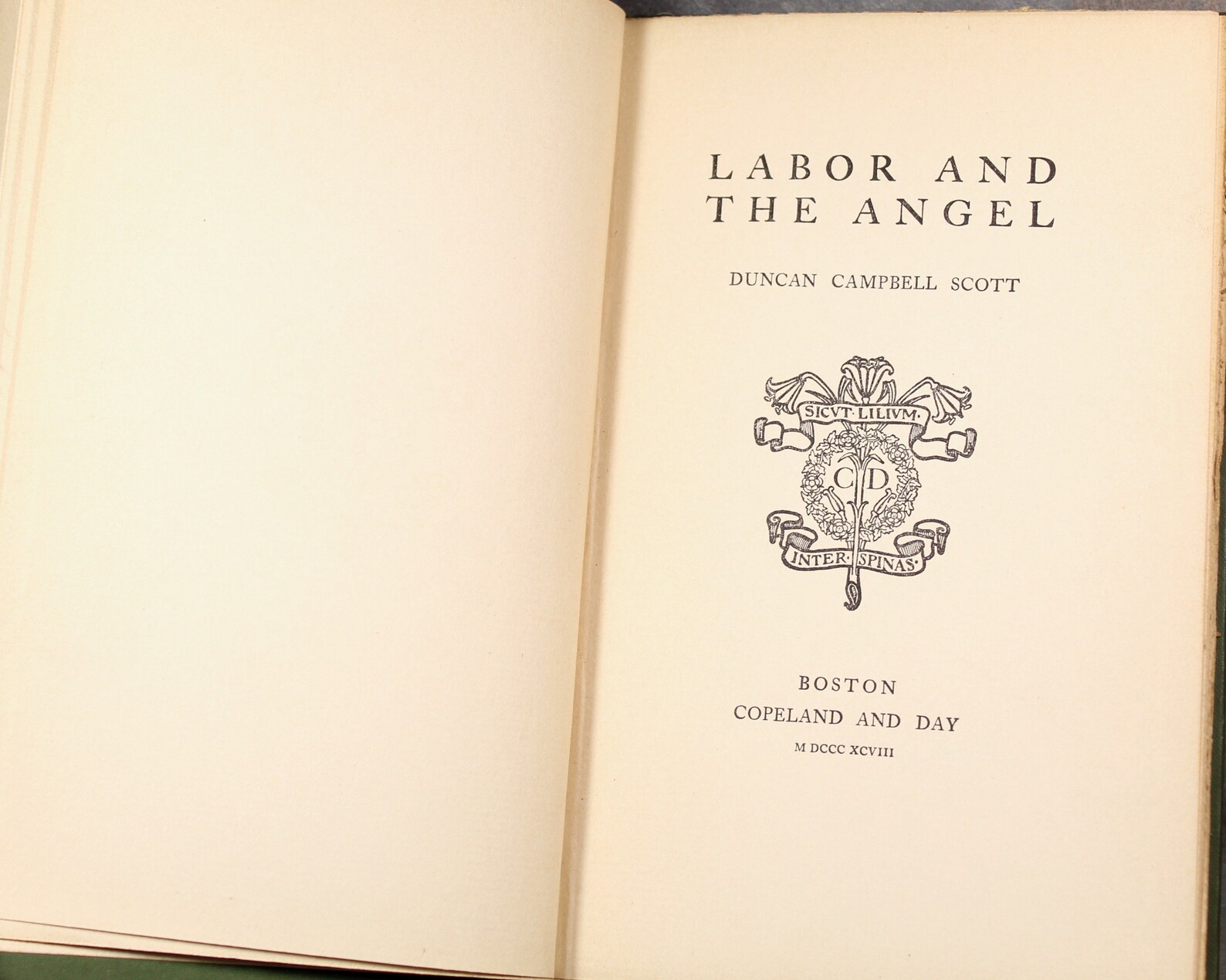
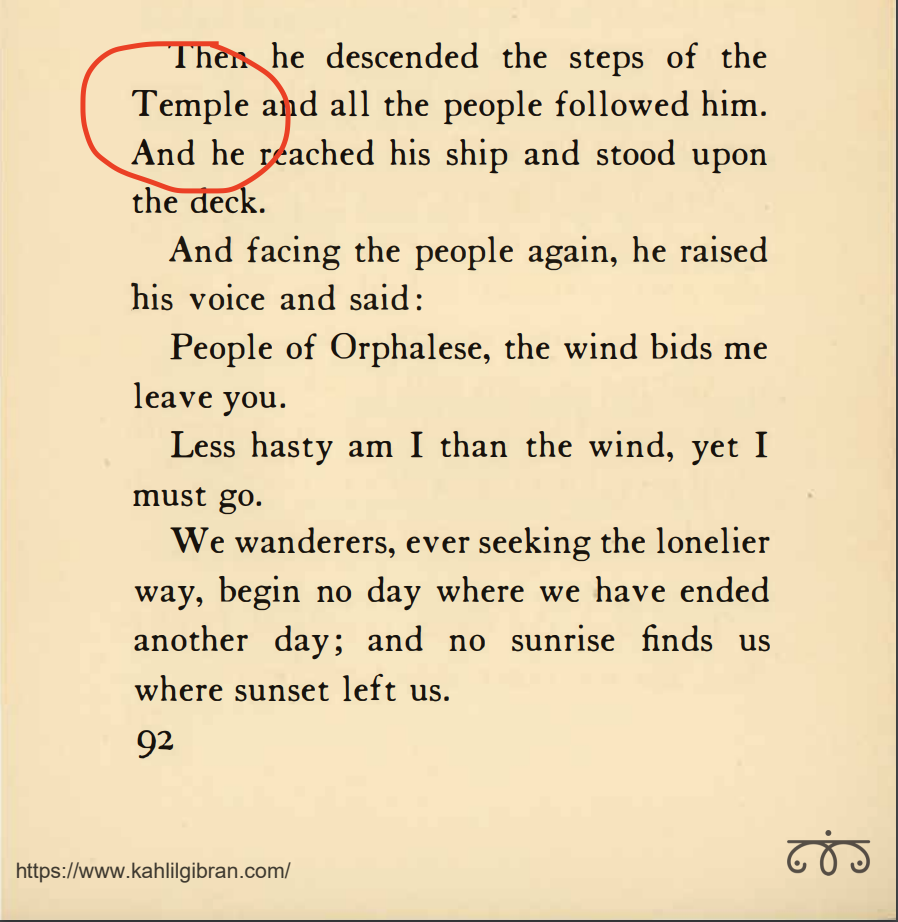
One last clue pertaining to Gibran's schooling at Copeland and Day came from a review of the firm published in the Boston Daily Advertiser, 27 April 1892 - which referenced the firm's mission "to promote a love for art and to contend for spiritual rather than material good," and its preference for Roman numerals over Arabic, and for capitalising certain words. This reflected some of the very anomalies that have long fascinated Gibran scholars - in particular Jean-Pierre Dahdah's observation of the capitalisation of certain words in The Prophet that arguably did not require it.
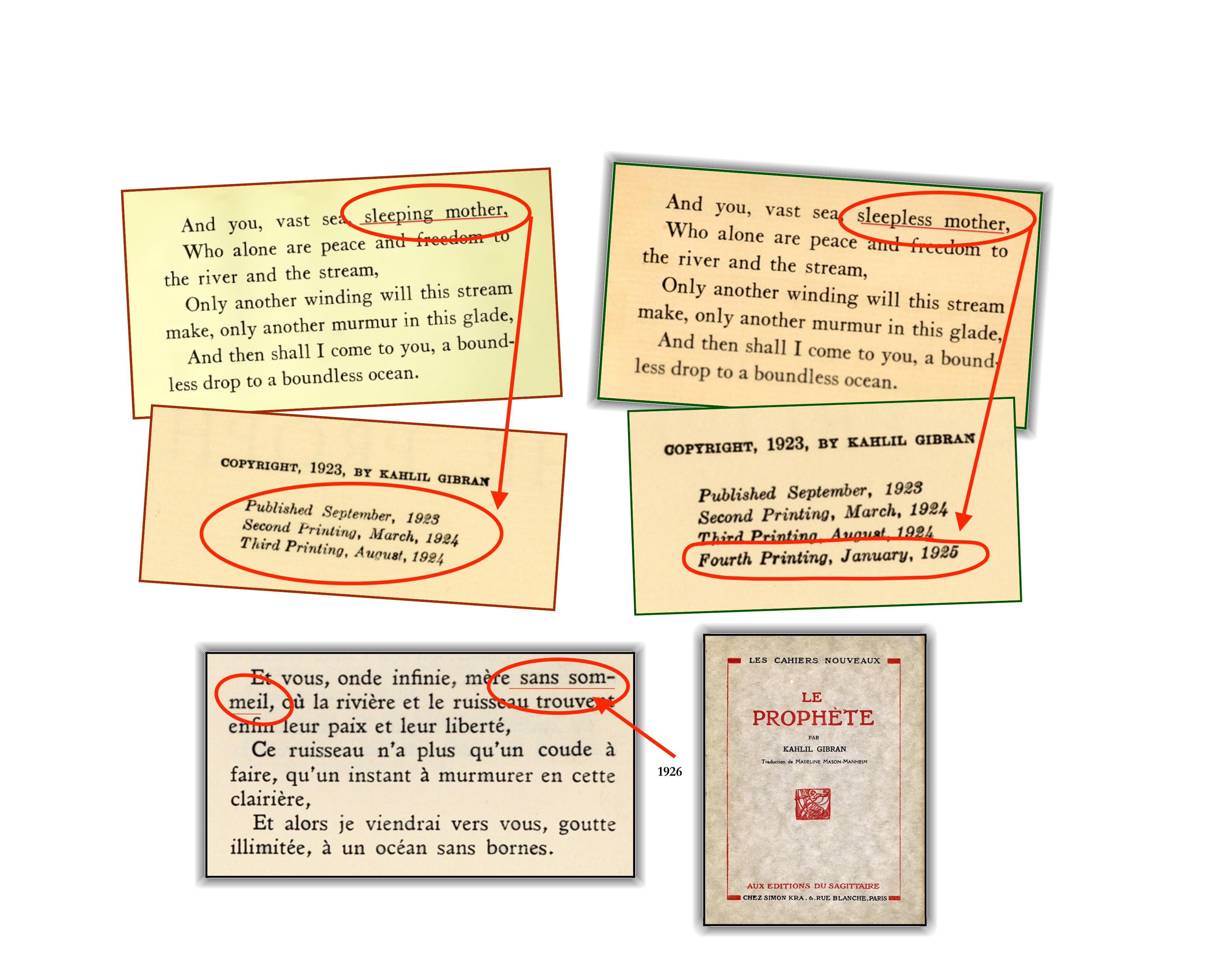
And there is the wonderful discovery by Philippe Maryssael, who noticed the correction of a significant word between the first print of The Prophet in 1923 and the twelfth print in 1925 - "sleeping mother" corrected to "sleepless mother" - which we previously published under the title "And you, vast sea…"
After a century of publication and readership, one certainty remains: The Prophet persists in unveiling its mysteries - encompassing both the words within its text and the souls who forged it, in realms both scholarly and spiritual.
In wrapping up this article, I recall a delightful Lebanese Arabic expression - a term of affection exchanged at anniversaries and birthdays: 3bal Miya! Roughly translated, it means "may you reach the age of 100." As we reflect on the remarkable centenary of The Prophet, I feel a deep sense of privilege to have recounted these fragments of its extraordinary journey. And now, let us extend our well wishes once more — may it endure for another hundred years.
"Work is love made visible."Kahlil Gibran · The Prophet, 1923
❁
All Rights Reserved © Copyright Glen Kalem-Habib and Francesco Medici 2023