She was eighteen when she translated The Prophet into French — the first person to do so in any language. Gibran had already illustrated her own book of poems, and drawn her portrait.
By Philippe Maryssael
• ❧ KGC ❧ •
KAHLIL GIBRAN COLLECTIVE
By Philippe Maryssael · Kahlil Gibran Collective · 2025 · kahlilgibran.com
• ❧ KGC ❧ •
I
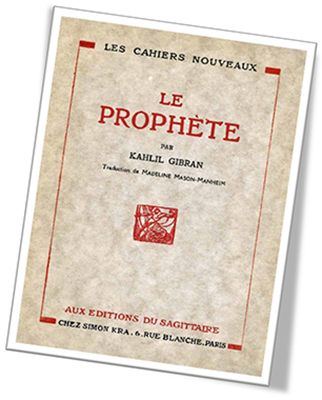
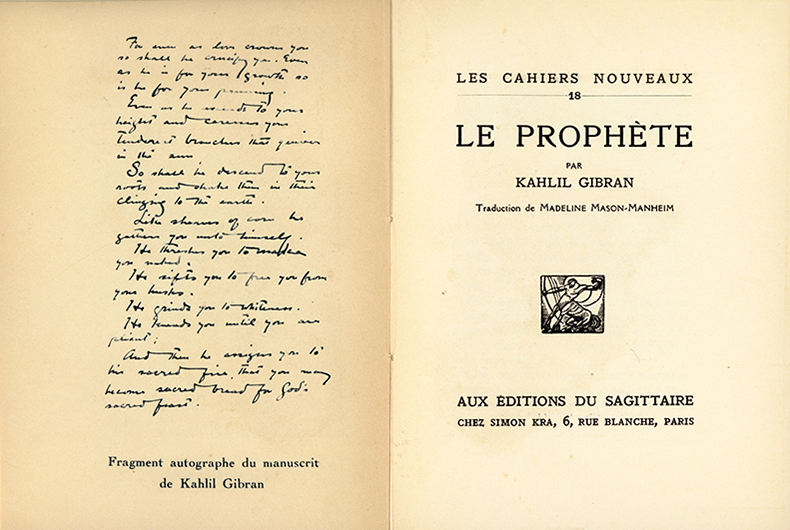
In 1926, three years after the publication of Kahlil Gibran's masterpiece The Prophet, Madeline Mason (1908-1990) had her French translation published in Paris, France, by Éditions du Sagittaire under the title Le Prophète, as a 750-copies-only numbered edition.
Born in the United States of America, she spent much of her youth in England and France where her parents owned estates. Madeline was a renowned poetess from her teens, and later a critic and author, fine speaker and lecturer on modern writers. She is known as the inventor of the so-called 'American sonnet' or 'Mason sonnet.'
English novelist and poet Thomas Hardy (1840-1928) and British physicist and writer Oliver Lodge (1851-1940) were among the first to see the unusual ability in her work. English novelist and playwright John Galsworthy (1867-1933) honoured her in London while he was president of the PEN International literary club to which she was elected. In America, poet Edwin Arlington Robinson (1869-1935), professor of English literature at Harvard University, George Lyman Kittredge (1860-1941) and Sterling Professor at Yale University Chauncey Brewster Tinker (1876-1963) recognised the originality and exquisite quality of her poems.
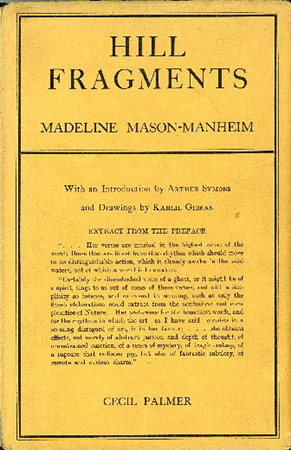
Madeline Mason was the very first translator of Gibran's masterpiece in the French Language. Her translation was preceded, one year earlier, in 1925, by her first collection of poems, titled Hill Fragments, which was published on both sides of the Atlantic, by Cecil Palmer in London, UK, and by Brentano’s Publishers in New York, USA. Both British and American editions were printed in Great Britain.
• ❧ KGC ❧ •
II
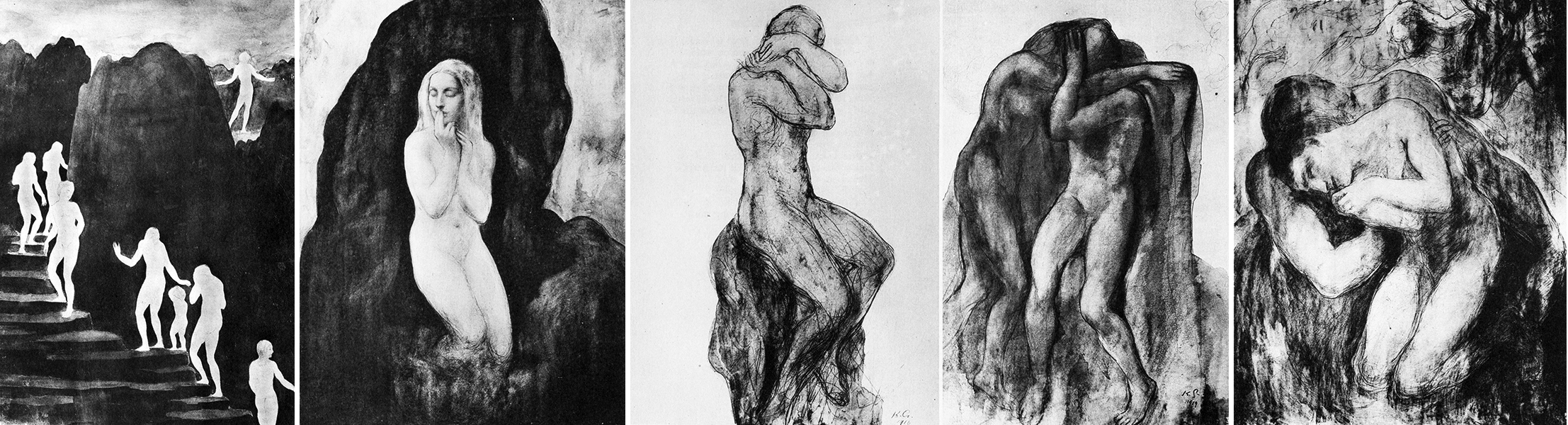
Quite interestingly, Hill Fragments contained no fewer than five illustrations by his friend Kahlil Gibran: Frontispiece (Purified Humanity Rising Towards the Infinite), Silence, Compensation, Loneliness and Life Answers. They were all from the period around the publication of Gibran's Twenty Drawings (1919).
In the early 1920s, Gibran drew a pencil portrait of Madeline Mason. The whereabouts of that drawing have not been identified with certainty. Is it in a private collection? Or in a museum? Who owns it? Is there a detective in the room?

• ❧ KGC ❧ •
III
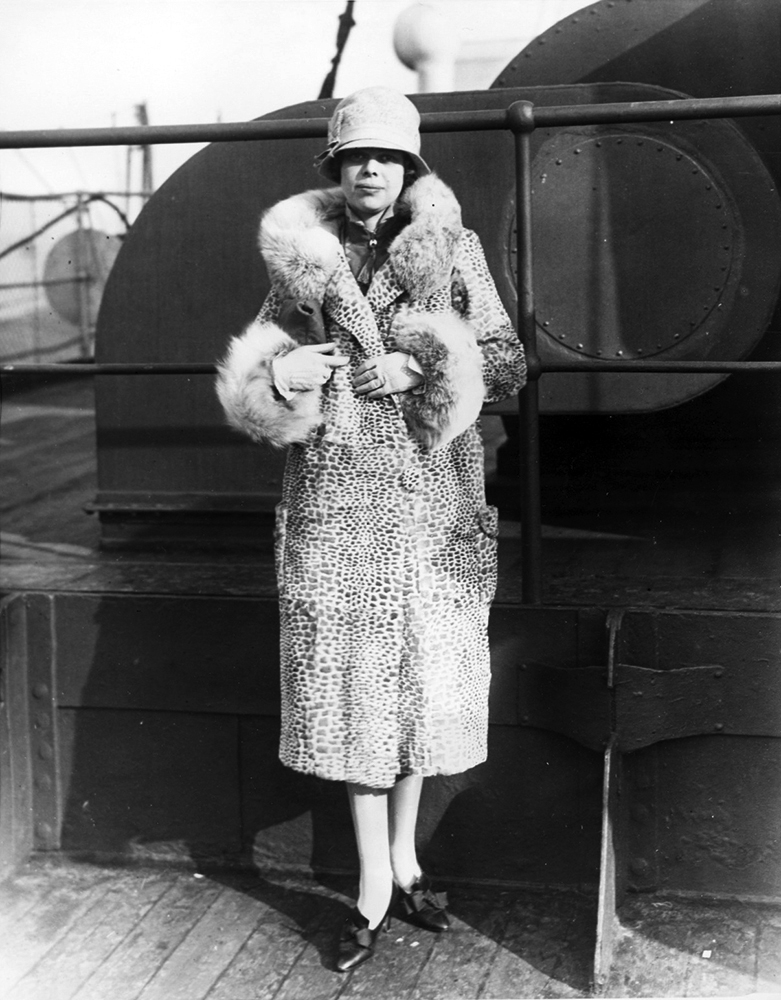
During the very year when her translation Le Prophète was published, Madeline Mason travelled back from London onboard RMS Berengaria. In London, she was selected by the Tolstoy Society of Europe to found a branch of the society in the United States. "Tolstoy Societies" refer to groups of followers of Russian writer Leo Tolstoy's philosophy, emphasising Christian anarchism, pacifism, simple living (vegetarianism, teetotalism), communalism, and non-resistance, often rejecting organised religion for a direct, moral interpretation of Jesus's teachings, forming communities and movements that sought to live out truth and brotherly love in a practical, anti-materialistic way.
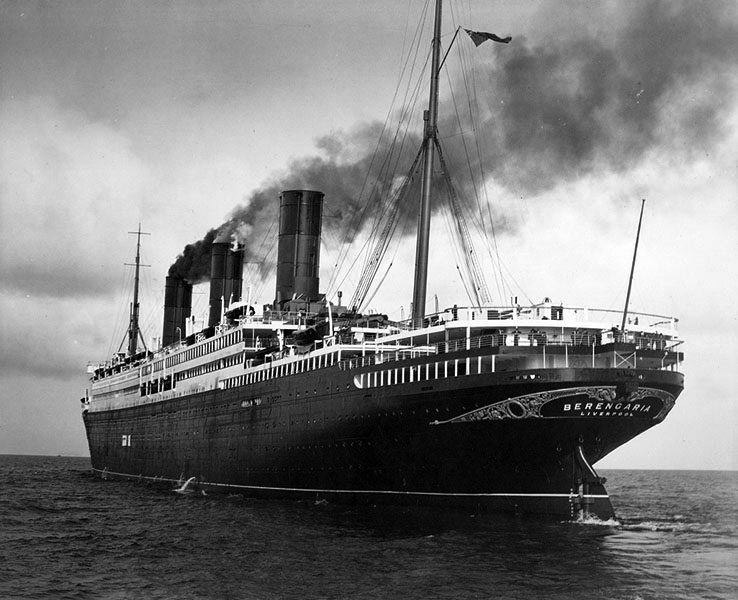
SS Imperator (known as RMS Berengaria for most of her career) was a German ocean liner built for the Hamburg America Line, launched in 1912. At the time of her completion in June 1913, she was the largest passenger ship in the world, surpassing the new White Star liner Olympic.
Imperator was the first of a trio of successively larger Hamburg America liners that included Vaterland (later the United States Liner Leviathan) and Bismarck (later the White Star Line Majestic) all of which were seized as war reparations.
Imperator served for 14 months on HAPAG's transatlantic route, until the outbreak of World War I, after which she remained in port in Hamburg. After the war, she was briefly commissioned into the United States Navy as USS Imperator (ID-4080) and employed as a transport, returning American troops from Europe. Following her service with the U.S. Navy, Imperator was purchased jointly by Britain's Cunard Line and White Star Line as part of war reparations, due to the loss of the RMS Lusitania, where she sailed as the flagship RMS Berengaria for the last 20 years of her career. William H. Miller wrote that "despite her German heritage and the barely disguised Teutonic tone of her interiors, she was thought of in the 1920s and 30s as one of Britain’s finest liners."
In February 1921, the ship was renamed after the English queen Berengaria of Navarre (c. 1165-1170 – 1230), wife of Richard the Lionheart (1157-1199). The name deviated from the usual Cunard practice of naming ships after Roman provinces but still retained the "-ia" suffix that was typically seen with other Cunard ships at the time.
❁
Sources
Information on Philippe Maryssael and his translation projects can be found at http://www.maryssael.eu/en/.
All Rights Reserved © Copyright Philippe Maryssael 2025