Mikhail Naimy is remembered as Gibran's closest friend and the secretary of Arrabitah — but years before he reached New York, a Lebanese boy from Baskinta was reading Puškin and Dostoevskij at a Tsarist seminary in Poltava, and writing poetry in Russian.
By Francesco Medici
• ❧ KGC ❧ •
KAHLIL GIBRAN COLLECTIVE
By Francesco Medici · Kahlil Gibran Collective · 2026 · kahlilgibran.com
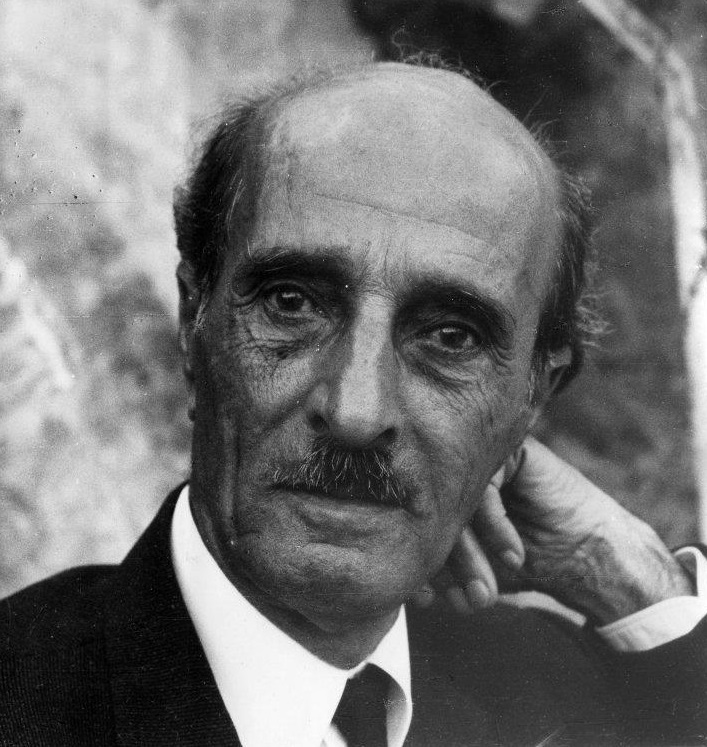
Mikhail Joseph Naimy (Mīḫā’īl Yūsuf Nu‘aymah) is generally regarded by critics as possessing a “triple soul,” reflecting his threefold linguistic and cultural heritage: Arabic, English, and Russian. If it is indeed true that the Anglo-American world shaped the “second soul” of numerous authors of early twentieth-century Arabic émigré literature, including, for instance, Kahlil Gibran (Ǧubrān Ḫalīl Ǧubrān, 1883–1931) and Ameen Rihani (Amīn Fāris al-Rīḥānī, 1876–1940), a combination of circumstances instead brought Naimy into contact with the Slavic world well before he crossed the Atlantic, as many of his compatriots did between the nineteenth and twentieth centuries, and settled, albeit not permanently, in the United States.1
Naimy was born on 17 October 18892 into a modest Greek Orthodox family. The third of six children, he was born in Baskinta (Baskintā, sometimes transliterated as Biskinta), a village of some 2,000 inhabitants located about forty kilometers northeast of Beirut, on the slopes of Mount Sannine, in the then Mutasarrifate of Mount Lebanon, an autonomous district of the Ottoman Empire with a predominantly Christian population.
• ❧ KGC ❧ •
I
In 1895, he began attending the local confessional school in his native village, a one-class school taught by two teachers, where he learned the Arabic alphabet and the rudiments of arithmetic. In 1899, he continued his studies at a school established in Baskinta by missionaries of the Imperial Orthodox Palestine Society. The teaching staff consisted of five male and four female teachers, who taught Arabic grammar, Russian, geography, arithmetic, history, and physical education.
Thanks to his excellent academic performance, in the autumn of 1902 the young student was given the opportunity to continue his education in Nazareth, Palestine, at a boys’ school established with the support of the Russian Orthodox Church and specifically founded to train future teachers and prepare young men for the priesthood. An uncle accompanied him by muleback to the port of Beirut, where the boy boarded a small steamer bound for Haifa. He reached Nazareth by train in December and remained there for the next four years.
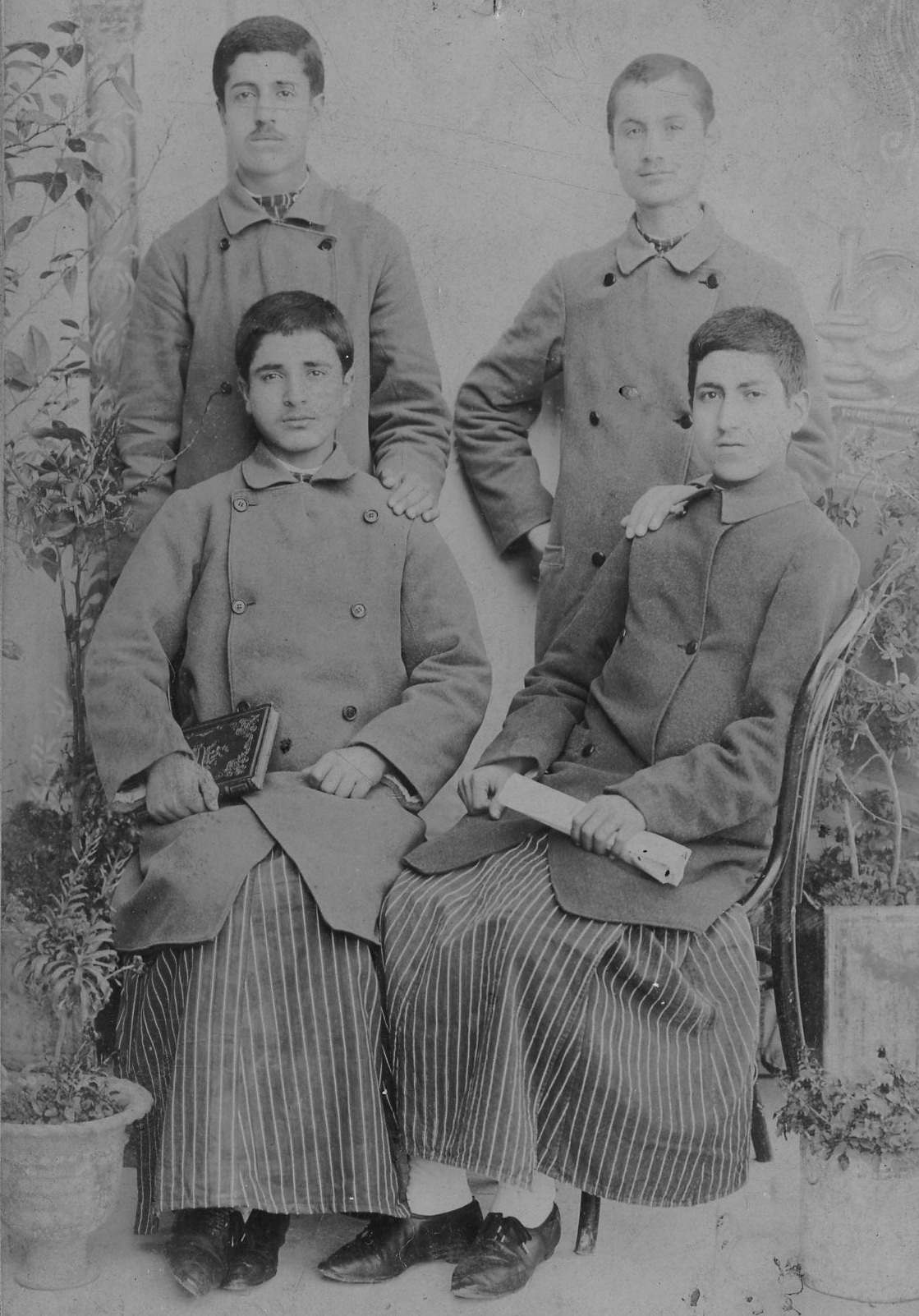
Once again selected among the institute’s best students, in September 1906 he set out for Tsarist Russia to pursue theological studies at the diocesan seminary in the city of Poltava, in present-day Ukraine. The seventeen-year-old reached his destination after a two-week sea voyage from Beirut to the port of Odessa, followed by a couple of days by train. In the years that followed, he would deepen his reading of Russian literature in the original, including works by Puškin, Lermontov, Žukovskij, Nikitin, Nekrasov, Gogol’, Turgenev, Dostoevskij, Čechov, Nadson, Gor’kij, Gusev-Orenburgskij, Belinskij.
• ❧ KGC ❧ •
II
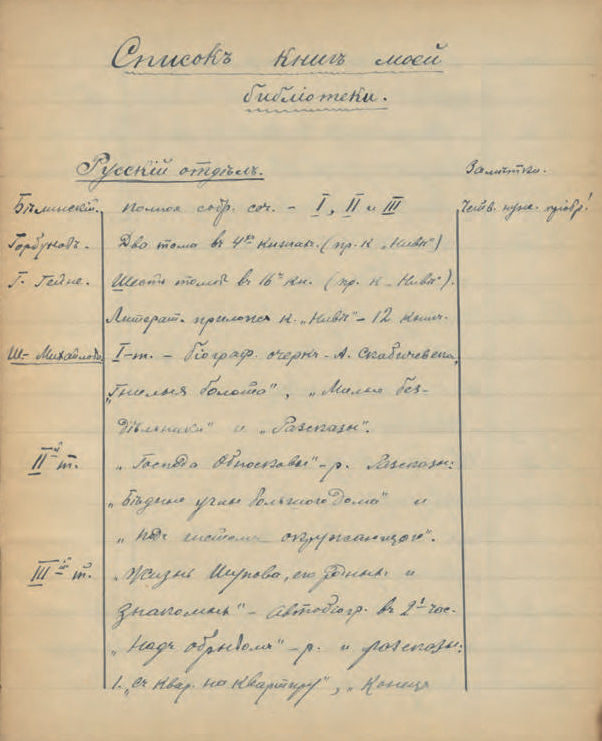
Beginning on 23 March 1908, he began keeping a diary in Russian, the final entries of which date from 21 May 1909. The diary comprises approximately 750 pages written in the old pre-revolutionary orthography, some of which, translated into Arabic, would be incorporated fifty years later into his three-volume autobiography, Sab‘ūn: ḥikāyat ‘Umr (Seventy: Story of a Lifetime).3 Naimy pours all his passion for the culture and people of his host country into his diary, paying particular attention to the humble and tireless peasant class. At the same time, he does not shy away from describing the many ills and contradictions of an increasingly decaying Russian Empire caught between two revolutions – the failed revolution of 1905 and the yet-to-come revolution of 1917 – glaring social inequalities and injustices, the cruelty of the feudal system, the inertia of the aristocracy, the poverty of farm laborers and workers reduced to serfs, political and religious despotism, and the corruption of the clergy. The young man seeks refuge in an ideal world of simplicity, truth, justice, and beauty, devoting himself to the ethical writings of Tolstoj.
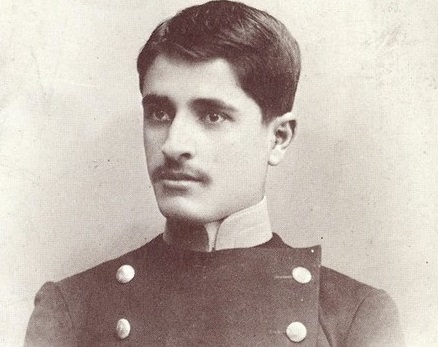
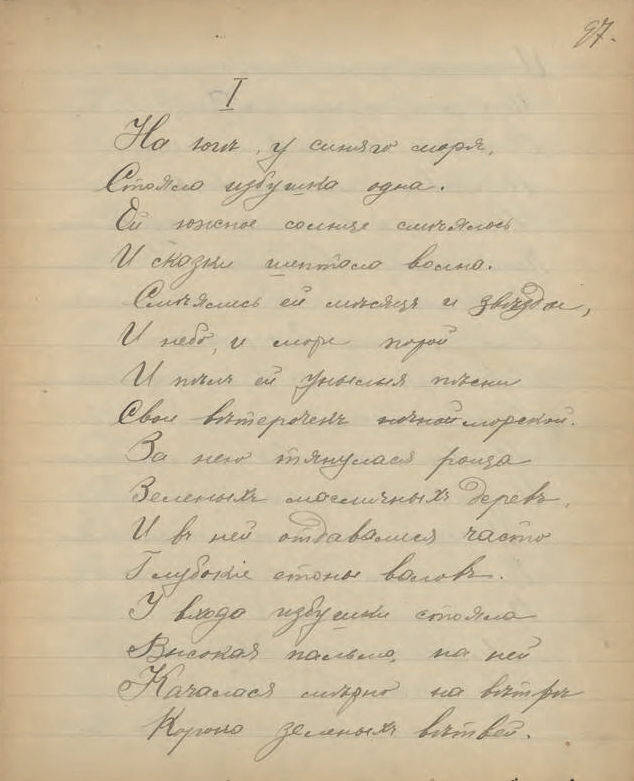
During the summer of 1909, he took a vacation in Baskinta, and in those same months he began experimenting with the composition of several poems in Russian, including Rybaki (Fishermen), K Stoletiju Godovščiny Nikolaja Vasil’eviča Gogolja (To the One Hundred Anniversary from the Birth of Nikolaj Vasil’evič Gogol’), Son (Dream), and Pochorony Ljubvi (Funerals for Love). All of these poems were systematically submitted for review to Ivan Vasil’evič Avramenko, his favorite teacher at the Poltava school and his literary mentor. The original manuscripts of some of these works, all of which remained unpublished, are preserved in a personal notebook from this period, held since 2015 at Harvard University Library in Cambridge, Massachusetts,4 while others have unfortunately been lost.
• ❧ KGC ❧ •
III
His poem Mjortvaja Reka (Dead River), also known as Zastyvšaja Reka (Frozen River), composed one winter evening after a walk along the Sulá river, a left-bank tributary of the Dnepr, was published in 1910 under the pseudonym “N.-Rêveur” (that is, “N.-Dreamer” in French) in the inaugural issue of “Avrora” (Aurora), an unofficial periodical of the seminary written entirely by hand by its students. Although these verses are still somewhat immature, they effectively mark the author’s poetic debut, as at that time he had not yet published anything in his native language. Below is Maria Lebedeva Swanson’s English translation of Naimy’s poem from the original Russian:
Why do you sleep, Sulá,
As if you are dead,
Covered all over
By a white shroud?You do not flow ahead
Through the steppe
[And] your silvery wave
Makes no noise?Or are you, Sulá,
Tired of flowing?
Or has someone
Enchanted you?Or did the winter come
And the dashing frost
Chain your hands and feet?Your shores
Started grieving
And your clean waters
Are frozen up in them.A courageous fisherman
With a seine net
Does not fish on [your waters].The sad willows
Stand above you,
Hanging down
Their bare branches.The impish nightingale
Does not sing into them,
[And] the South winds
Do not caress them.Only a black flock
Of crows sadly caw
When flying towards them.And it seems to me
That they are singing
Burial songs to you.[And] the sad chorus
Of these ravens
Is singing a burial song
To your youth.***
But spring will come,
[And] it will bring warmth
And once again you will rip off
[Your] winter chains (?)And your currents
Will roll once again
To the blue sea
Amid forests and fieldsYour banks again
Will bloom all around
And willows
Will be covered by greenery.And nightingales sitting upon them
And not ravens
Will sing to you
Wonderful songs.***
But will my spring
Come back again
[My] dear childhood,
[And] beautiful youth?Will my poor heart
Be reborn?
Will things become clear
To my darkened soul?Will my harsh life
Smile on me?
And will happy days
Come back to me?They will not return
To me any more
[And] I, alone,
Shall not see the spring!…The careless dreams,
Flew away,
And my peace is gone
All is lost!…***
And will our mother Russia
Wake up from its
Centuries of sleep
Like the Russian bogatyrs5 of yore?Will springtime waters
Flow across her land
And will life enter
Her bare steppes?And will the red sun shine
In its heavens
[That are] forever cloudy?Will cheerful life
Fill her fields
[That are] quietly slumbering?Will the working people
Live to see
Happy days
In Holy Russia?***
Oh, Russia, we believe,
We believe with all our hearts,
That spring will come
Even to your lands.But tell [us] when
It will come?
O, Russia, you are silent!…
Sleep, [my] dear!…6
The poet, who compares the condition of the Russian Empire to that of a frozen, stagnant river, seems almost to foreshadow an impending and inexorable revolution. Characterized by a prose-like rhythm, the poem is structured in short rhymed stanzas rich in exclamations and alliteration. Its style is typical of the songs of the Russian peasant tradition, in which the natural landscape becomes the setting for the deepest emotions of the human soul: melancholy, tenderness, anguish, and disorientation. The interplay of contrasts and parallelisms, as well as the theme of the cyclical recurrence of the seasons, are likewise characteristic of Russian folk songs. Of particular interest in this regard is also the use of archaic and colloquial forms: “staja voronov” (“a flock of crows,” a portent of misfortune and death), “pesenki pogrebal’nyja” (“funeral songs,” an integral part of the religious ceremonies and rituals of the East Slavic regions, recounting both the earthly existence of the deceased and his or her new life in heaven), “Rus’ Matuška” (“Mother Russia”), and “krasno solnyško” (literally “red sun,” in the sense of “beautiful sun”).
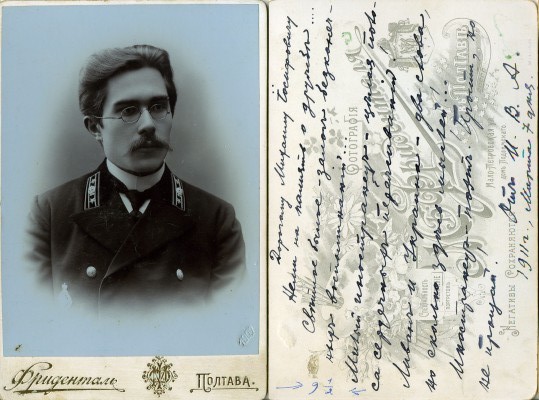
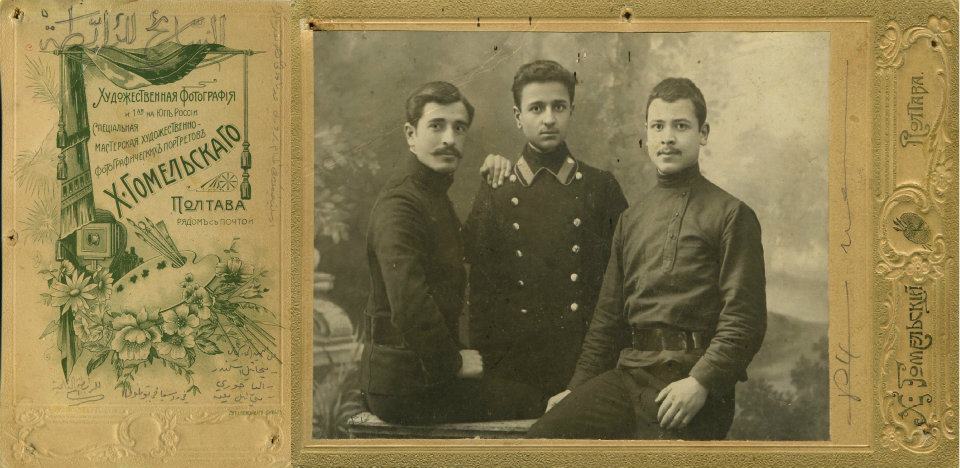
Although governed by a strict and narrow-minded internal discipline, the Poltava institution nevertheless allowed its students a certain degree of freedom of movement and social interaction. It was during this period that the budding poet first attended theatrical performances, ballets, and various artistic and cultural events, as well as embarking on his first romantic adventures with some local girls, including a certain Varja, the married sister of Aljôša, one of his fellow students. Unfortunately, only some time after the publication of Mjortvaja Reka, the young man became involved in a student protest which, by decree of the Holy Synod, resulted in his expulsion from the seminary. He was therefore forced to prepare for his final examination as an external candidate, and obtained his diploma in March 1911. Having no intention of being ordained as a priest, he left Poltava and returned to Baskinta in early April.
• ❧ KGC ❧ •
IV
In November, he was persuaded by one of his older brothers to accompany him to the United States, and settled in Walla Walla, Washington. In October 1912, he enrolled to study English Literature and Law at the University of Washington in Seattle. In July 1913, his first article appeared in the New York-based Arabic-language monthly “al-Funūn” (The Arts), founded shortly before by Naseeb Arida (Nasīb ‘Arīḍah, 1888–1946), his former schoolmate in Nazareth from 1902 to 1904. It was an enthusiastic review of the novel al-Aǧniḥah al-Mutakassirah (The Broken Wings) by his compatriot Gibran, entitled Faǧr al-Amal Ba‘d Layl al-Yā’s (The Dawn of Hope after the Night of Despair).7 Beginning with the November issue of the same monthly, which was soon to become the official literary organ of Arabic émigré literature, he inaugurated the column al-Ši‘r wa al-šu‘arā’ (Poetry and Poets), in which he explored the role of poetry and its principal exponents within the broader history of Arabic literature.
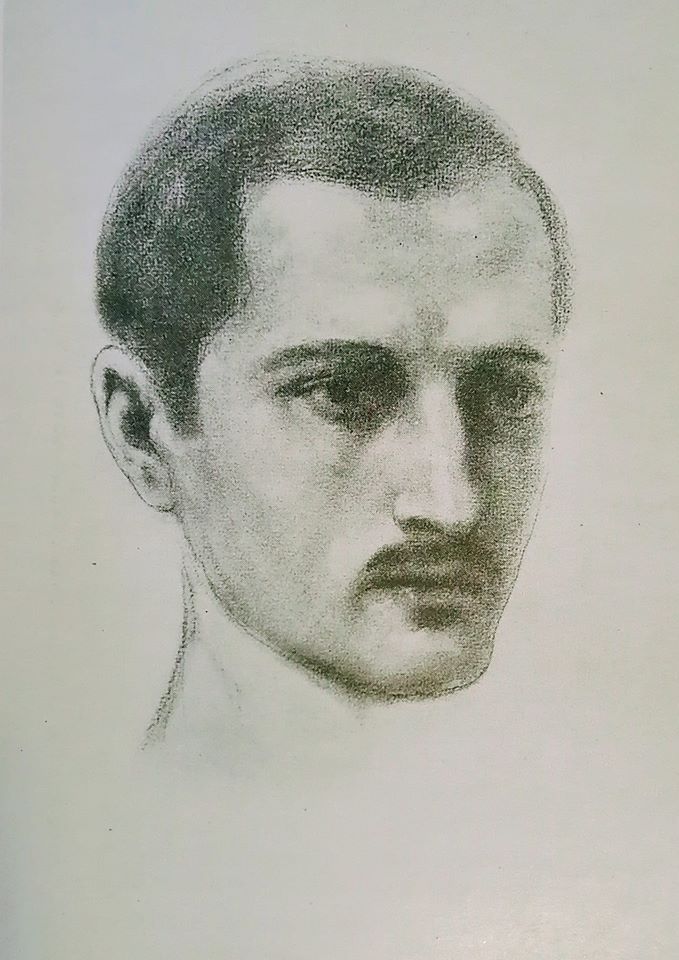
On 14 June 1916, he received his degrees in both law and literature. On 18 August, he resigned from his position as deputy secretary at the Russian Consulate in Seattle, and in October he moved to New York, where he met the poet and painter Gibran, with whom he became a close friend. The latter, like his closest circle of friends and associates, affectionately called him “Mischa,” a reference to his years in Russia. To support himself in New York, he first worked as a low-level clerk in the offices of the Russian Merchant Marine, and later as an assistant inspector on behalf of the Russian delegation at Bethlehem Steel Co., headquartered in the eponymous town in Pennsylvania, a steel-supply company that received numerous orders from the Tsarist government for the purchase of weapons. Despite the relatively good pay, the job caused him a profound crisis of conscience: years later, he would confess that he could not bear the thought that the bread he earned was steeped in the blood of thousands of young men dying at the front and stained by the tears of their loved ones around the world. Beginning in December, he started publishing in installments in “al-Funūn,” of which he had meanwhile become co-editor, a four-act play entitled al-Abā’ wa al-Banūn (Fathers and Sons),8 after Turgenev’s title.
• ❧ KGC ❧ •
V
The February 1917 issue of “al-Funūn” featured al-Nahr al-Mutaǧammid (Frozen River), an Arabic reworking of the poem of the same title composed in Russian seven years earlier. The poem would later be included, nearly three decades later, in the collection Hams al-ǧufūn (Eyelid Whisperings).9 By a fateful coincidence, his first poem in Arabic was published in the very year in which the Tsarist Empire he had known in his youth dissolved. An English translation of the poem by Roger Stanley Monroe, under the title The Frozen River, is provided below:
O river! Have your waters run so dry that I no longer hear your murmuring?
Or have you grown old? Has your will grown weak so that you have ceased to flow?Yesterday you used to sing among the fields and flowers;
You recited to the world and all therein the tales of the ages.Yesterday you flowed along fearing no obstacles on your way,
While today, the silence of the deep grave has fallen over you.Yesterday when I came to you weeping, you cheered my spirits;
Whereas today, when I came to you laughing, you led me to weep.Yesterday when you heard my sighing and lamenting, you wept,
Whereas now here am I, weeping alone, but you do not join in my tears.What are these shrouds? Or are they bonds of ice
With which the hand of the harsh winter chill has chained and humbled you?Here the willows, beside you, with neither leaves nor beauty
Kneel in grief every time the North Wind passes through them.And the poplar spreading its branches mourns above your head;
The goldfinches do not range there chanting their antiphonies.Flocks of crows come cawing through the vast expanses,
As though they were lamenting your life’s youth which has passed.With their croaking at morn and at eve, as though
They were a choir escorting your pure body to the next world.The winter however will depart and the days of spring return,
To release your body from the bonds which the hand of the frost has fastened.And your clear wave will turn again and freely charge down toward the seas
Pregnant with the secrets of darkness, drunken with the lights of day.You will again smile for the breeze will fondly caress your serene face;
The stars of thick black night will again swim in your waters.And the full moon from her sky will spread over you a veil of silver
And the sun with her flowers will hide your bare shoulders.And the poplar will forget what calamities and trials have afflicted her
And hold high her head, swinging to and fro proudly and her boughs will turn green.And the days of youth will return to the willow after old age.
And the goldfinch will warble sweetly above her branches instead of the crow.***
I once had, O River, a heart laughing like the meadows.
As free as your heart, a heart in which passions and hopes surged.My heart used to awake in the morning different from what it has been in the evening, not complaining of boredom.
But today the waves of hope have frozen there, as your face has frozen.The days have become all alike in my heart, their mornings and their evenings,
Life in it has become all the same, its happiness and its misery.For my heart the spring with autumn and the winter have grown alike,
Alike are the moans of the miserable and the laughter of the merry.The turmoil of life has banished my heart which has turned away from life and become solitary.
It has become hard neither showing affection nor feeling sympathy for anyone.My heart has become a stranger among people to whom it formerly belonged.
I have become among men a riddle, in whom there exists an obscure riddle.***
O river, this is my heart, which I see as I see you, bound…
With one difference that you will be set free from your bonds, whereas my heart will never be set free.10
The poem conforms, at least in part, to one of the traditional meters of classical Arabic poetry, known as the kāmil, albeit with some departures from its conventional form. At the same time, it bears the influence of Western metrical forms, such as the English heroic couplet, which enjoyed a certain degree of popularity in the nineteenth century. In the transition from Russian to Arabic, all references to Russia – its inhabitants, its culture, and its natural features (for example, the word “step’” [“steppe”] is replaced by “al-ḥadā’iq wa al-zuhūr” [“the gardens and flowers”]) – are omitted, and the text takes on a more intimate character: the frozen river, here left unnamed, becomes exclusively a metaphor for the poet’s inner crisis and his sense of isolation among his fellow human beings.
With the aim of promoting the voluntary enlistment of Syrian Americans alongside the Allied forces, the Syrian-Mount Lebanon League of Liberation (also known as the Syrian-Lebanese League of Liberation or the Syrian-Mount Lebanon Volunteer Committee) was founded in New York in May 1917. Its secretaries were Gibran, who handled correspondence in English, and Naimy, who was responsible for correspondence in Arabic. With the October Revolution, and consequently Russia’s withdrawal from the conflict and the ensuing severance of all relations between the United States and the Soviet Union, Naimy’s employment with Bethlehem Steel Co. also came to an end. Having left the town of Bethlehem, he returned to New York at the beginning of 1918. After volunteering for the United States Army, he was called up on 25 May and assigned to the Franco-German front. His enlistment had been deferred because of his employment at Bethlehem Steel Co., which, as noted above, supplied armaments to the Russian Allies.
In the autumn of 1919, he returned to New York, where he rejoined his colleagues at “al-Funūn” and began taking on a variety of odd jobs to make a living. On 28 April 1920, together with about a dozen Syrian-Lebanese writers, he was among the founders of al-Rābiṭah al-Qalamiyyah (The Pen Bond), known in English simply as Arrabitah, a literary association presided over by Gibran, of which he was appointed secretary and for which he drafted the official statutes. During these years, he strengthened his collaboration with the New York periodicals “al-Sā’iḥ” (The Traveler), founded in New York in 1912 by the Syrian brothers Nadra Abdo Haddad (Nadrah Ḥaddād, 1881–1950) and Abdulmassih Abdo Haddad (‘Abd al-Masīḥ Ḥaddād, 1890–1963), and “The Syrian World,” the first Arabic-American monthly published in English, founded in 1926 by Salloum Mokarzel (Sallūm Mukarzil, 1881–1952), as well as with various national newspapers and periodicals.
On 19 April 1932, he left the United States for good and returned to his homeland, with $500 in his pocket and a profound disillusionment with American civilization, which, in his view, was entirely subservient to the god of money. Upon his return to Lebanon, he took a vow of celibacy and embraced an ascetic life, retreating to a hermitage in a mountainous area not far from Baskinta, known as Shakhroub (al-Šaḥrūb), where he continued tirelessly to write and publish short stories, novels, and various other works in Arabic and English.
• ❧ KGC ❧ •
VI
In 1956, he attended a ceremony in Beirut commemorating the seventy-fifth anniversary of Dostoevskij’s death. Following the event, in August, at the invitation of the Union of Soviet Writers, he travelled to Russia for three weeks, revisiting, after forty-five years, the places he had frequented in his youth, by then profoundly transformed by the Revolution. In addition to Moscow, Leningrad (St. Petersburg), Stalingrad (Volgograd), and Kyiv, he revisited Poltava, where the former seminary had become a cultural center and the church a conference hall.
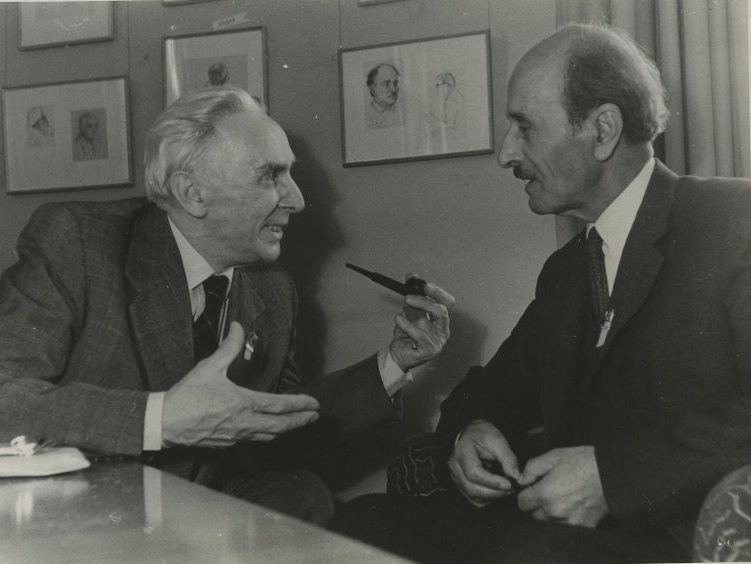
In his book Ab‘ad min Mūskū wa min Wāšinṭun (Beyond Moscow and Washington),11 published in Beirut the following year, he wrote on the subject: “I do not blame communism for stigmatizing such a faith (that of fossilized rites, superstition, and the exploitation of believers); I blame it for stigmatizing every form of faith and for seeking to impose atheism, thus forgetting to turn its own atheism into a faith, in no way different from the one it opposes.” He also regretted not having been able to meet in person the great Arabist Ignatij Kračkovskij (1883–1951) – also known among his Arab acquaintances by the pseudonym “Ġanṭūs al-Rūsī” (“Ġanṭūs [a diminutive of Ignatij in the Lebanese dialect] the Russian”) – who had died a few years earlier. Kračkovskij had taken an interest in Naimy’s literary works as early as the 1920s,12 and the two had maintained a long and intense correspondence for many years. In 1962, he visited Moscow for the last time, as a participant in the International Peace Conference held in the Soviet capital.
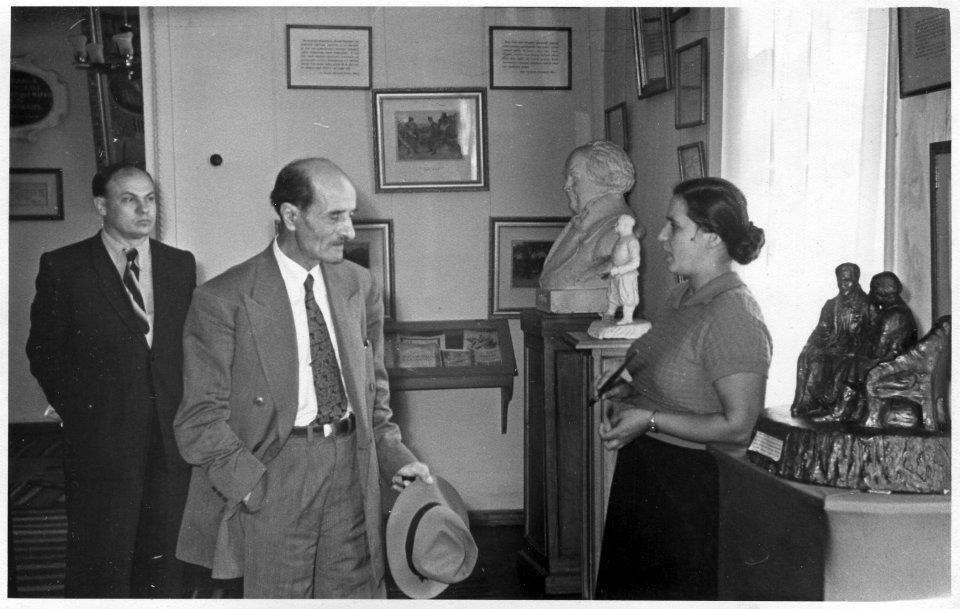
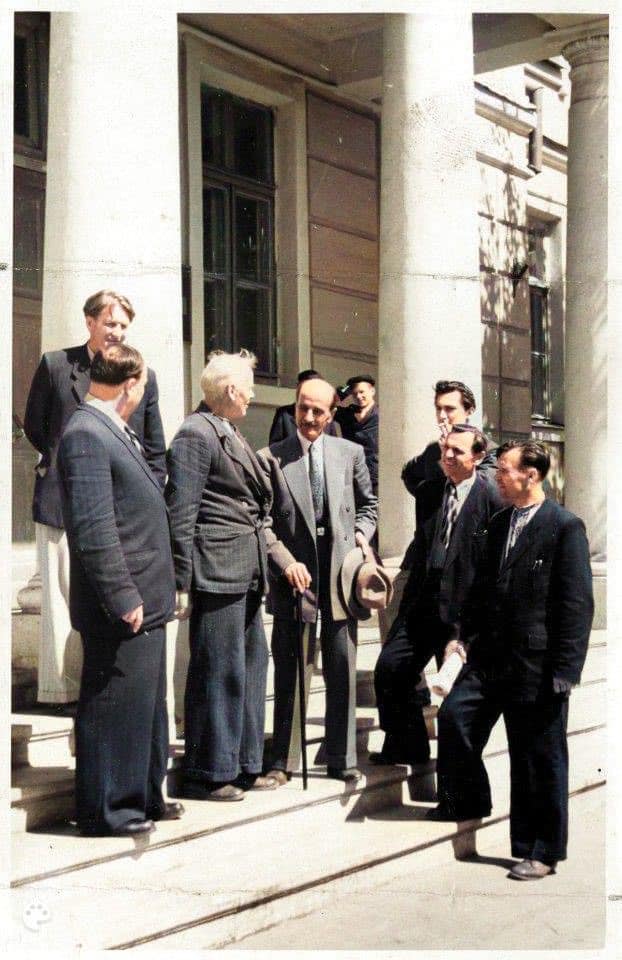
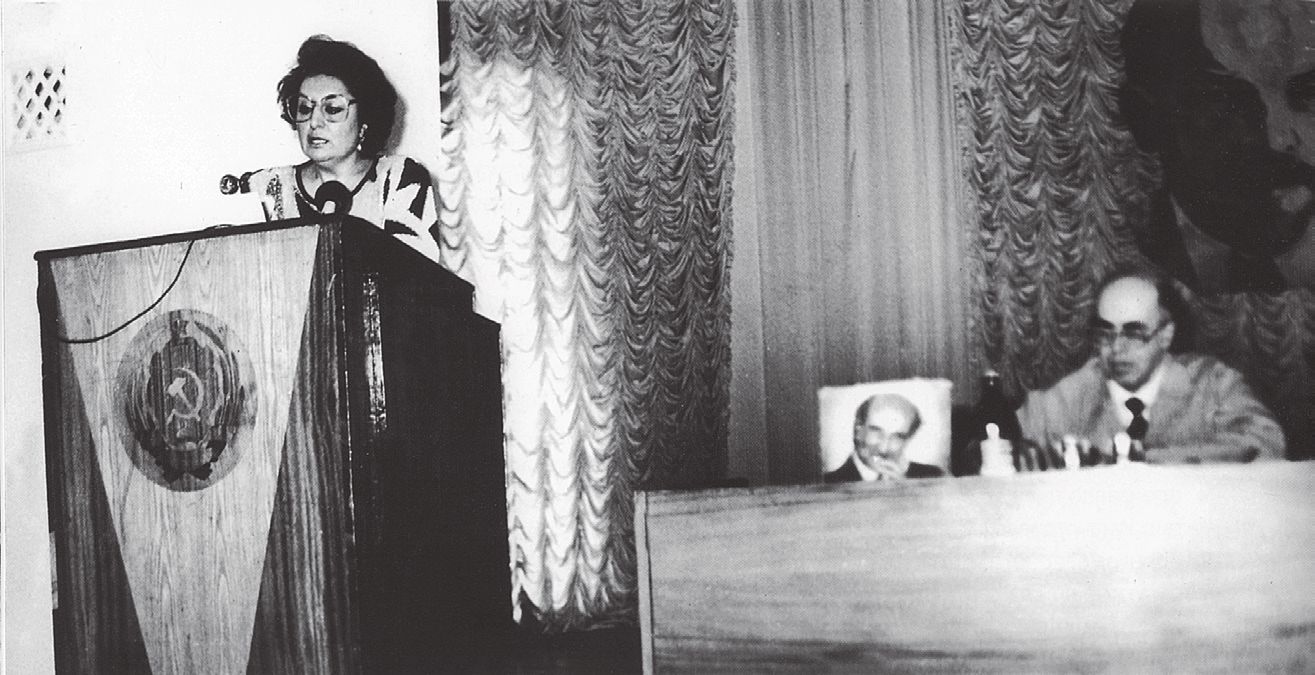
On 28 February 1988, Naimy died, just short of his hundredth birthday, from a pulmonary infection in Zalka (Zalqā), a suburb north of Beirut, in the apartment where he had spent the final twenty years of his life, surrounded by the loving care of his niece May Najeeb (Mayy Naǧīb, 1924–2014) and his great-niece Suha Haddad (Suhá Haddād), better known as Suha Naimy (Suhá Nu‘aymah). From 1958 to the present day, the USSR, followed by the Russian Federation and Ukraine, has repeatedly honored the writer from the Land of the Cedars through numerous translations of his works,13 commemorative celebrations, events, and conferences. On the occasion of the centenary of his birth, a conference devoted to the author was held in Poltava from 24 to 26 April 1989, attended by some of the leading Soviet Arabists, including the Russian scholar Anna Dolinina (1923–2017) and the Azerbaijani scholar Aida Imangulieva (1939–1992).14 On 29 October 2011, in the same city, a monument dedicated to him was unveiled by Youssef Sadaka (Yūsuf Ṣādiq), Ambassador of Lebanon to Ukraine. In November 2019, on the occasion of the 130th anniversary of his birth, the Lebanese House of Moscow (an association known in Arabic as al-Bayt al-Lubnānī and in Russian as Livanskij Dom) devoted an international conference to him. In Moscow as well, from 11 November to 9 December, the Russian National Library’s Department of Asian and African Literature hosted an exhibition of first Arabic editions of some of his works, together with their Russian translations.
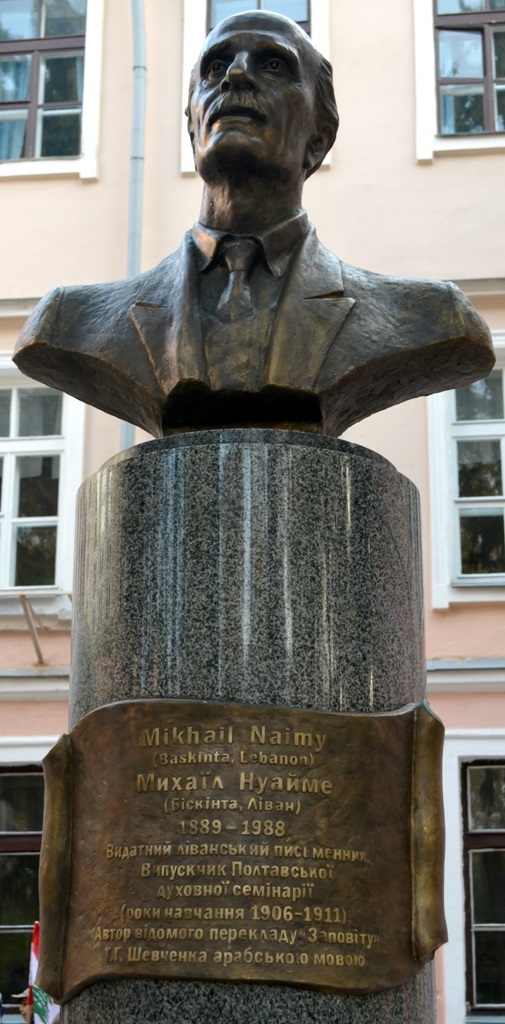
Among the most evocative pages of Naimy’s autobiography are undoubtedly those in which the author recounts how and when his Russian experience began, with the establishment of the “Moscowite” school in his impoverished native village, “under the tolerant and indifferent gaze of the Ottoman regime:”
I was between five and six years old when the Orthodox community announced the construction, in the eastern part of Baskinta, […] of a large building. We children understood that the building in question was to be a “Moscowite” school, which would spare us from having to attend the humble confessional school of the village […]. The building was completed in 1896, and as soon as we moved in, it was for us like passing from hell to paradise. The classrooms were spacious, beautiful, and clean, and the desks were of a kind we had never seen before… But the most wonderful thing was that books, notebooks, and pens were distributed to us free of charge; moreover, the school, which in the past had been attended only by boys, had now become coeducational […]. But the most important thing, in our eyes, was that blows with a cane on the hands and feet had been prohibited, and teachers who resorted to such punishment were liable to sanctions. […] We children could not know where all that grace from God came from, nor how! We knew only that the “Muscovites” were a strong and generous people, ruled by a tsar whose words made all the kings of the earth tremble, and that they lived in a cold and distant country in the North and were Rūm15 like us, and for this reason sympathized with us and were concerned with defending us and our “religion,” the only true religion! As for our Sublime State,16 it had reached an irreparable state of division and decay […]. Once a year—on 6 December—the feast of Saint Nicholas, a grand ceremony was held in honor of Tsar Nicholas II on the occasion of his name day. […] fireworks were set off, and cries of hurrah were raised for His Majesty, the sovereign happily dwelling in his remote St. Petersburg: “May God make him victorious…”. And what if our cries had reached the ears of the Ottoman Sultan ‘Abd al-Ḥamīd on the shores of the Bosphorus? After all, we were still considered his subjects!
❁
1 Cf. Maria Swanson & Rebecca Ruth Gould, The Poetics of Nahḍah Multilingualism: Recovering the Lost Russian Poetry of Mikhail Naimy, “Journal of Arabic Literature”, 52 (2021), pp. 170–201. ↩
2 In fact, both official and unofficial sources are entirely at odds as to the exact date of his birth: 22 November, 3 December, 9 December, and so forth. A Lebanese identity card issued in 1956 even gives his year of birth as 1890. The date of 17 October 1889, reported in the most authoritative studies, is simply the date the author “chose” for himself following a revelatory dream he had in 1932. ↩
3 Mīḫā’īl Nu‘aymah, Sab‘ūn: ḥikāyat ‘Umr, Bayrūt: Dār Ṣādir, 1959–1960. ↩
4 “Papers of Nasīb ‘Arīḍah, 1887–1946,” section “N. Arida, A. Haddad and N. Haddad Collection,” Widener Library, Harvard University, Box 2. ↩
5 Heroes of epic poetry, traditionally portrayed as defenders of the Russian land who undertake difficult military exploits or arduous labors, or as figures endowed with great strength, beauty, intelligence, or wealth. ↩
6 Maria Lebedeva Swanson, The Russian Influence on the Literary and Critical Writings of Mikhail Naimy, A Dissertation Submitted to the Faculty of the School of Middle Eastern and Northern African Studies, University of Arizona, 2014, pp. 242–247. ↩
7 Mīḫā’īl Nu‘aymah, Faǧr al-Amal Ba‘d Layl al-Yā’s, “al-Funūn”, 1, 4 (Jul. 1913), pp. 50–70. ↩
8 Mīḫā’īl Nu‘aymah, al-Abā’ wa al-Banūn, “al-Funūn”, 2, 7 (Dec. 1916), pp. 609–622; 2, 8 (Jan. 1917), pp. 710–726; 2, 9 (Feb. 1917), pp. 794–813; 2, 10 (Mar. 1917), pp. 905–930; 2, 11 (Apr. 1917), pp. 1002–1023. ↩
9 Mīḫā’īl Nu‘aymah, al-Nahr al-Mutaǧammid, “al-Funūn”, 2, 9 (Feb. 1917), pp. 783–785; Hams al-ǧufūn, Bayrūt: Dār Ṣādir, 1943, pp. 10–13. ↩
10 Roger Stanley Monroe, “Eyelid Whisperings” by Mikhail Naimy Translated from the Arabic, in Mikhail Naimy: A Study of His Life with Special Reference to His Poetry, A Thesis Submitted in Partial Fulfilment of the degree of Master of Arts in the Center for Arabic Studies at the American University in Cairo, 1968, pp. 4–9. ↩
11 Mīḫā’īl Nu‘aymah, Ab‘ad min Mūskū wa min Wāšinṭun, Bayrūt: Dār Bayrūt, 1957. The work compares the constituent elements of Russian and American civilizations, beyond the ideologies of communism and capitalism. ↩
12 Cf. Ignatij Kračkovskij, Poltavskij Seminarist (The Seminarian of Poltava), in Nad Arabskimi Rukopisjami (On Arabic Manuscripts), Moskva-Leningrad, 1946, pp. 49–55. ↩
13 In 1958, Znatni, the Ukrainian translation of the collection of short stories Akābir (Highbrows), was published in Kyiv, while in Moscow the short stories Sanatūhā al-ǧadīdah (Her New Year) and al-‘Aqir (The Barren Woman) appeared in Russian translation as Jejo Novij God and Besplodnaja, in the anthology Rasskazy Pisatelej Livana (Short Stories by Lebanese Writers). In 1959, an anthology of his short stories translated into Russian was published in Moscow as Livanskije Novelly (Lebanese Novellas). In 1963, Silāč (A Strong Man) and Almaznaja Svad’ba (The Diamond Wedding) followed in Russian in Moscow. In 1966, several short stories appeared in the Moscow anthology V Mojom Gorode Idjot Dožd’: Novelly Pisatelej Sirii, Livana, Iordanii (It Is Raining in My City: Novellas by Syrian, Lebanese, and Jordanian Writers). In 1979, Sā‘at al-Kūkū (The Cuckoo Clock) and Ǧundīyān (Two Soldiers) appeared in Moscow as Časy s Kukuškoj and Dva soldata. In 1980, the Russian translation of Sab‘ūn: ḥikāyat ‘Umr was published in Moscow as Moi Sem’desjat Let (My Seventy Years). In 1981, several works appeared in the Leningrad anthology Arabskaja Romantičeskaja Proza XIX–XX Vekov. In 1998, Vstreča čerez Veka (A Meeting Across the Centuries), the Russian translation of the novel Liqā’ (Meeting), was published in Moscow. In 2004, the Russian translation of The Book of Mirdad was published in St. Petersburg as Kniga Mirdada. ↩
14 Cf. Aida Imangulieva, Gibran, Rihani & Naimy. East-West Interactions in Early Twentieth-Century Arab Literature, Oxford: Inner Farne Press, 2009. For the original Russian edition, cf. Aida İmanquliyeva, Korifei Novoarabskoj Literatury: K Probleme Vzaimosvjazi Literatur Vostoka i Zapada Načala XX Veka, Baku: Elm, 1991. ↩
15 The Arabic term is generally used to designate the Byzantines, Eastern Christians, and Orthodox Christians in general. It also refers to Westerners. ↩
16 The Ottoman state, also known as the Sublime Porte. ↩
All Rights Reserved © Copyright Francesco Medici 2026