Contrary to popular belief, Kahlil Gibran did not lead an ascetic life. Scholar Francesco Medici traces Gibran's eating habits, favourite restaurants, and the foods that sustained — and occasionally eluded — one of the most celebrated writers of the twentieth century.
By Francesco Medici
• ❧ KGC ❧ •
KAHLIL GIBRAN COLLECTIVE
By Francesco Medici · Kahlil Gibran Collective · 2016 · kahlilgibran.com
• ❧ KGC ❧ •
I
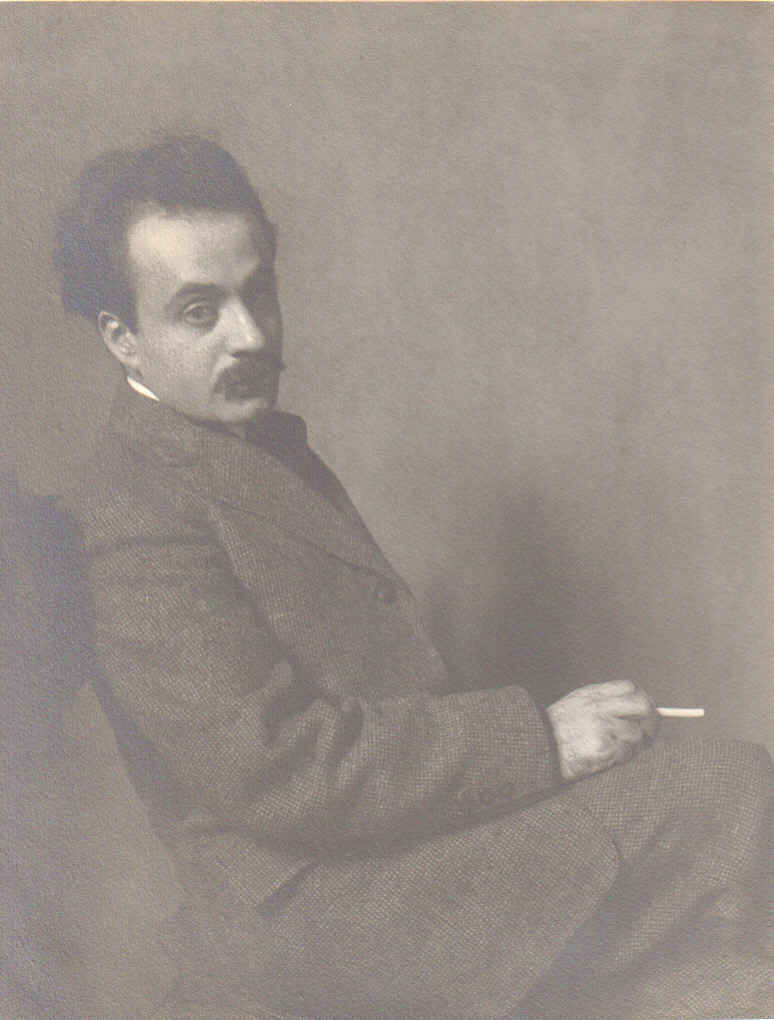
Contrary to popular belief, Kahlil Gibran — Lebanese artist, poet, and philosopher, best known the world over as author of The Prophet — did not lead a properly ascetic life. He had a sober lifestyle, to be sure, and used to spend most of his time writing, painting, and drawing by himself in his studio. Immersed in work, he often forgot to eat ("Work and food don't go together," he found), which was a constant worry to Mary Haskell, his patroness and friend, who wrote once in her private journal:
He eats very little. An orange for breakfast — and a cup of Turkish coffee — or only the coffee. No lunch or a bit of bread and a cup of coffee — or just coffee — or a piece of fruit. A dinner that would be small for anyone else. And no more. Nothing between meals.
Gibran used to joke with her about it: "Mary, that coffee pot is the nearest thing to my life." He tried to ease her mind, though not always successfully:
Am I too thin? I feel well. I usually eat one meal a day — my imagination and food don't go together. I'm always keener mentally and imaginatively before a meal than after. One day a month, or two days together in a month, I go entirely without food — regularly. If anything is wrong with me, I just starve a while — and I get well. When you are not here I dine out oftener than alone.
He was neither a vegetarian nor a vegan, as some admirers might imagine. For him, "beef and eggs and milk" were simply "nourishing food." He explained his position through plain logic:
Life is not cruel. It is great. And we kill nothing. You only change its place, you transfer it from one vessel to another. The Hindus lay such stress on physical death that they eat no flesh, but only herbs — as if the herbs have no life and are not killed in order to be eaten!
• ❧ KGC ❧ •
II
He often repeated that it was sufficient food was "delicious and clean," yet he was by no means indifferent to the pleasures of good cuisine. Gibran and Mary Haskell in New York, when not at Childs' — one of the first national dining chains in the United States — ate at Gonfarone's (their favourite), Delmonico's, or Moretti's. He had a particular fondness for Italian food.
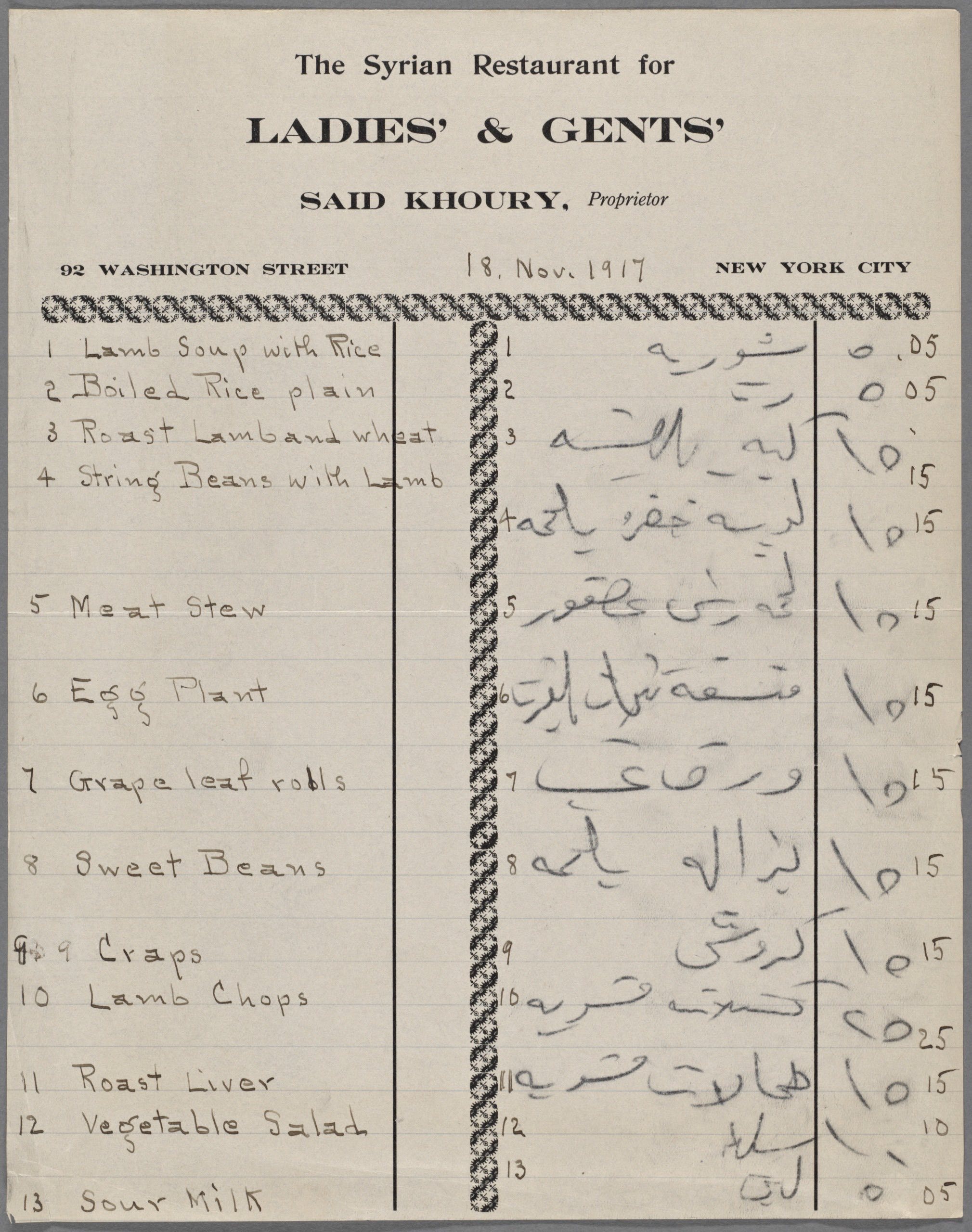
Gibran's frugal studio suppers are described by Barbara Young, the American poet who served as his amanuensis during his last years:
He would say, "In the East there is a custom of eating all from one huge vessel. Let us have our soup tonight in one bowl!" So we would arrange the small table with one large bowl of soup. There were always croutons, many croutons, and the soup was thick, a purée. Next a glass of wine and breadsticks to be dipped in the wine — another of his favourite pleasures.
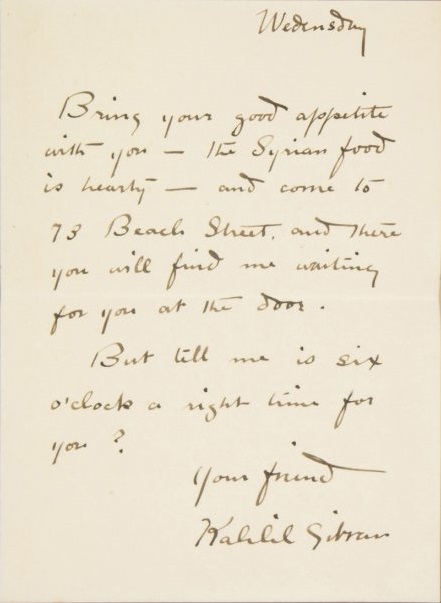
But it was Syro-Lebanese cuisine that he loved most. His colleague Mikhail Naimy records that, while his mother Kamilah was still alive, Kahlil was especially fond of mujaddarah — a porridge of lentils and rice — cooked by her. And he once invited a friend to dinner with these words: "Bring your good appetite with you — the Syrian food is hearty."
• ❧ KGC ❧ •
III
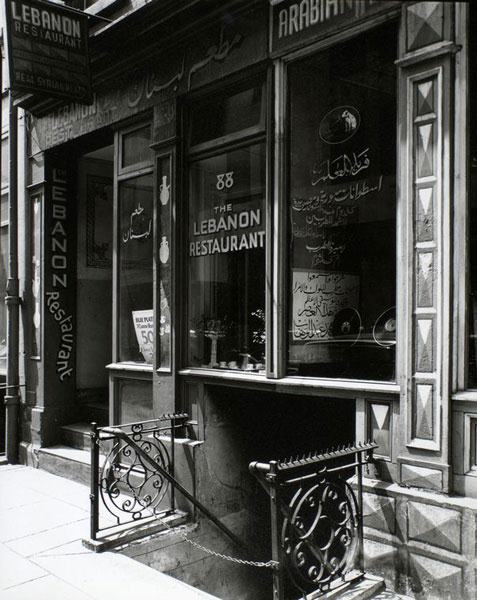
The most detailed account of Gibran's Levantine eating habits comes from Joseph Nahas, an assistant to Ameen Guraieb, founder of the Arabic-language newspaper Al-Mohajer (The Emigrant):
While Gibran enjoyed an occasional steak, he preferred dishes prepared as in the land of his birth, Lebanon, and he frequently patronized a coffee house and restaurant located at 19 Washington Street, operated by an émigré from Zahleh, Lebanon, named Milhem — a man of portly stature, and well versed in Arabian cookery.
Among the dishes Gibran enjoyed most was Lahm Mishwi, known today as Shish Kebab — lamb meat cut into one-inch cubes, strung on a skewer with chunks of tomatoes, green pepper, and onion slices, then broiled and garnished with chopped green parsley and onions, with a side dish of Laban yogurt and a demitasse of strong Turkish coffee to finish.
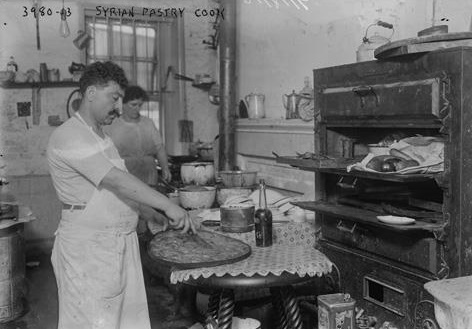
Another dish Gibran favoured was Kibbi, the so-called national dish of the Arabic-speaking peoples — coarse ground wheat pounded with finely ground lamb or beef into a paste, layered with thinly sliced onions, browned ground meat, and Snowbar pine seeds, saturated with butter and baked in the oven. He also relished Malfoof, a stuffed cabbage variation — ground meat mixed with rice, seasoned with salt and pepper, rolled cigar-like into a leaf wrapper, topped with slices of tomato, and cooked on the burner.
Gibran was not a teetotaler. He enjoyed a measure of Arak — an aniseed-flavoured spirit distilled from grapes — though always in moderation. He was fond of Turkish coffee and drank one cup after another as he smoked Turkish tobacco cigarettes with cork tips.
• ❧ KGC ❧ •
IV
Then an old man, a keeper of an inn, said, Speak to us of Eating and Drinking.
And he said: Would that you could live on the fragrance of the earth, and like an air plant be sustained by the light. But since you must kill to eat, and rob the newly born of its mother's milk to quench your thirst, let it then be an act of worship, and let your board stand an altar on which the pure and the innocent of forest and plain are sacrificed for that which is purer and still more innocent in man.
When you kill a beast say to him in your heart: By the same power that slays you, I too am slain; and I too shall be consumed. For the law that delivered you into my hand shall deliver me into a mightier hand. Your blood and my blood is naught but the sap that feeds the tree of heaven.
And when you crush an apple with your teeth, say to it in your heart: Your seeds shall live in my body, and the buds of your tomorrow shall blossom in my heart, and your fragrance shall be my breath, and together we shall rejoice through all the seasons.
— Kahlil Gibran, The Prophet (Alfred A. Knopf, New York, 1923)
❁
References — Kahlil Gibran, The Prophet (Knopf, 1923). Barbara Young, This Man from Lebanon (Knopf, 1945). Virginia Hilu (ed.), Beloved Prophet (Quartet Books, 1972). Joseph Nahas, Seventy-Eight and Still Musing (Exposition Press, 1974). Mikhail Naimy, Kahlil Gibran: A Biography (Philosophical Library, 1985). Robin Waterfield, Prophet: The Life and Times of Kahlil Gibran (Penguin, 1998).
All Rights Reserved © Copyright Francesco Medici 2016