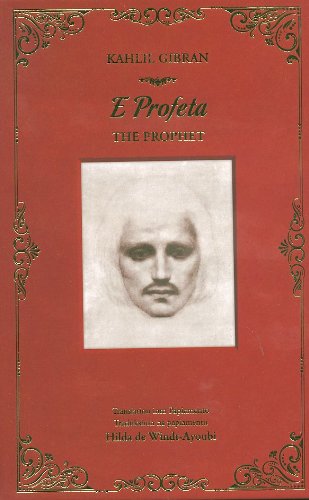
In her own words, Hilda de Windt-Ayoubi — poet, painter, and translator from Curaçao — tells the story of how she came to translate Kahlil Gibran's The Prophet into Papiamento: a journey that began with a stranger's letter and ended with the world's first Creole-language edition of Gibran's masterpiece.
By Hilda de Windt-Ayoubi
• ❧ KGC ❧ •
KAHLIL GIBRAN COLLECTIVE
By Hilda de Windt-Ayoubi · Kahlil Gibran Collective · 2014 · kahlilgibran.com
• ❧ KGC ❧ •
I
Translating The Prophet started in an almost mystical way. Someone I know asked me, six years ago, if I knew Kahlil Gibran. Despite the fact that I replied that I did not, he kept mentioning Kahlil's name from time to time. He wrote to me that some aspects of my poems reminded him of this writer. One day he told me that Kahlil, like my parents, hailed from Lebanon. It was then that I could not close my heart any more. So I searched for this Lebanese writer — and when I saw his work I was truly startled.
In 2011 my son Faried bought me The Prophet as a birthday present. I was deeply touched by this wonderful book. A few months later, I received a second gift: a Dutch translation, De Profeet. While reading it, I felt a great desire to translate this marvellous book into Papiamento, our local language.
I mentioned it to my son and his response was: "Mama, you can do it." It was enough. From that moment on the project was born.
• ❧ KGC ❧ •
II
What made Gibran's masterpiece so well suited to Papiamento? His themes of love, freedom, pain, and the wisdom of simple things are not ideas that need translation — they are already present in the Papiamento spirit. The language itself, woven from Portuguese and Creole, with deep threads of Spanish and Dutch, carries its own poetry. Gibran's prose seemed to call out for it.
The process was not easy. Papiamento is a living, oral language — rich in expression but not always standardised on the page. There were moments of great joy when a phrase fell perfectly into place, and moments of long struggle when I had to find a way to carry the weight of Gibran's imagery without losing its lightness. I worked through the nights, often with the original English and the Dutch translation side by side, listening for the music of both.

• ❧ KGC ❧ •
III
Three years after that first spark, E Profeta was complete. It was launched on 21 May 2014 at the National Anthropological-Archaeological Museum (NAAM) in Pietermaai, Curaçao — on the International Day of Cultural Diversity. For me, the timing felt right. The Prophet is above all a book about our shared humanity, and Papiamento — spoken across several islands, born from the encounter of many peoples — is itself a language of cultural diversity.
I am a grandchild of Lebanese immigrants who came to Curaçao as far back as 1907. In translating Gibran, I felt I was also making a journey back — to roots that time and geography had stretched thin, but never severed. It was an act of love: for the language of my island, for the land of my grandparents, and for a poet whose words had been waiting, I think, to be heard in Papiamento.
E Profeta is available via Amazon. For more on Hilda de Windt-Ayoubi's ongoing work with Gibran's legacy — including her 2023 Dutch translation and her Kahlil Gibran International Association Award — see New Translation by Award-Winning Hilda de Windt-Ayoubi.
❁
All Rights Reserved © Copyright Hilda de Windt-Ayoubi 2014