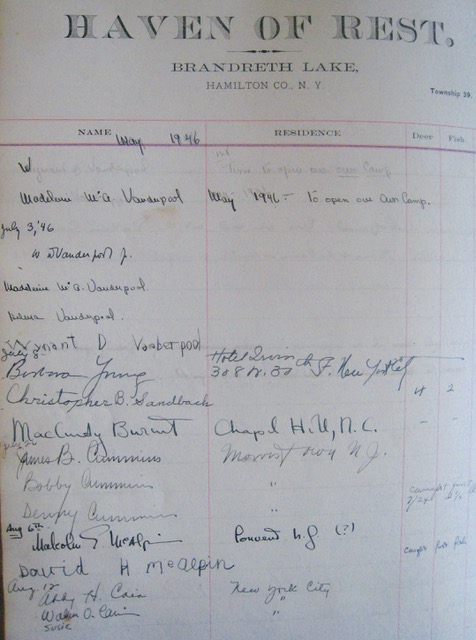
In the spring of 1946, a poet named Barbara Young signed her name in a guest book at a summer house in the Adirondack wilderness. It is one small token of a friendship that ran deep — one that produced years of correspondence, shared lunches, and the gifting of objects from Gibran’s own personal collection. This is the story of Barbara Young, Kahlil Gibran’s devoted secretary and biographer, and of Madeleine McAlpin Vanderpool — the woman whose friendship with Young would ultimately lead to the most significant donation of Gibran-related material ever made to our collection.
By Glen Kalem Habib · Kahlil Gibran Collective · 2026
Tucked into the remote Adirondack wilderness of Hamilton County, New York, lies Brandreth Park — the oldest private family forest preserve in the state, a place of pristine lakes and unbroken silence that has sheltered the same family for over 175 years. It was here, in the spring of 1946, that a poet named Barbara Young signed her name in the guest book of “Haven of Rest,” the Mcalpin-Vanderpool family summer house. That signature — sitting quietly beside a date, “May 1946” — is a small but telling token of a friendship that ran far deeper: years of letters, shared lunches, and the gifting of objects from Gibran’s own personal collection that would, decades later, lead to the most significant donation of Gibran-related material ever made to our collection.
Brandreth Park has a history as extraordinary as the people who have passed through it. In 1851, Dr. Benjamin Brandreth — a British-born entrepreneur who had amassed a fortune marketing his “Vegetable Universal Pills” — purchased 24,000 acres of remote Adirondack timberland for a mere 15 cents an acre, establishing what would become the first private park in the Adirondacks. No motor boats are permitted on its 890-acre Brandreth Lake. Development has always been confined to the north shore, leaving the southern views permanently unspoiled — a conservation philosophy that anticipated modern thinking by nearly a century.
It was to this quiet, protected world that Barbara Young came as a guest in the spring of 1946 — a world away from her New York City penthouse near 34th Street, and from the literary circles in which she had moved for three decades. And she was not the first figure connected to the world of American arts and letters to find their way to the Adirondack wilderness. Gibran himself had been a guest at Henderson House — the Adirondacks estate of Corinne Roosevelt Robinson, the younger sister of President Theodore Roosevelt and an accomplished poet in her own right. That Gibran’s closest associate would later sign a guest book in the same mountain wilderness is one of those quietly resonant historical coincidences that feels, in retrospect, almost inevitable.
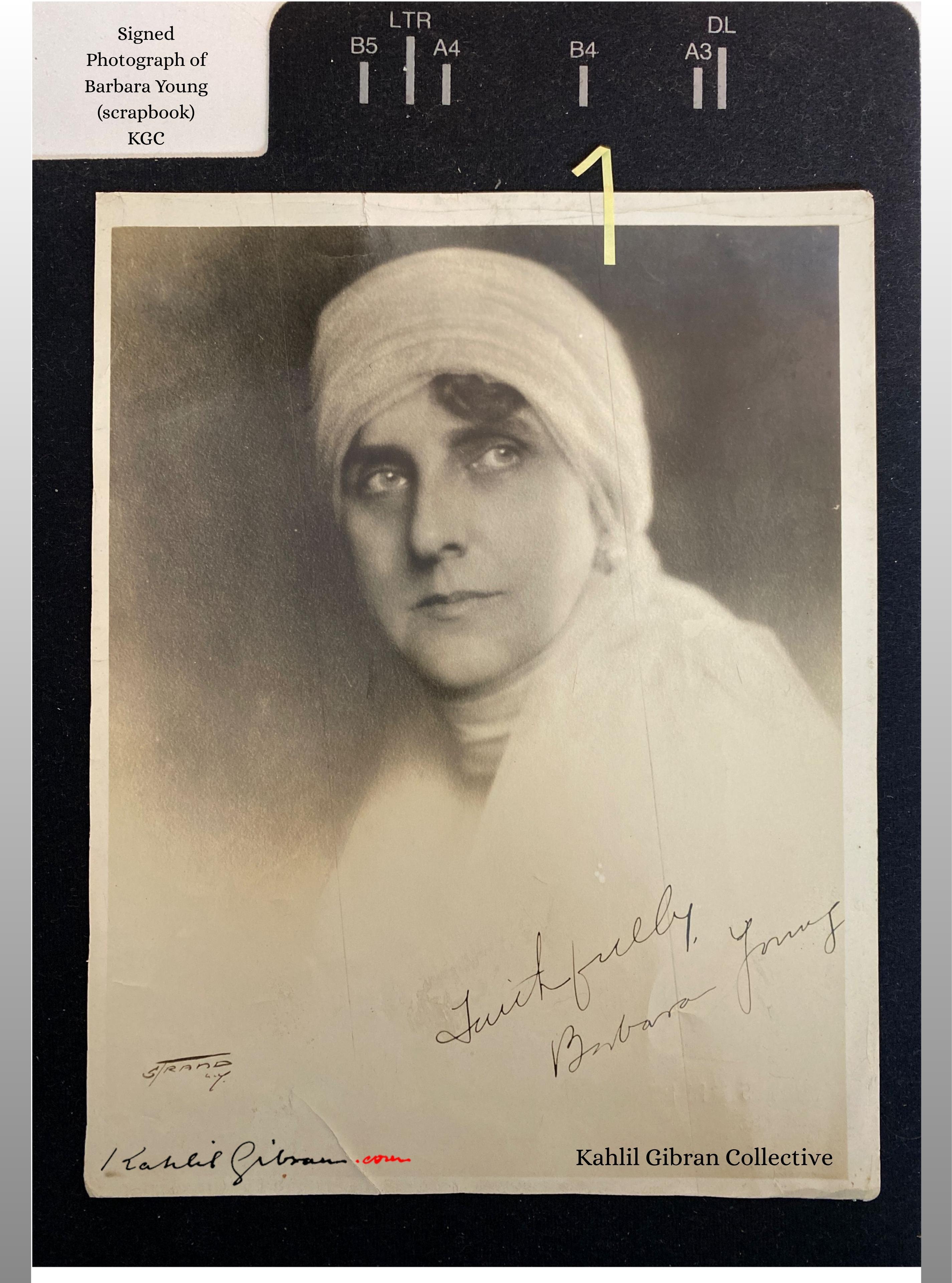
Henrietta Breckenridge Boughton (1878–1961), known by her pen name Barbara Young, was already an established American poet and critic when fate first brought her into Kahlil Gibran’s orbit. Her pre-Gibran career was substantial: a poetry collection, The Temple (1912), and critical essays in Poetry Review and The Bookman that demonstrated a sharp analytical mind equally at home with Romantic poetry and modernist experimentation.
That changed in 1923, at a reading organised by rector William Norman Guthrie at St. Mark’s Church in-the-Bowery, New York. Something in Gibran’s words reached her in a way that little else had. Two years later, she became his secretary — a role she held without remuneration, driven by genuine spiritual and literary devotion, until his death in 1931.
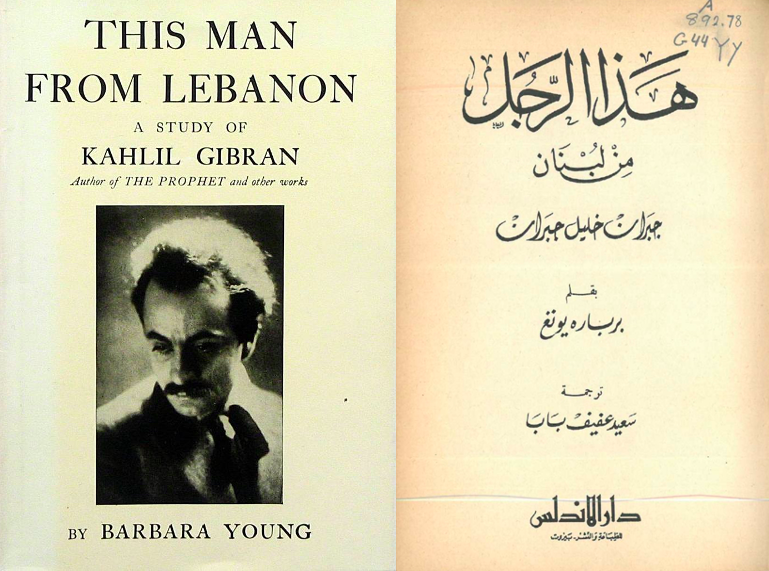
Even within her role as secretary, Young never stopped writing in her own voice. Her 1927 collection The Keys of Heaven (E.P. Dutton & Co.) revealed Gibran’s influence while remaining distinctly her own. After Gibran’s death she organised exhibitions of his artwork — including a 1939 showing at New York’s Sherman Square Hotel — and is credited with completing The Garden of the Prophet, published posthumously in 1933. Her 1945 biography This Man From Lebanon (A.A. Knopf) blended memoir with critical analysis in a way that scholars still reference today. Such was the book’s reach that it was translated into Arabic in 1964 — returning Gibran’s story, via Young’s pen, to the language of his birth.
Long before the McAlpin-Vanderpool collection came to light, Barbara Young had already left her mark on our own archive. Some years ago, we were fortunate enough to acquire a remarkable object: Young’s own curatorial scrapbook, assembled in 1933 — the year The Garden of the Prophet was published. Titled “Barbara Young Presents the Works of Kahlil Gibran,” it is a working document — part catalogue, part record of purpose — compiled as Young was actively organising and presenting Gibran’s visual legacy to the world.
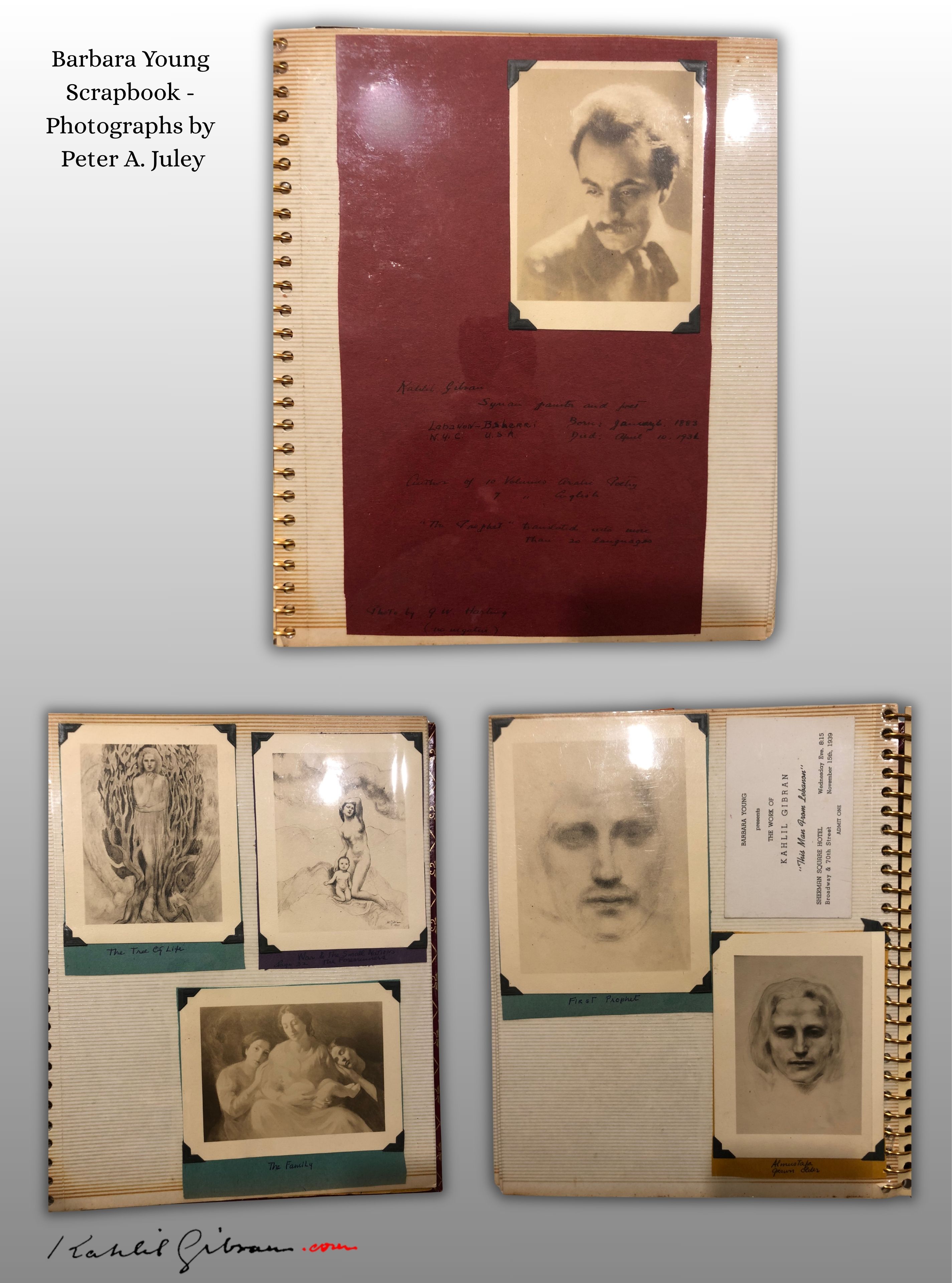
The scrapbook contains annotated photographs of Gibran’s visual artwork, many produced by Peter A. Juley & Son — the New York firm whose 127,000 negatives, now held by the Smithsonian American Art Museum, represent the most comprehensive photographic record of American art from 1896 to 1975. Juley documented Gibran’s paintings and drawings with the same rigour he brought to Thomas Eakins, Winslow Homer, and the circle around Alfred Stieglitz. In some cases, the Juley photographs constitute the only surviving record of works since lost or altered.
That Young chose Juley for this curatorial work tells us something important. She was not simply preserving Gibran’s memory out of sentiment; she was approaching the task with the professionalism of a trained critic who understood the standards of the field. The scrapbook served as her operational record for exhibitions she mounted, and in our hands it remains a document of exceptional significance: a first-hand account of how Young understood, organised, and advocated for Gibran’s visual work in the years immediately following his death.
What neither Young nor anyone else could have anticipated is that a parallel set of Juley photographs — likely drawn from the same body of material — would surface decades later within the McAlpin-Vanderpool collection. The archive and the archivist, separated by decades, have found each other again.
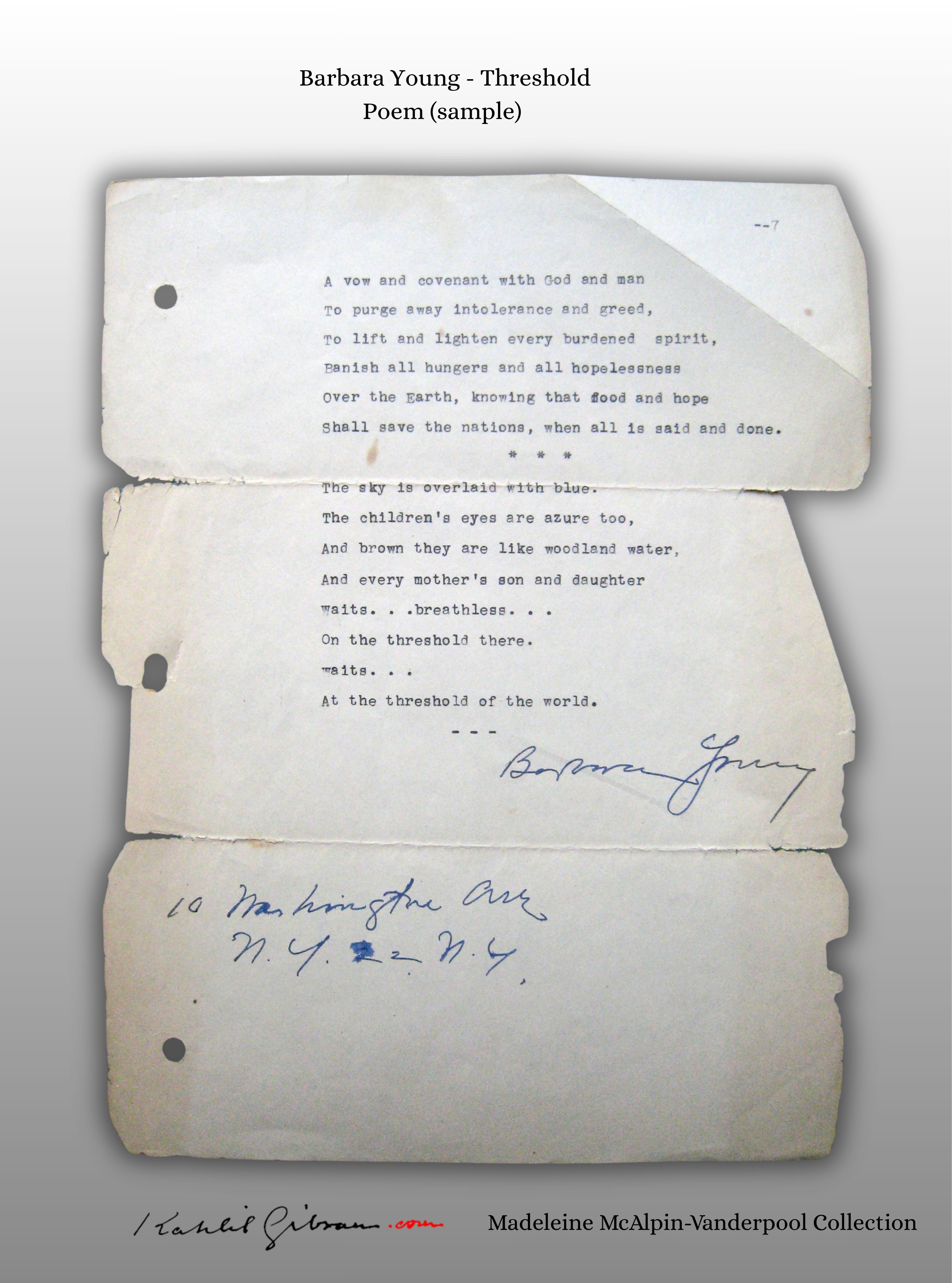
In May of last year, I received an email from Madeleine Findlay, daughter of Madeliene McAlpin-Vanderpool, from Littleton, Massachusetts. Her mother, who shared the same name, had become a close friend of Barbara Young in the late 1940s — a friendship that, over the years, resulted in Madeleine Sr. being gifted a number of items from Gibran’s collection that were in Young’s possession, including unpublished poems by Young herself. About 20 years ago, Madeleine Sr. passed away, leaving her daughter to inherit these remarkable objects.
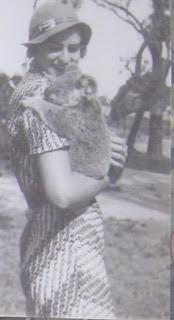
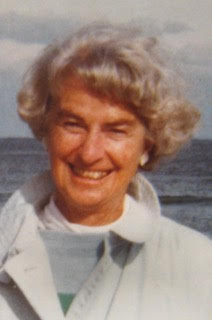
Madeleine McAlpin-Vanderpool was a young mother from New Jersey finding her footing in life when, in the act of browsing a bookstore, she picked up Barbara Young’s 1945 memoir on Gibran — This Man From Lebanon — and found herself, as she later wrote, embraced by it. She had heard of The Prophet but had never read it. She read the biography cover to cover, started The Prophet immediately, and wrote Barbara Young a letter. She barely expected a reply.
What followed was a correspondence, then an invitation, then a friendship that defied the usual bounds of such things — a friendship between a celebrated poet in her late sixties and a searching young mother decades her junior, united by a love of language, of Gibran, and of something harder to name. In Madeleine’s own words, drawn from her handwritten memoir “In Memory of Barbara Young”:
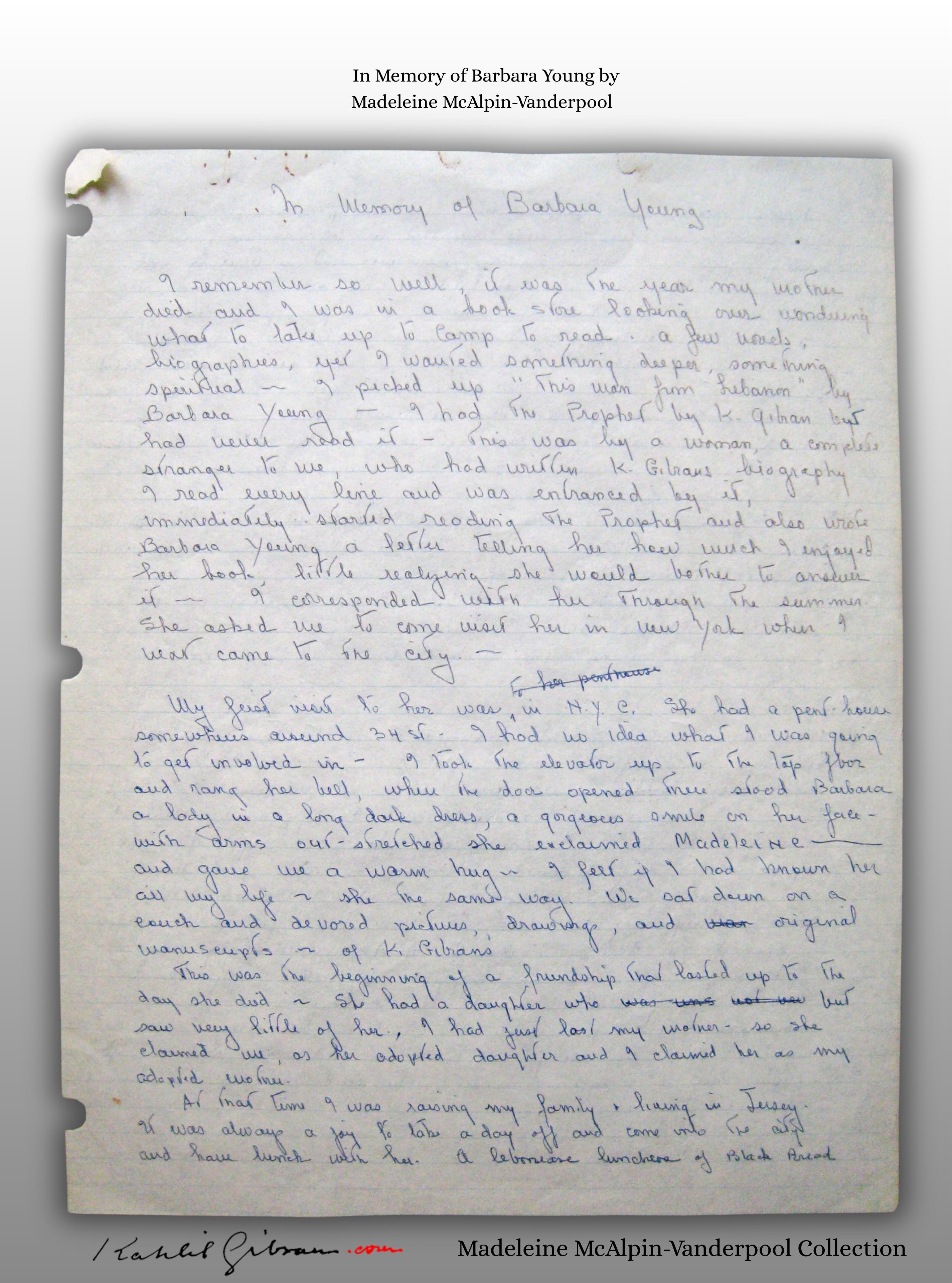
“I remember so well, it was the year my mother died, and I was in a bookstore looking over wondering what to take up to camp to read. A few novels, biographies, yet I wanted something deeper, something spiritual. I picked up This Man From Lebanon by Barbara Young. I had The Prophet by Kahlil Gibran but had never read it. This was by a woman, a complete stranger to me, who had written K. Gibran’s biography. I read every line and was embraced by it, immediately started reading The Prophet and also wrote Barbara Young a letter telling her how much I enjoyed her book, little realizing she would bother to answer it. I corresponded with her through the summer. She asked me to come visit her in New York when I next came to the city.”
“My first visit to her was in New York City. She had a penthouse somewhere around 34th Street. I had no idea what I was going to get involved in — I took the elevator up, to the top floor and rang her bell, when the door opened, there stood Barbara, a lady in a long dark dress, a gorgeous smile on her face, with arms outstretched, she exclaimed ‘Madeleine’ — and gave me a warm hug. I felt as if I had known her all my life, she the same way. We sat down on the couch and devoured pictures, drawings and original manuscripts of Kahlil Gibran’s.”
“This was the beginning of a friendship that lasted up to the day she died. She had a daughter who she saw very little of. I had just lost my mother, so she claimed me as her adopted daughter and I claimed her as my adopted mother.”
“At that time, I was raising my family and living in Jersey. It was always a joy to take a day off and come into the city and have lunch with her. A Lebanese luncheon of black olives, cheese and wine. We really didn’t care much about eating — we were far more interested in communicating and sharing ideas.”
What emerges from Madeleine’s memoir is a portrait of Young that no biography has fully captured: a woman of warmth and spontaneity, chasing ideas through taxi rides across Manhattan, instructing drivers to stop at the nearest hotel so she could find paper before an idea escaped her. A woman who, when Madeleine arrived unannounced, would say: “I knew it was you because I called my angels this morning and wanted to see you.”
And it was a friendship that extended beyond the city. It was Madeleine’s family who kept a summer house at Brandreth Park — and it was there, in May 1946, that Barbara Young signed her name in the guest book, leaving the single piece of physical evidence that connects these two worlds: the literary inheritance of Gibran, and the quiet wilderness of the Adirondacks. The same mountains where Gibran had once been a guest at Henderson House, the retreat of his admirer Corinne Roosevelt Robinson, were now quietly receiving the woman who had dedicated her life to his memory.
“What a deep, beautiful soul she was,” Madeleine concluded, “so understanding, warm and completely open and natural with a delightful sense of humour.”
We are eternally grateful to the Madelleine Findlay, in particular, for entrusting to our organisation what will be the largest single donation of related works we have ever received. These items will henceforth be known as the Madeleine McAlpin-Vanderpool Collection — a name that honours both the woman who received them and the extraordinary friendship that made their preservation possible.
The collection comprises:
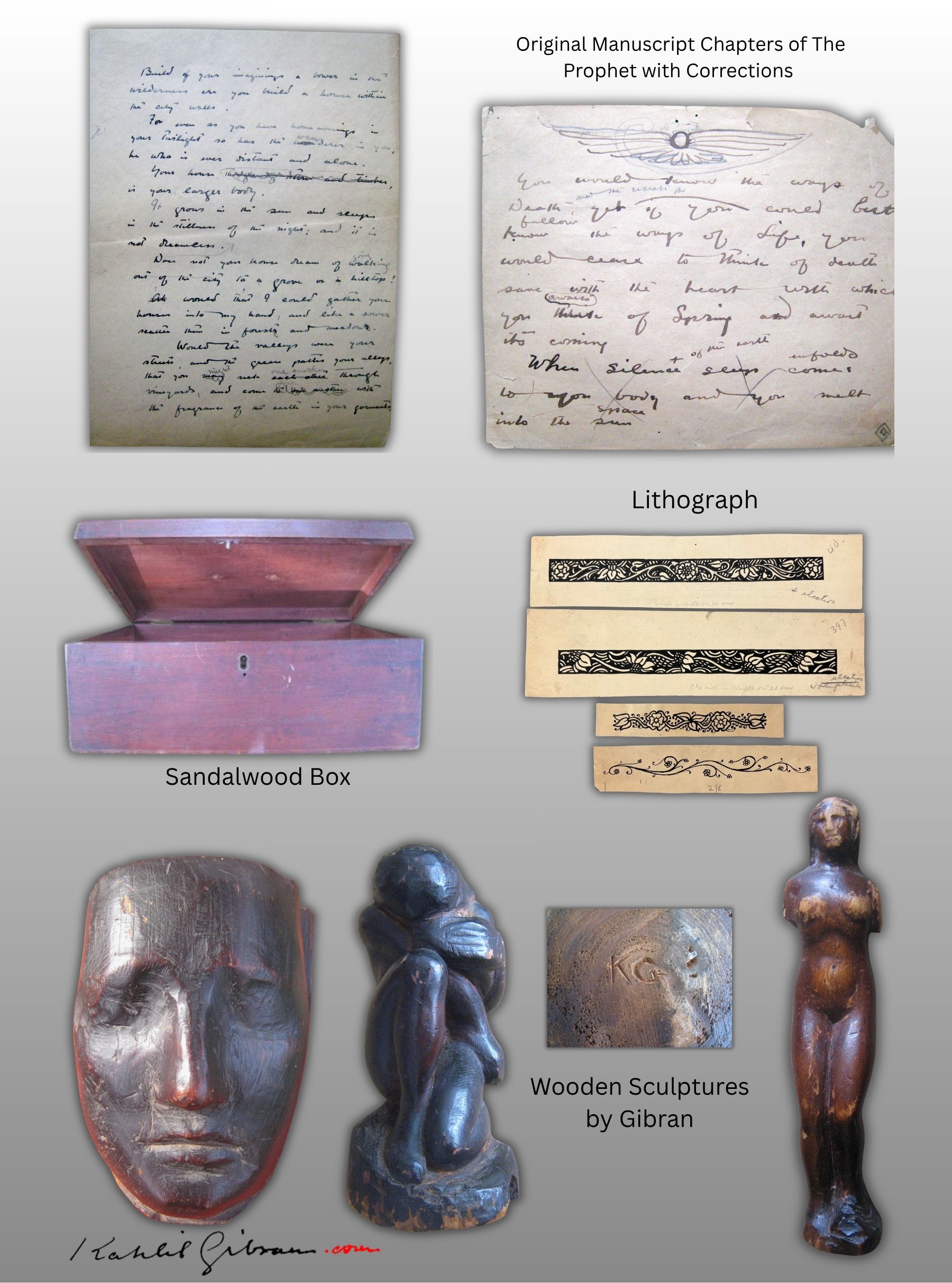
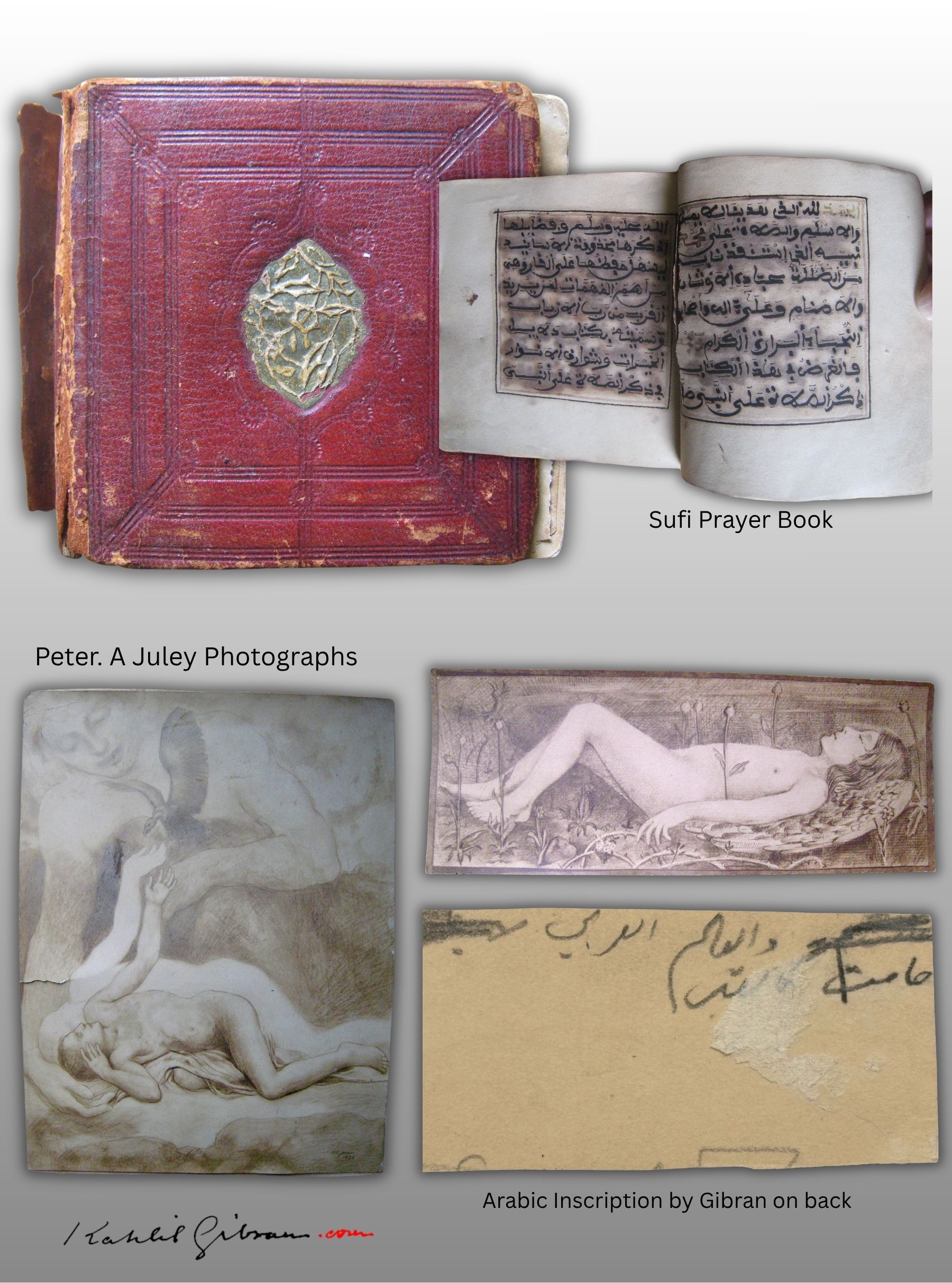
Cross-referencing the Findlay items against the official Barbara Young inventory — “List of Objects in Suitcase to Be Kept by Barbara Young, Apr. 18, 1931, 51W. 10th St, NY” — we have been able to confirm, with a high degree of certainty, several direct matches. The sandalwood box appears on the inventory as “Sandalwood(?) inlaid and carved box, with key.” Two of the wooden carvings correspond precisely to entries highlighted on the inventory: “Gibran carving, crouching woman, face buried in arms, wood” and “Gibran carving, woman, face turned over left shoulder, small, wood.”
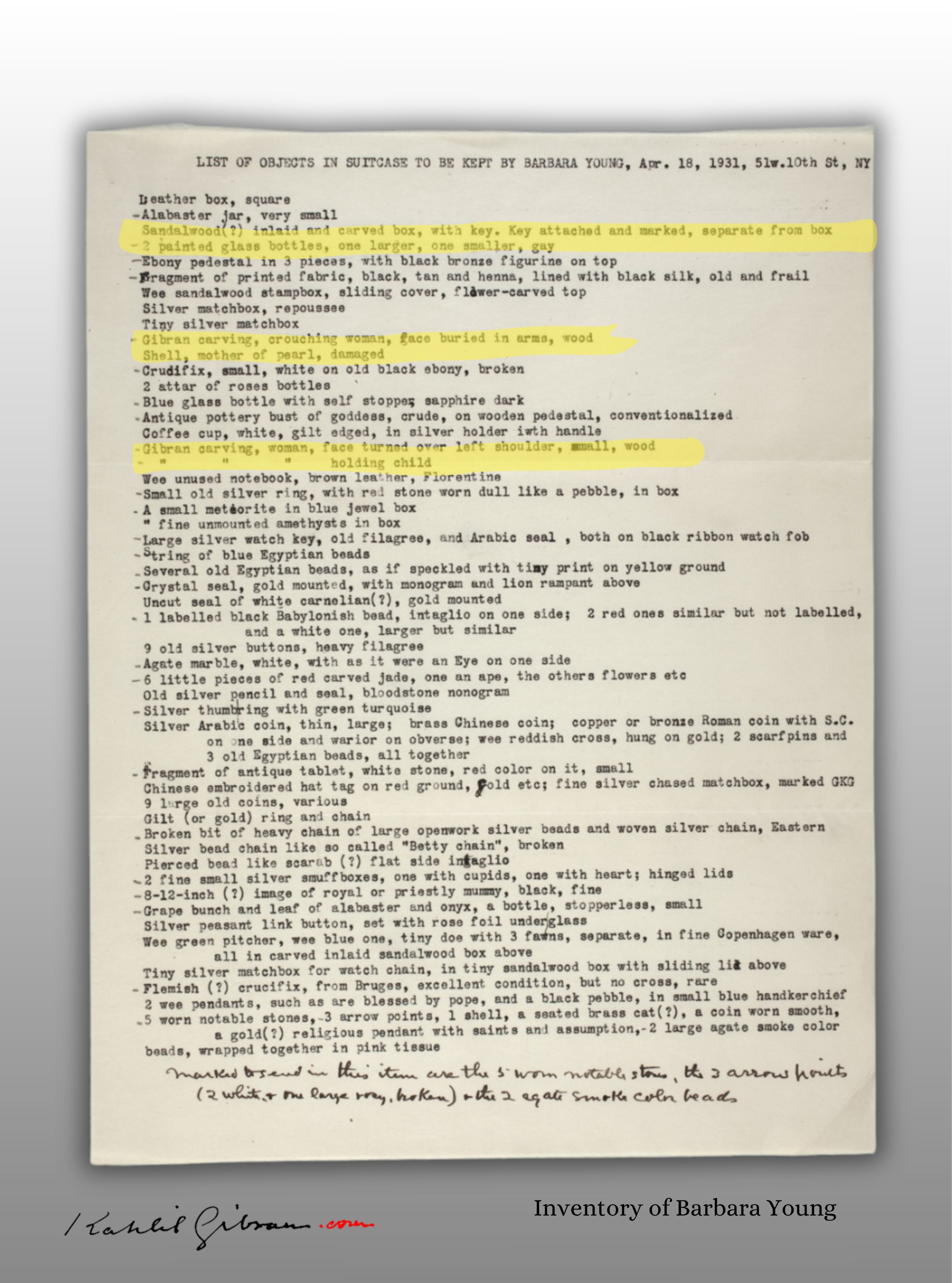
This inventory — compiled on the very day Gibran died, or within days of his death — is itself a document of profound historical significance. It is Barbara Young’s own hand-typed accounting of what she held in trust: a suitcase of Gibran’s most personal objects, to be kept for posterity. That several of those objects have now found their way to us, via the warmth of a friendship, is something we do not take lightly.
There is something quietly fitting about the fact that it all comes back to a guest book. A signature at a summer house in the Adirondacks. A date. A name. Barbara Young had devoted the better part of her adult life to ensuring that Gibran’s words and images would not be lost — organising, curating, writing, travelling to Lebanon, commissioning the finest art photographers of the age, and finally committing her memories to the page. What she could not have known was that her own story would be preserved in a different way: not through monuments or major archives, but through the warmth of a friendship, a handful of gifted objects, a curatorial scrapbook, and the handwritten memoir of a woman from New Jersey who had simply picked up a book in a bookstore and been transformed by it.
That the Juley photographs — images Young assembled in 1933 to document Gibran’s visual legacy — should reappear within the McAlpin-Vanderpool collection, having travelled through the intimacy of friendship rather than the channels of scholarship, reminds us of something important: great archives are not only built in libraries and institutions. They are built in sitting rooms, over Lebanese lunches, on long drives past the Palisades at sunset. They are built in the Adirondacks, in a guest book, in May.
The Madeleine McAlpin-Vanderpool Collection is, in that sense, more than a donation of artefacts. It is evidence of how culture travels: not only through institutions and scholars, but through ordinary people who are moved by extraordinary work, and who have the courage to follow that feeling wherever it leads — even to a penthouse near 34th Street, where a woman in a long dark dress answers the door with arms outstretched.
© 2025 Glen Kalem Habib and the Kahlil Gibran Collective. All rights reserved.
kahlilgibran.com