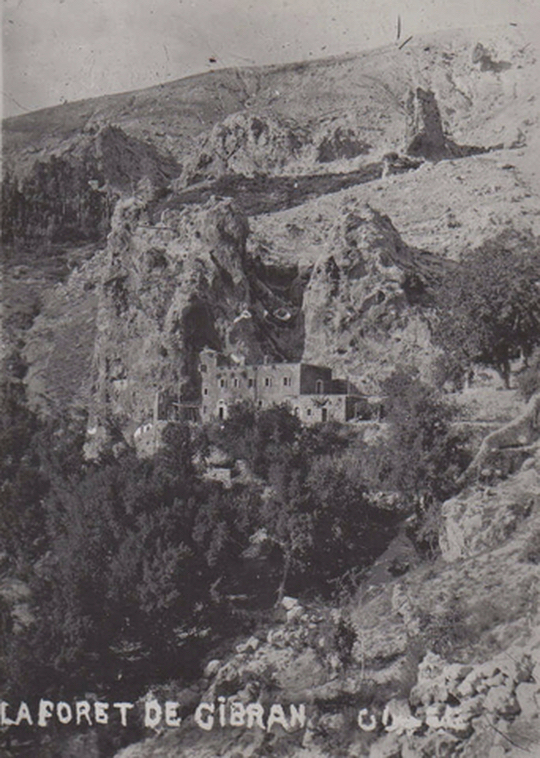
In the spring of 2014, writer and academic Emily Jane O'Dell made the journey to Bsharri, Lebanon — to the monastery where Kahlil Gibran is buried and the museum that holds over a hundred of his original paintings. Her account, first published on HuffPost, offers a vivid and personal portrait of what it means to make a pilgrimage to Gibran in the land he never forgot.
Republished with acknowledgement to Emily Jane O'Dell
• ❧ KGC ❧ •
KAHLIL GIBRAN COLLECTIVE
By Emily Jane O’Dell · Kahlil Gibran Collective · 2014 · kahlilgibran.com
• ❧ KGC ❧ •
I
In the spring of 2014, Emily Jane O'Dell — then a writer and Assistant Professor of History and Archaeology at the American University of Beirut — made the journey north from the city to Bsharri, the mountain village where Kahlil Gibran was born in 1883 and to which his remains were returned after his death in New York in 1931. Her destination was the Monastery of Mar Sarkis and the Gibran Museum it houses: sixteen rooms holding more than a hundred of his original paintings, personal effects, and the intimate traces of a life lived between two worlds.
O'Dell's account — part travelogue, part meditation — captures something that scholarly biography rarely can: the physical, sensory experience of encountering Gibran in place. The worn suitcase with its metal plate. The bookshelves lined with Chekhov, Whitman, and Hugo. The portraits of Mary Haskell and his mother, who died of tuberculosis in the slums of Boston's South End. It is the kind of writing that reminds us why pilgrimages matter — not for what they reveal about the destination, but for what they reveal about the traveller.
• ❧ KGC ❧ •
II
The following is an excerpt from her original piece. We commend it to anyone who has ever read The Prophet and wondered about the man behind it.
While surveying the fading titles in his large collection of books, I felt grateful for the unexpected glimpse into the mind of the poet. On the museum's dusty bookshelves, I spotted Chekhov, Shakespeare, Whitman, Goethe, Balzac, Rousseau, Hugo, and Poe — along with The Kingdom of Happiness and Life in Freedom by Krishnamurti, and Human Personality and its Survival of Bodily Death by Frederic William Henry Myers. Near the books, in vitrines lining the wall, were porcelain figures from Asia, an Egyptian servant statue that looked fake, and a leather suitcase with a metal plate which read:
K. Gibran
51 West 10th Street NWAdmiring this worn artifact from the years when Gibran paid just $20.78 a month in rent to live in Greenwich Village, I thought of all the other eyes that had seen it too. After all, Gibran's social circle was composed of the best artists and thinkers of the day — W.B. Yeats, Carl Jung, Gertrude Stein, Abdu'l-Bahá, Auguste Rodin, Sarah Bernhardt, and Ruth St. Denis.
Though Gibran's art was shown at several prestigious galleries in New York, he never gave up his fight for the poor. One day, after witnessing a noon-time tide of workers in Manhattan, he remarked, "This procession is of slavery. The rich are rich because they can control labor for little payment." In a piece entitled "The Plutocrat," Gibran called the figure of an insatiable capitalist a "man-headed, iron-hoofed monster who ate of the earth and drank of the sea incessantly."
— Emily Jane O'Dell
Read the full article at HuffPost: Pilgrimage to Gibran — Emily Jane O'Dell
❁
Published with acknowledgement to Emily Jane O'Dell. Original article © Emily Jane O'Dell 2014. Republished by the Kahlil Gibran Collective 2014.