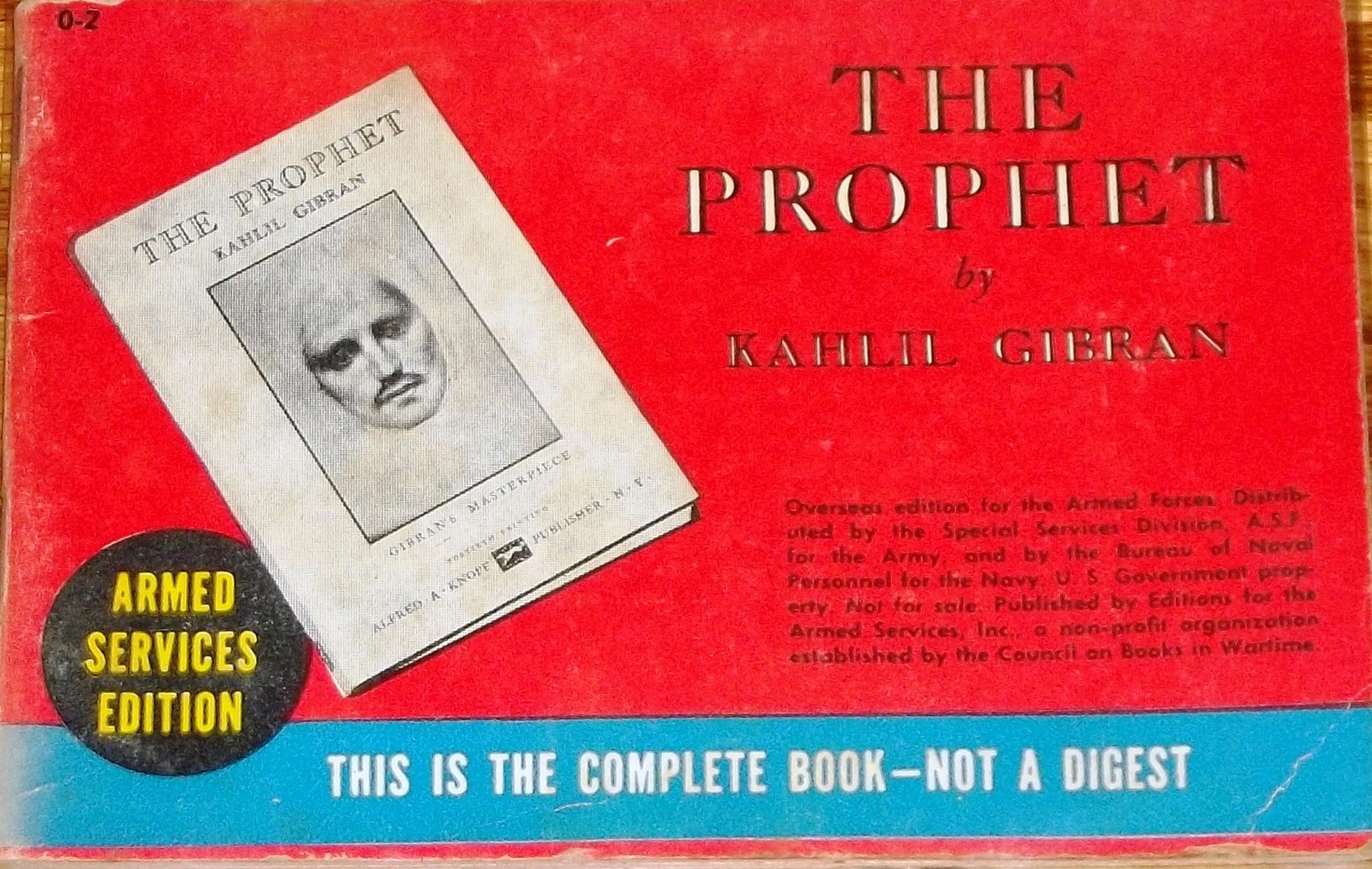
Between 1943 and 1947 the United States printed 123 million pocket-sized paperbacks and gave them free to servicemen and women at war. Among the 1,322 titles chosen — westerns, mysteries, Steinbeck, Twain, Woolf — was one book by an Arab-American: Kahlil Gibran's The Prophet.
By Glen Kalem-Habib
• ❧ KGC ❧ •
KAHLIL GIBRAN COLLECTIVE
By Glen Kalem-Habib · Kahlil Gibran Collective · 2014 · kahlilgibran.com
• ❧ KGC ❧ •
I
Picture this. You are a combat soldier in the Second World War, a few thousand miles from home, hunched in a murky bunker waiting for the order to go out onto the front line at Normandy. Or you are the co-pilot of a United States aircraft loaded with an atomic bomb, en route to Hiroshima. Or you are one of the sixty-eight American servicewomen held as prisoners of war in the Philippines.
Packed into your uniform sits an oblong paperback. The front cover reads "Armed Services Edition"; beside it, the distinguishing catchphrase, "This is the complete book — not a digest." Between them sits a photograph of the original book cover with its title and author. The back carries a glowing account of the contents and a short biography. The book you are carrying is Kahlil Gibran's The Prophet. You open it at the chapter on Good and Evil and read:
Of the good in you I can speak, but not of the evil. For what is evil but good tortured by its own hunger and thirst? Verily, when good is hungry it seeks food even in dark caves, and when it thirsts it drinks even of dead waters.
As a researcher of Kahlil Gibran's work and legacy for over two decades, I was astonished to find The Prophet reprinted in the Armed Services Edition catalogue. It opened a can of worms, and I began a long search to find out what I could about it.
• ❧ KGC ❧ •
II
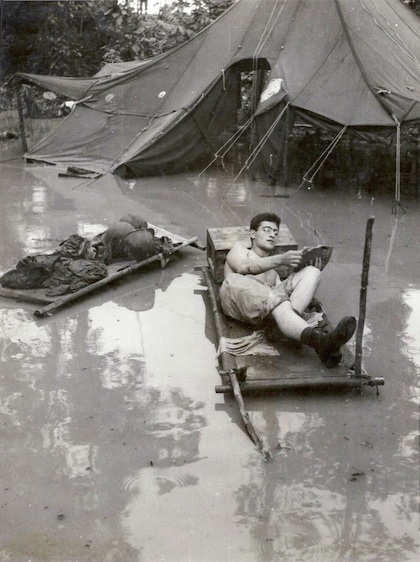
Daniel J. Miller, in Books Go to War, explains it this way: "When the United States entered World War II in December of 1941, the Armed Services needed to do everything in their power to mobilize millions of ordinary American civilians to become physically fit, mentally awake, and high-spirited soldiers and sailors. Maintaining morale among the troops became a primary objective, and military officials realized that books could be instrumental in the process."
Formed in 1942, the scheme answered a need to publish and distribute reading material in a compact new format: the paperback. It allowed cost-effective printing and production at a fraction of the price of hardbacks, and the slim, complete books were small enough for servicemen and women to carry with them to war.
Between 1943 and 1947 a series of 1,322 titles was published. They included popular westerns, science fiction, and murder mysteries. Printed, published, and distributed free, the Armed Services Editions are believed to have produced a staggering 123 million copies in a relatively short printing life. Most were complete and unabridged reprints of their original texts.
Working closely with publishers, librarians, and booksellers, the Council on Books in Wartime organised and managed the project, marshalling the whole American book industry behind it. Set up as a non-profit, it charged only recuperation costs to cover printing and distribution. The Council drew up a set of recommendations that all participating publishers and authors abided by, making it fair game for everyone involved. Most publishers agreed to minimal royalties; the reputational value of having your book on the list was reason enough.
Each month an advisory committee selected thirty to forty books for reprinting. The committee chose writers who had earned a place within the literary canon, or who might reasonably be expected to do so in time — Thomas Mann and John Steinbeck, Mark Twain and Virginia Woolf — alongside humour, history, and science, with titles such as Boris Sokoloff's The Story of Penicillin. The first Armed Services Edition to be printed, in September 1943, was Leo Rosten's collection of short stories, The Education of Hyman Kaplan.
• ❧ KGC ❧ •
III
How Gibran's The Prophet came to be on that list is a question still pending further research with his publisher, Alfred A. Knopf. I am on the case. The exact print and readership numbers are hard to establish, but I can only imagine that the soldiers who read it took some comfort from the book during their service. One thing can be said with confidence: across a vast selection of reading matter, printed over four short years, The Prophet was the only title on the list by an Arab-American.
Although he did not live to see it circulate, I imagine Gibran would have taken some comfort in knowing his book was read on the battlegrounds — the same battlegrounds that overthrew Turkish rule in his beloved Lebanon, a subject close to his heart. Gibran fought long and hard with brush and pen to liberate the Levant.
• ❧ KGC ❧ •
IV
In 1914 he published an "Open Letter to Islam," calling on the various native sects in Ottoman-occupied lands to cease their internecine struggles and unite in opposition to the Turks, and wrote other articles highlighting the plight of his people and appealing for aid. He helped organise a League of Liberation, and was instrumental in forming a relief committee that raised funds to combat the famine sweeping the Middle East in those terrible years.
In 1921 he wrote an essay which, through an overstated translation from the Arabic, came to be linked with President Kennedy's famous "ask not" line. First translated in 1958 as "The New Era," it reads:
Are you a politician who says to himself: "I will use my country for my own benefit"? Or are you a devoted politician, who whispers into the ear of his inner self: "I love to serve my country as a faithful servant"?
In a later translation of 1965, retitled "The New Frontier" — matching the theme of Kennedy's 1960 acceptance speech — the same passage appears as:
Come and tell me who and what are you. Are you a politician asking what your country can do for you, or a zealous one asking what you can do for your country?
So was it any wonder that his book ended up in the pockets of those soldiers? I cannot help asking myself what Gibran would have said about it. As a champion and campaigner for peace and unity, what would he have made of his prophet of war?
I have to end this piece with a "to be continued," because I do not feel it is the end of the story. I have recently acquired a copy of the book with soldiers' names written inside the cover. The search goes on.
❁
Glen Kalem-Habib · Sydney, Australia. See also The Prophet of War (Part II).
All Rights Reserved © Copyright Kahlil Gibran Collective 2014