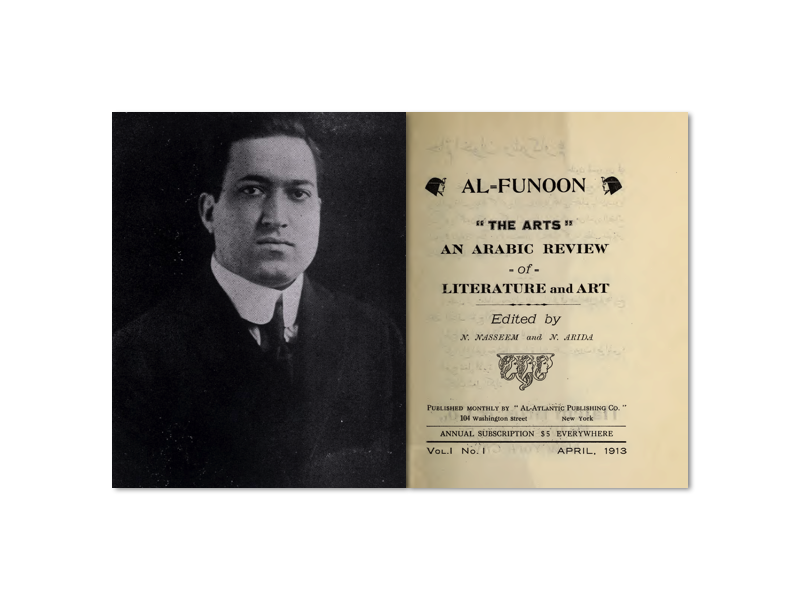
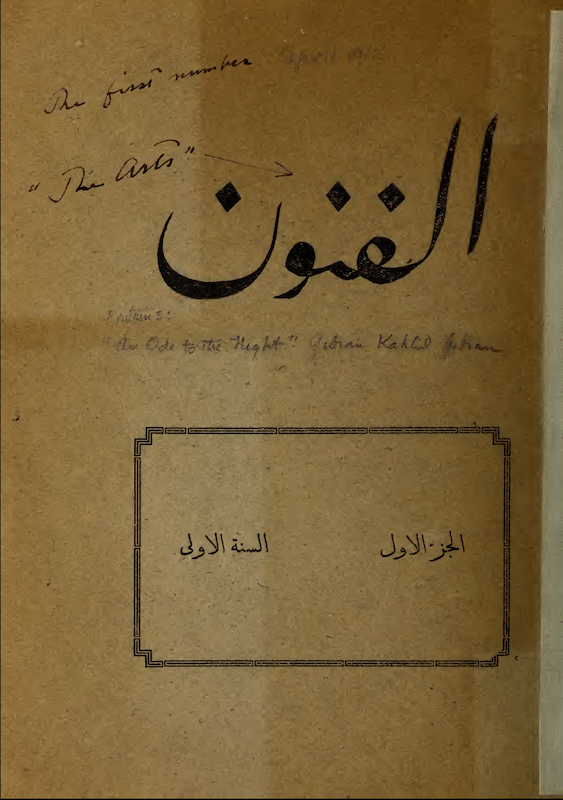
When Al-Funoon launched in New York in April 1913, its first pages were given to Kahlil Gibran — a poem and a full-page photograph. It was not an accident, but a statement about who the Mahjar's leading voice was.
By Francesco Medici
• ❧ KGC ❧ •
KAHLIL GIBRAN COLLECTIVE
By Francesco Medici · Kahlil Gibran Collective · 2019 · kahlilgibran.com
• ❧ KGC ❧ •
I
The Arab-American literary monthly Al-Funoon ("The Arts") began publication in April 1913 in New York City under the editor and publisher Naseeb Arida,1 who had founded the Al-Atlantic Publishing Co. there the previous year. After twenty-nine issues it ceased publication in August 1918, brought down by paper supply, unpaid subscriptions, a shortage of manpower, and the war.2
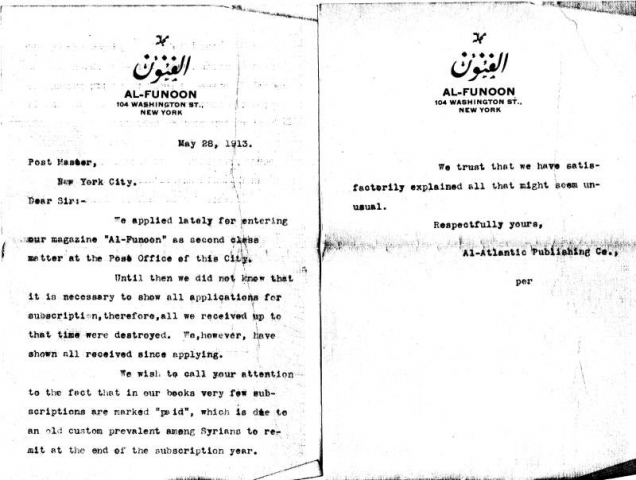
Arida's magazine met economic and logistical difficulties from the start, as an unsigned draft of a 1913 letter from its editorial board to the New York City postmaster shows:
AL-FUNOON, 104 Washington St., New York — May 28, 1913
Post Master, New York City.
Dear Sir: — We applied lately for entering our magazine "Al-Funoon" as second class matter at the Post Office of this City. Until then we did not know that it is necessary to show all applications for subscription, therefore, all we received up to that time were destroyed. We, however, have shown all received since applying.
We wish to call your attention to the fact that in our books very few subscriptions are marked "paid", which is due to an old custom prevalent among Syrians to remit at the end of the subscription year. We trust that we have satisfactorily explained all that might seem unusual.
Respectfully yours, Al-Atlantic Publishing Co.3
• ❧ KGC ❧ •
II
Gibran contributed a great deal to the journal, both as artist and as poet, publishing several drawings and writings. Arida's deep respect for him is confirmed by the fact that the first issue of Al-Funoon dedicated its opening pages to him — an original poem, Ayyuha al-Layl, which Gibran himself rendered in English as "An Ode to the Night" in the copy he sent to Mary Haskell,4 together with a full-page photograph of the poet. This was no accident, but a planned way of setting Gibran's name at the head of Mahjar literature.
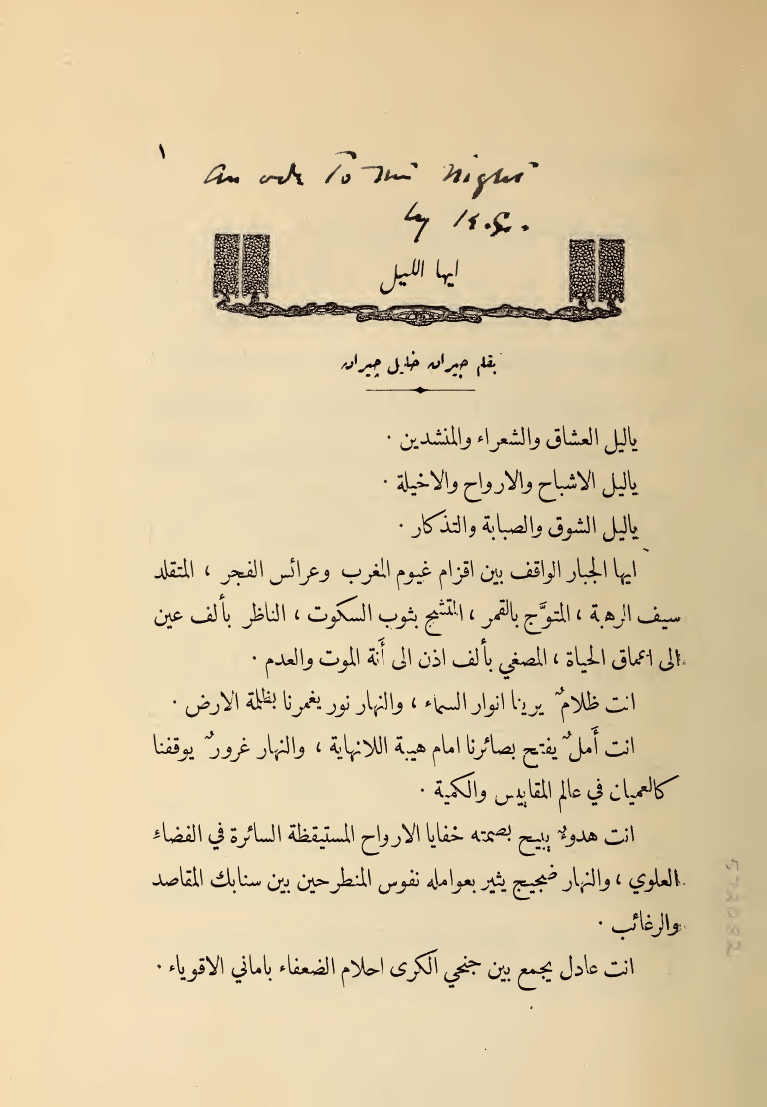
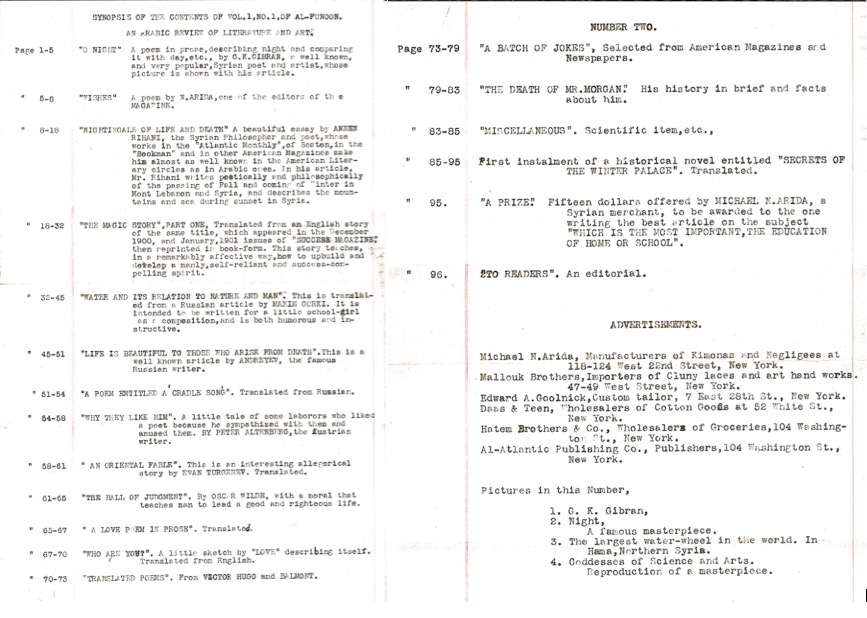
The same intention shows in an early two-page document in English — a draft table of contents, probably typed by Arida when the review was still an embryonic project:
SYNOPSIS OF THE CONTENTS OF VOL. 1, NO. 1, OF AL-FUNOON. AN ARABIC REVIEW OF LITERATURE AND ART.
Page 1–5 · "O NIGHT" — A poem in prose, describing night and comparing it with day, etc., by G. K. Gibran, a well known, and very popular, Syrian poet and artist, whose picture is shown with his article.
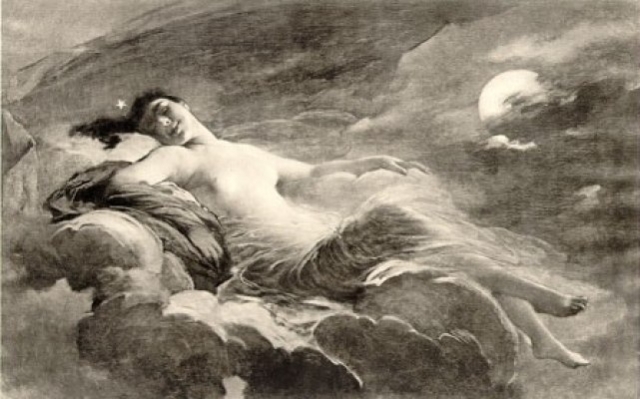
Pictures in this Number: 1. G. K. Gibran. 2. Night — a famous masterpiece [by Charles Joshua Chaplin (1825–1891), French painter and printmaker].5
❁
1 Together with Nazmi Nasseem. ↩
2 For additional details, see al-funun.org. ↩
3 Francesco Medici Collection.
4 See Mary Haskell's personal copy of the issue, given to her by Gibran — Mary Haskell Minis Collection, University Library, University of North Carolina at Chapel Hill. ↩
5 Francesco Medici Collection.
This article is based on an excerpt from "Tracing Gibran's Footsteps: Unpublished and Rare Material," in Gibran in the 21st Century: Lebanon's Message to the World, edited by H. Zoghaib and M. Rihani (Beirut: Center for Lebanese Heritage, LAU, 2018), pp. 93–145.
All Rights Reserved © Copyright Francesco Medici 2019