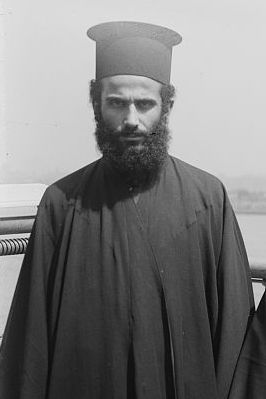
Gibran chose a young Lebanese clergyman to carry all his English books into Arabic. When Antony Bashir's The Prophet appeared in 1926, Gibran told him: only you could have tailored such a beautiful Arabic garment for it.
By Francesco Medici
• ❧ KGC ❧ •
KAHLIL GIBRAN COLLECTIVE
By Francesco Medici · Kahlil Gibran Collective · 2019 · kahlilgibran.com
• ❧ KGC ❧ •
I
As a young clergyman, the Lebanese-born Antony (Antonious) Bashir (1898–1966) — future Orthodox Archbishop of New York and Metropolitan of All North America of the Church of Antioch from 1936 to 1966 — was adept at translating from English into Arabic. It was Gibran who chose to entrust Bashir with the Arabic translation of all his English works published by Knopf in New York: The Madman (1918), The Forerunner (1920), The Prophet (1923), Sand and Foam (1926), Jesus, the Son of Man (1928), and The Earth Gods (1931).1 Bashir also edited a collection of Gibran's short writings and sayings, published in Cairo in 1927 as Kalimat Jubran.2 When in 1926 the poet saw the Arabic Prophet, he said to the Archimandrite:
Only you could have tailored such a beautiful Arabic garment for my Prophet.3
• ❧ KGC ❧ •
II
There was a rich epistolary exchange between Gibran and his official Arabic translator. Bashir's letters to him — or part of them — are now preserved in the Soumaya Museum, Mexico City. Gibran's letters to Bashir remained hidden in the archives of the Antiochian Orthodox Christian Archdiocese of North America, unknown and unpublished, until 11 November 2004, when they appeared in the original Arabic in the Lebanese daily An-Nahar. They had been found by chance by Philip Saliba (1931–2014), the Lebanese-born former Metropolitan, while searching the old files of his predecessor.4 In 2005 the letters were translated into English by the Lebanese professor George Nicolas El-Hage for a leading international literary journal. Some of the more significant passages follow.
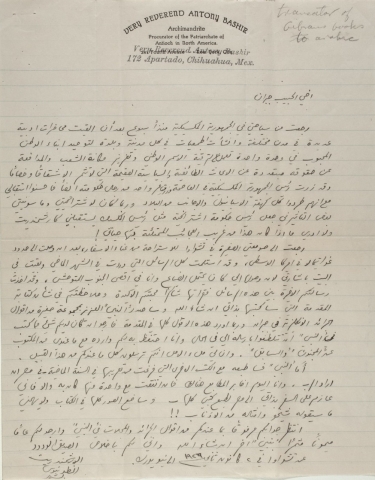
23 January 1925
Concerning the translation of The Prophet into the Arabic language… You know that this small book is a part and parcel of my being, and I hardly wrote a chapter of it without experiencing a transformation in the depth of my soul. This is the reason why I ask you… rather, I implore you to grant it a vast space in the garden of your attention… I ask that you please send me your translation, chapter by chapter if you will, so we can collaborate together in the best way possible for you, me and the book. I will return to New York after a few days and will search my library for the books that I deem advisable to translate into Arabic and will inform you.
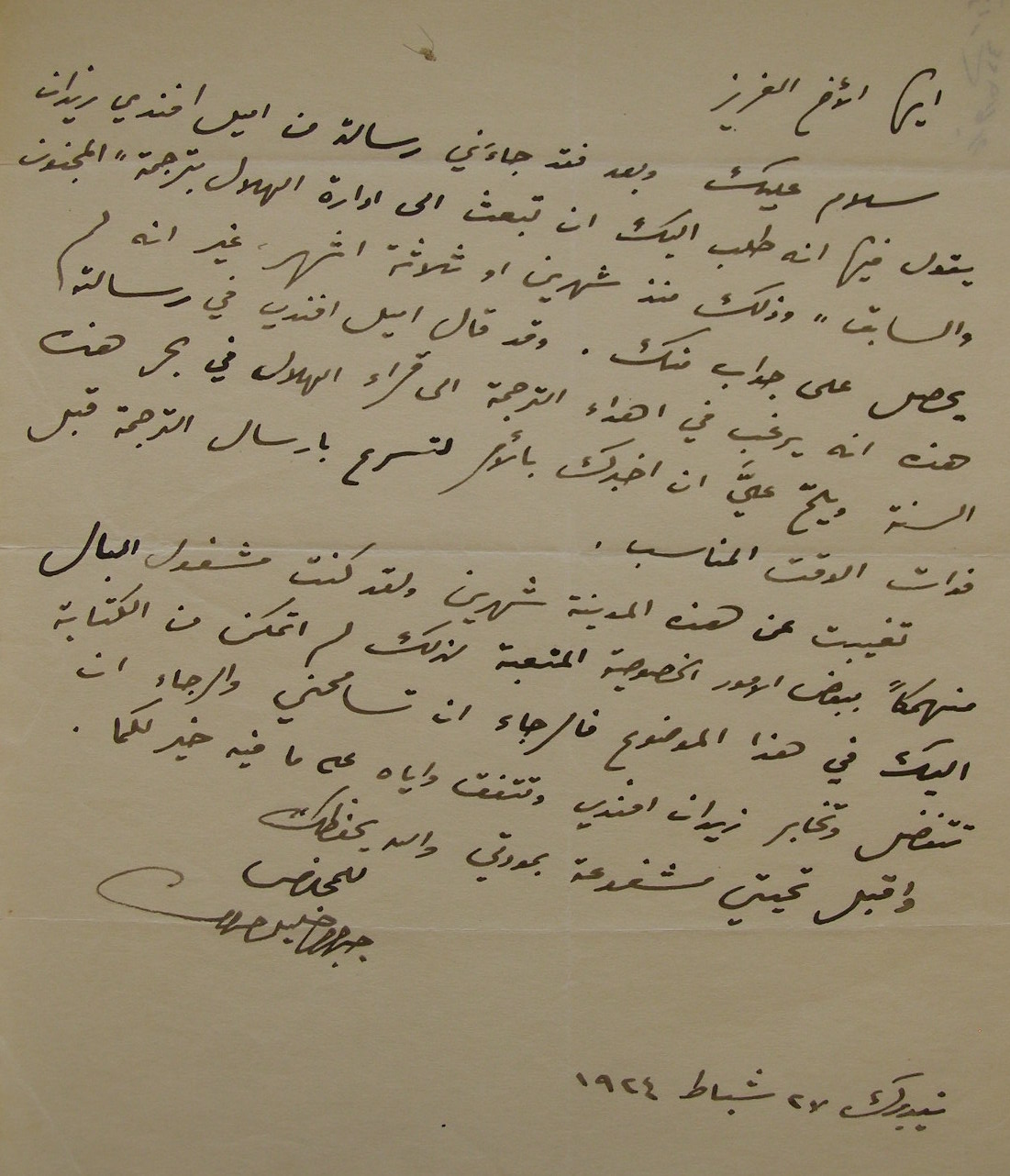
10 November 1925
Your translation of The Prophet is an act of kindness towards me that I will gratefully remember as long as I live. My hope is that the readers of the Arabic language will appreciate your literary enthusiasm and afford it its due worth. In my judgment, the translator is a creator, whether people acknowledge this or not. As far as I am concerned, the most deserving of all people to write the introduction is you, because he who spends days translating a book from one language to another is certainly the most knowledgeable of all people about the merits and shortcomings of that book.
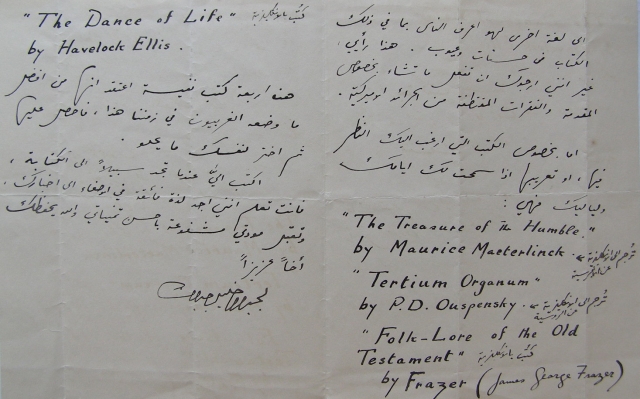
In the same letter Gibran listed the books he wished Bashir to consider translating:
· The Treasure of the Humble by Maurice Maeterlinck — translated into English from the French
· Tertium Organum by P. D. Ouspensky — translated into English from the Russian
· Folk-Lore in the Old Testament by James George Frazer — written in English
· The Dance of Life by Havelock Ellis — written in English
"These are four valuable books which I believe are among the best that Westerners have written during our present time. Try to obtain these books. Then choose for yourself what appeals to you."
Undated
You ask me now to send you the reviews of The Prophet from the American newspapers. It is really hard for me to respond to your request because three years ago I suspended my subscriptions due to what they call here the "international censorship" of newspaper excerpts. All I can say to you now about the small book is that it has just reached its tenth edition and that it has been translated into ten European languages — rather, eleven — and into Japanese and Hindi among the Eastern languages, and there are more yet to come. As for the opinion of other people on the small book, from Woodrow Wilson to the best English poet, to the most famous French writer, to Gandhi the Indian, to the simplest labourer, to the wife and mother, the response has been something I have not expected or even imagined at all. This is why I sometimes find myself embarrassed to face the affection of the people and their generosity.5
❁
1 Cf. respectively al-Majnun (Cairo: Matba'at al-Hilal, 1924); al-Sabiq (Cairo: Matba'at al-Hilal, 1925); al-Nabi (Cairo: al-Matba'ah al-Rahmaniyah, 1926); Ramal wa-Zabad (Cairo: Maktabat al-'Arab, 1927); Yasu' Ibn al-Insan (Cairo: al-Matba'ah al-'Asriyah, 1932); Alihat al-Ard (Cairo: al-Matba'ah al-'Asriyah, 1932). ↩
2 Kalimat Jubran (Cairo: Yusuf al-Bustani, 1927). ↩
3 Quoted in Elizabeth Boosahda, Arab-American Faces and Voices: The Origins of an Immigrant Community (Austin: University of Texas Press, 2003), p. 218.
4 Gibran's letters to Bashir are now preserved in the Antiochian Heritage Museum & Library, Bolivar, Pennsylvania. ↩
5 George Nicolas El-Hage, "Gibran's Unpublished Letters to Archbishop Antonious Bashir," Journal of Arabic Literature, vol. 36, no. 2 (2005), pp. 172–182. Cf. Francesco Medici, "Un abito arabo per Il profeta. Lettere inedite di Kahlil Gibran a Antony Bashir," Kervan, 7–11, January 2010, pp. 37–57.
This article is based on an excerpt from "Tracing Gibran's Footsteps: Unpublished and Rare Material," in Gibran in the 21st Century: Lebanon's Message to the World, edited by H. Zoghaib and M. Rihani (Beirut: Center for Lebanese Heritage, LAU, 2018), pp. 93–145.
All Rights Reserved © Copyright Francesco Medici 2019