A new tribute book marking America's 250th anniversary places Kahlil Gibran among 250 people "who shaped the United States" — and its authors asked the Collective to help to tell his story.
By Philippe Maryssael
• ❧ KGC ❧ •
KAHLIL GIBRAN COLLECTIVE
By Philippe Maryssael · Retired translator and terminologist, translator of Kahlil Gibran and contributor to the Kahlil Gibran Collective · Arlon, Belgium · 2026 · kahlilgibran.com
To mark America's 250th anniversary, a new collection gathers 250 men and women born outside the United States — among them nearly fifty Nobel laureates — whose lives, in the words of its publisher, "helped shape the United States." From the World to America: 250 People Who Shaped the United States was independently published on 31 July 2026, runs to 548 pages, and was compiled by Dr. Valery Tsepkalo and Dmitry Bolkunets.1 Its subjects range from Alexander Hamilton and Tadeusz Kościuszko to Nikola Tesla, Albert Einstein, Charlie Chaplin, and Igor Sikorsky — immigrants and children of immigrants who, the authors argue, transformed America's science, industry, culture, and public life while carrying with them "the language, training, and hard-won perspective of the countries they left behind."
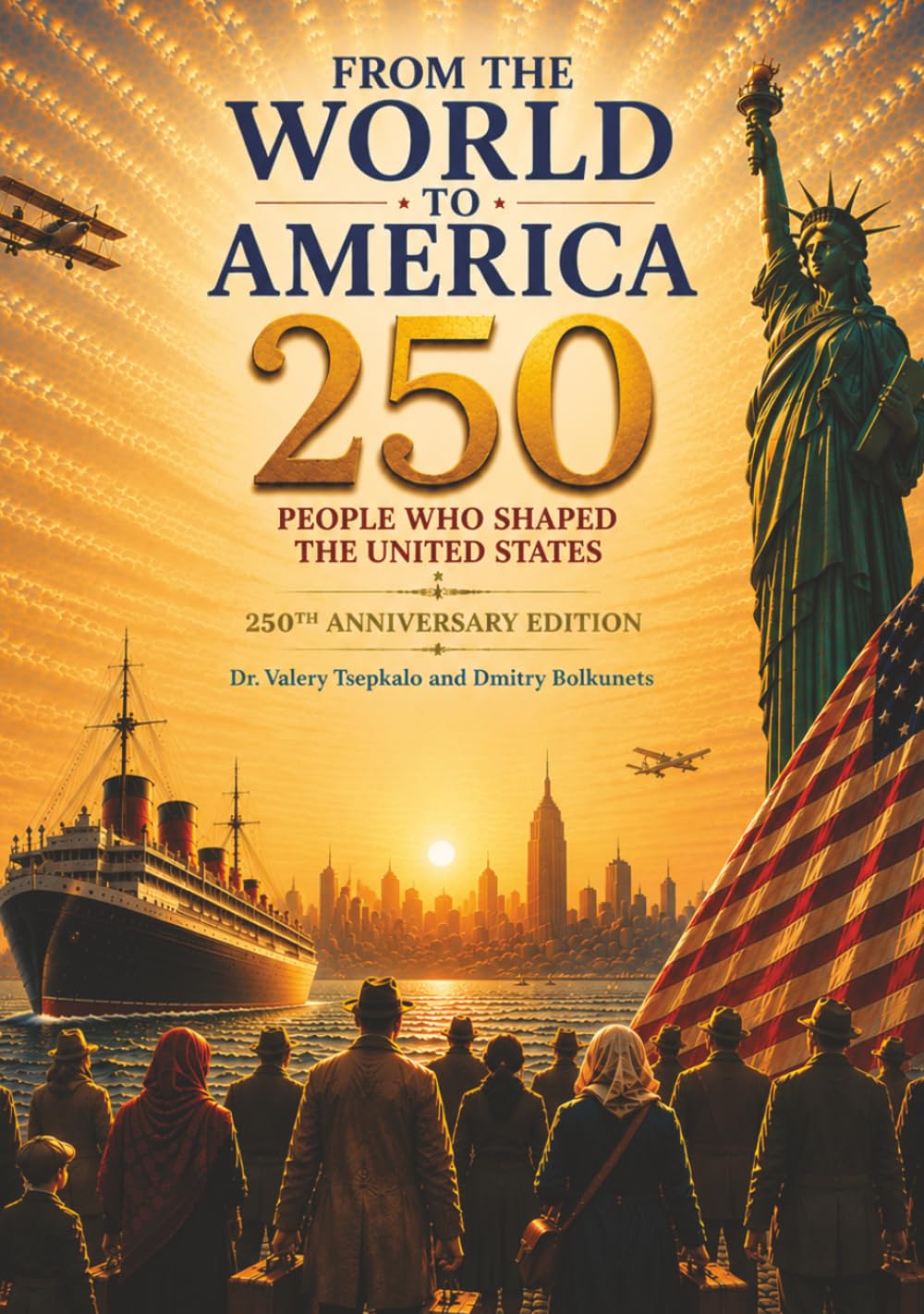
Every entry, the publisher notes, is "based on primary sources, archival records, and verified historical research" — a tribute, in the authors' framing, to the idea that "the American story has never belonged to one people alone."
• ❧ KGC ❧ •
I
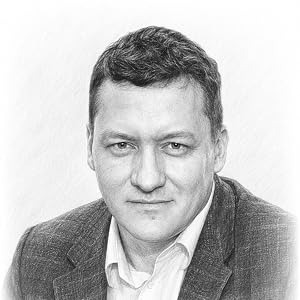
Dr. Valery Tsepkalo is Belarusian: a former diplomat, technology entrepreneur, and 2020 presidential candidate who fled Belarus for fear of arrest after being barred from the ballot, and who now lives in exile.2 Dmitry Bolkunets, also Belarusian, is a journalist and analyst known for VeloLiberty, a solo cycling journey across Europe undertaken in solidarity with Belarusian political prisoners.3 Their own histories of exile and reinvention on foreign soil sit close to the book's central theme — and, one might add, close to Gibran's own.

• ❧ KGC ❧ •
II
The book's seven-page list spans science and society (Nikola Tesla), government and military leadership (Henry Kissinger, Madeleine Albright), arts and popular culture (Irving Berlin, Charlie Chaplin, Arnold Schwarzenegger), and literature and philosophy (Hannah Arendt, Isaac Asimov), among many others. Ask ten people to choose 250 names from American history and no two lists would agree — a point worth keeping in mind for any inclusion a reader might question on this one.
• ❧ KGC ❧ •
III
Among the 250 names is the writer and painter our website is devoted to: Kahlil Gibran. The authors have kindly given permission to reproduce their entry on him in full (pp. 438–439).
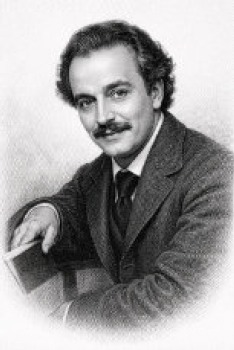
A note before you read on: the image accompanying Gibran's entry in the book is not a photograph. It is an AI-generated image the authors commissioned, based on a well-known photograph of Gibran taken around 1913. We include it here exactly as the authors used it, with that disclosed plainly rather than presented as an archival portrait.
Writer, poet, and visual artist
Birth name: Gibran Khalil Gibran
Born: January 6, 1883, Bsharri, Ottoman Empire (now Lebanon)
Died: April 10, 1931, New York City, New York, United StatesWhen The Prophet appeared in October 1923, it drew almost no notice. In its first year the book sold barely twelve hundred copies, a commercial footnote from a small poetry press. Kahlil Gibran had spent nearly a decade writing and revising it, working in a one-room studio in Greenwich Village on a manuscript addressed to no particular audience, and by the ordinary measures of publishing it looked, in 1923, like a quiet failure. It would go on to sell past one hundred million copies in more than one hundred languages, becoming one of the bestselling books ever published in the United States and turning its author into an enduring fixture of American shelves, weddings, and funerals.
Gibran was born Gibran Khalil Gibran on January 6, 1883, in Bsharri, a Maronite Christian village in the Mount Lebanon Mutasarrifate, then an autonomous Ottoman district set above the Qadisha Valley. His father worked as a tax collector until Ottoman authorities imprisoned him for embezzlement and confiscated the family's property, leaving his mother Kamila, daughter of a Maronite priest, to support four children largely alone. In 1895, with her husband remaining behind, Kamila took Gibran and his three younger siblings to Boston, joining the city's growing Syrian and Lebanese community. Gibran arrived at twelve speaking no English; a settlement house teacher, unable to fit Jubran Khalil Jubran onto an enrollment card, wrote down Kahlil Gibran instead, and the anglicized name stuck for life.
A local art teacher noticed his drawing and introduced him, at thirteen, to the Boston photographer and publisher Fred Holland Day, who called him a natural genius and drew him into a circle of writers and artists far beyond what a seamstress's son should have expected to reach. At fifteen his mother sent him back to Beirut to study Arabic literature at a Maronite college. He returned in 1902 to catastrophe: within about a year his half-brother, his younger sister, and then his mother all died, of tuberculosis and cancer, leaving Gibran and one surviving sister to support each other on her wages. At a Boston exhibition of his drawings in 1904, he met Mary Haskell, a school headmistress a decade his senior, who became his patron, editor, and closest correspondent for the rest of his working life, funding his study at the Académie Julian in Paris in 1908, where the sculptor Auguste Rodin reportedly called him the William Blake of the twentieth century.
Haskell's support carried him to New York in 1911, where he settled into a one-room Greenwich Village studio he called the Hermitage and began writing in English as well as Arabic, positioning himself at the center of an emerging Arab American literary culture with no real precedent in the country before him. His early Arabic works, including the 1908 novella Spirits Rebellious, had already made him one of the Mahjar movement's leading voices — immigrant Arab writers using the language of exile to challenge the conservatism of the homeland they had left — and in 1920 he helped found the Pen League, a New York–based society that made the city a new center of modern Arabic letters. In 1918 Alfred Knopf published The Madman, parables and aphorisms illustrated with Gibran's own drawings, followed by The Forerunner in 1920 and, finally, The Prophet in 1923, twenty-six poetic essays delivered by a fictional exile named Almustafa on love, marriage, work, and death, written in an English shaped as much by the King James Bible and William Blake as by Gibran's own Arabic prose poetry.
Gibran wrote for readers who wanted spiritual language stripped of denominational machinery, blending the Maronite Christianity of his childhood with Sufi mysticism, Blake's prophetic visions, and Walt Whitman's democratic expansiveness into a voice that asked to be read rather than believed, giving American readers a vocabulary for spirituality outside organized religion decades before that vocabulary became common. Critics who prized the cool irony of Eliot and the terse realism of Hemingway dismissed him as a sentimentalist, and for decades American literary history largely agreed. Readers ignored the verdict. The Prophet found a second life in the 1960s counterculture, its chapters on children, work, and death read at weddings and passed hand to hand, helping define the modern American market for inspirational literature, a category publishers still devote entire shelves to today.
Gibran never became an American citizen, unwilling to fully relinquish the Lebanon he had left as a child, though he willed all future American royalties from his books to Bsharri for what he called civic betterment, a bequest so large it triggered decades of dispute in his home village before the Lebanese government settled it. His fusion of Arabic and English literary traditions shaped modern Arab American writing and gave the country a shelf of inspirational literature that had not existed before The Prophet. Decades later, a young American senator drew on the rhetorical structure of one of Gibran's own essays in a line that would help define his political career — the long-running "ask not" connection between John F. Kennedy's 1961 inaugural address and Gibran's own writing.4
Thank you to Dr. Tsepkalo and Mr. Bolkunets for reaching out to the Kahlil Gibran Collective, and for their generosity in letting us reproduce this entry in full. That the authors of a book on this scale thought to contact us directly means a great deal — it tells us that the work we do here continues to matter.
❁
1 Valery Tsepkalo and Dmitry Bolkunets, From the World to America: 250 People Who Shaped the United States, 250th Anniversary Edition, independently published, 31 July 2026. Amazon listing. ↩
2 Author biography, Amazon author page; see also contemporaneous reporting on Tsepkalo's 2020 departure from Belarus, e.g. Washington Post and Euronews, July 2020. ↩
3 Author biography, Amazon author page; VeloLiberty project details at bolkunets.org. ↩
4 For the full history of this claim, see Glen Kalem-Habib, "The 'Ask Not' Controversy: Linking John F. Kennedy (JFK) with Kahlil Gibran," Kahlil Gibran Collective. ↩
All Rights Reserved © Copyright Philippe Maryssael 2026