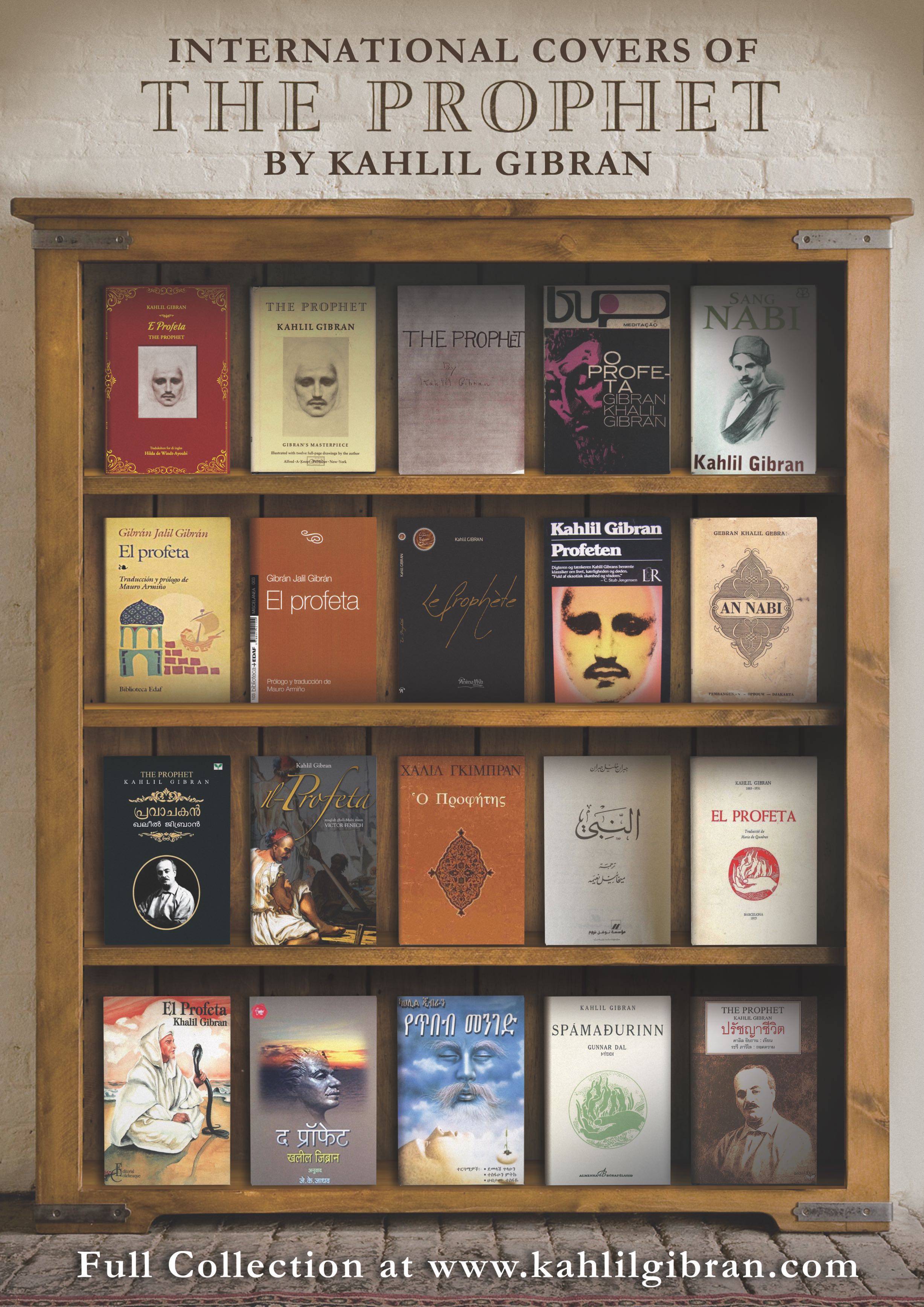
Asked to verify how many times The Prophet had been translated, Glen Kalem-Habib and Francesco Medici went looking. The accepted figure was forty to sixty. What they found, language by language and library by library, was more than a hundred — enough to place Gibran's book among the ten most translated works in history, and the only book of prose poetry on that list.
By Glen Kalem-Habib · Research with Francesco Medici
• ❧ KGC ❧ •
KAHLIL GIBRAN COLLECTIVE
By Glen Kalem-Habib · Kahlil Gibran Collective · 2018 · kahlilgibran.com
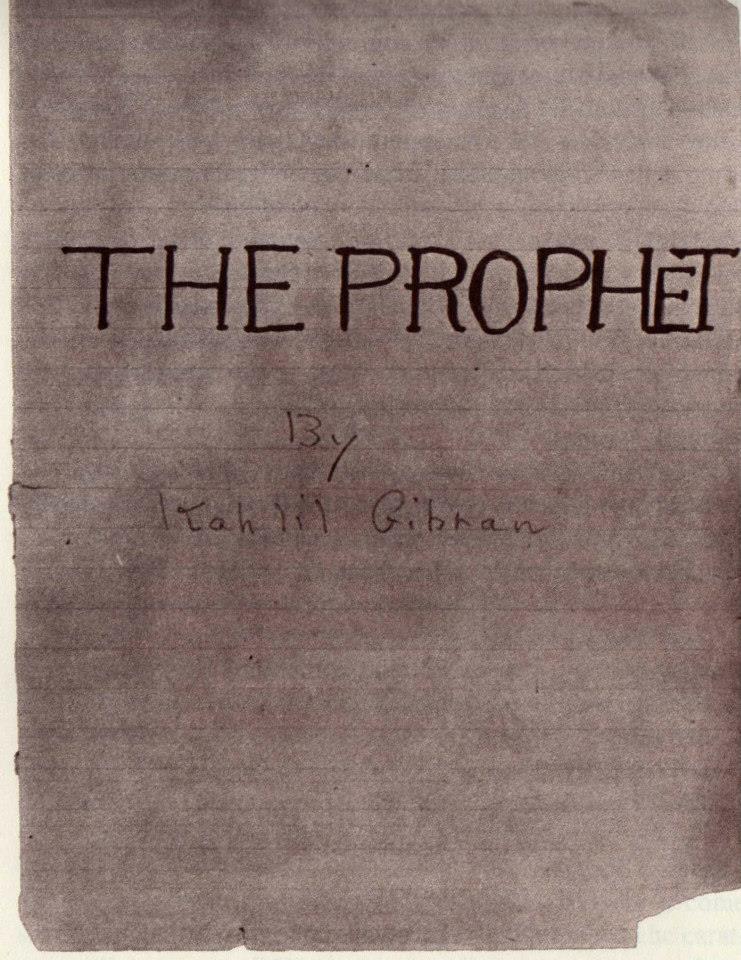
I have come to say a word… but if death prevents my word the book of eternity will not leave a word unspoken. What I do today in my solitude will be echoed tomorrow by the multitude.
— Kahlil Gibran
Update, 4 September 2018: four further translations discovered — see The Prophet Translated: Four New Translations Found. The study has since been carried much further; the current count stands at 117 languages — see Still Speaking: The Prophet at 117 Languages.
• ❧ KGC ❧ •
I
Not long ago I was asked to verify the official number of translations of Kahlil Gibran's crowning jewel, The Prophet. This was not the first request of its kind, but it came at a serendipitous time, when the right partner — my fellow researcher Francesco Medici — and the right tools and information were aligned in such a way as to provide both the desire and the motivation for the undertaking. What we found was no less than awe-inspiring.
For years Gibran scholars have either grappled with conducting such an in-depth study or relied on unscientific figures published by Gibran enthusiasts. As I have mentioned in previous articles, this discrepancy is likely also due to the lack of focused international research and study associated with the author himself. The earlier uncertainty surrounding his work can be traced all the way back to his publisher, Alfred A. Knopf, who once said of Gibran's work: "It must be a cult, but I have never met any of its members. I haven't met five people who ever read Gibran… I never understood him." The result is that over the ninety-five years since The Prophet was published in 1923, worldwide translation numbers have never been accurately recorded. Current estimates remain at around forty to sixty2 — nowhere near enough to place it on existing lists of the most translated books of all time.3
This is why a handful of researchers, myself among them, have long lobbied for reliable, fact-based studies that would finally give concrete ground to the widely recognised claim that Gibran is one of the most read poets in history. On completion of our initial research, we are pleased to announce our finding: Kahlil Gibran's The Prophet has been translated more than a hundred times, placing it among the ten most translated books in history.
• ❧ KGC ❧ •
II
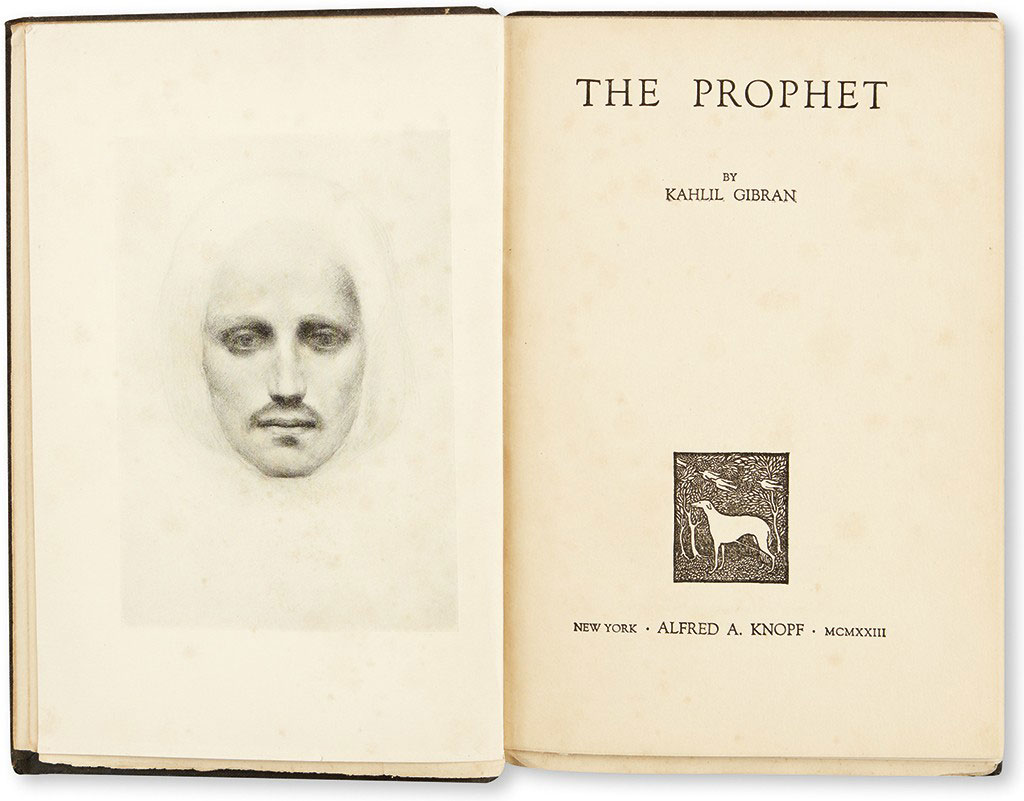
To put the book and our research into perspective, consider the publishing and translation numbers that stood before this study. According to its publisher, The Prophet, first published in 1923, has been reprinted an astonishing 188 consecutive times in ninety-five years, making it one of the longest-running of any published work, with an estimated worldwide readership of 100 million. I say "estimated" because some countries — parts of Southeast Asia, for example — have not adhered to copyright law, and readership there may be far more widespread than we think. These are among the regions where I have found Gibran's readership growing in large numbers, with no sign of slowing: China alone has at least fifteen full or partial translations of The Prophet.
This study also coincides with the end of the publisher's worldwide copyright privileges, and we wanted the current number officially on the record before that happened. After ninety-five years, Alfred A. Knopf — now part of Penguin Random House — would no longer hold copyright authority over the original English works from the end of 2018. From January 2019 we can expect to see many more iterations of The Prophet and related material around the world: an exciting prospect indeed.
• ❧ KGC ❧ •
III
My colleague and fellow Gibran researcher Francesco Medici and I always knew Gibran's readership was larger than estimated, and so we began our search by tapping into online library archives and our international networks. What we found has far exceeded our expectations, and surprised even those who thought they knew all there was to know about Gibran.
To our knowledge, no such comprehensive study had been conducted until now, at least not by an academic or private institution. This study has not analysed each translation in detail, and the debate over the authenticity of each individual text is a study in itself. We have simply tallied and collated to reach a base number of available texts, from which there is a solid foundation to build upon.
All translations here were counted on first editions only, and we have verified each listed work by citing at least the writer and publisher of the text. We did not, however, have the capacity to review the full contents of each work individually, nor to test the accuracy of the poetic message and how that relates back to the virtue of the original. It is also difficult to tell whether the translators worked from the original English or from some other language. In summary, we focused solely on the existence and authenticity of the publication itself.
We began at the Kahlil Gibran Museum in Lebanon under the guidance of Mr. Joe Jaja, who sent us a list of forty-nine translations from the museum's private collection. Building on that official list, we verified each copy and quickly added a further four, bringing the number to fifty-three — still within the publicly available range of forty to sixty.
Digging further, Francesco and I emailed our shared file back and forth in what became a daily ritual. "The List," as we came to call it, was growing rapidly. To see The Prophet translated into languages as obscure as Assamese, Occitan, and Uyghur — and even into constructed ones such as Kotava — was astonishing.
As the research went on, the questions that kept coming to mind were: how many more are there, and in what part of the world are they to be found? When we broke the seventy mark we thought it was time to ring the bells, but the numbers kept coming, and week after week we found ourselves adding two, three, or five more.
"List update: 82! 86!" became typical email subject lines, and when we reached ninety confirmed translations we were both astonished. Naturally we wondered: could there be a hundred? Or more? Was it possible we would hit the magic milestone of three digits?
We edged closer and closer — a braille edition among the finds — and then, within reach of the target, we hit a lull. Both of us were out of research currency. After a couple of weeks with no updates it finally came, the email we had hoped for, affirming what no one had thought possible: 102 translations.
Astonished, amazed, and plain bewildered, we both knew we had found something extraordinary — something that would open a new frontier for Gibran's chef-d'œuvre. The official total to date now sits at 104, a number no one could have guessed, not even the most ardent Gibran reader.
As the weeks went by, I began to wonder where this placed The Prophet in the rankings of the most translated books. The answer: according to existing lists, at 104 translations it sits at number ten, just behind the Book of Mormon. More striking still, it is the only book of prose poetry to hold a top-ten position.
• ❧ KGC ❧ •
IV
This discovery is only the beginning. We have included first editions only, and have reason to believe the overall number could exceed two hundred: we know of thirteen to fifteen editions in China alone, another fifteen to twenty in France, and so on.
Remembering how profoundly The Prophet influenced my own life and work, it is deeply touching to be able to share the full extent of Gibran's impact on different generations and cultures around the world. That a book with little to no promotional support across ninety-five years should reach such a readership is remarkable — especially measured against works backed by multi-million-dollar marketing campaigns.
This study remains in progress as we expand beyond first editions. All updates and further announcements are published here at kahlilgibran.com.
• ❧ KGC ❧ •
V
Translations of The Prophet — first editions
| # | Language /Dialect |
Title | Publisher | Place of Publication |
Editor | Copyright Date |
Edition | Translator(s) | Cover Type |
Pages | Notes |
| 1 | Afrikaans | Die profeet | J.L. Van Schaik | Pretoria | 1955 | 1st | Louis Fourie | 104 | |||
| 2 | Albanian | Profeti | Botimet Toena | Tirana | 2003 | 1st | Maksim Rakipaj | 71 | |||
| 3 | Alsatian | De Prophet | Atelier de Promotion de l'Alsacien | Zinswiller (France) | Fouad Alzouheir | 2013 | 1st | APECM | 130 | ||
| 4 | Amharic | YeTibeb Meniged (Nebiyu) | Commercial Publishing Enterprise | Addis Ababa (Ethiopia) | 2011 | 1st | Demelash Tiulahun, Tesfahun Mitiku, Habitamu Tesfaye | 192 | |||
| 5 | Arabic (Egypt) | al-Nabī | al-Maṭbaʻah al-Raḥmānīyah bi-Miṣr | Cairo | Antūniyūs Bashīr | 1926 | 1st | Antūniyūs Bashīr | 120 | ||
| 6 | Arabic (England) | al-Nabī | Elan Publications[?] | London | 2016 | 1st | Jamīl al-ʿĀbid | 115 | |||
| 7 | Arabic (Lebanon) | al-Nabī | Mu'assasat Nawfal | Beirut | Mikhail Naimy | 1956 | 1st | Mikhail Naimy | 108 | ||
| 8 | Armenian (Eastern) | Margarēn | Lebanese Embassy of Armenia | Yerevan | 2008 | 1st | Hovik Yordekian | 70 | |||
| 9 | Armenian (Western) | Margarēn | Tparan Kat̕oġikosowt̕ean Hayoc̕ Meçi Tann Kilikioy | Antelias (Lebanon) | Vahe-Vahian (Sarkis Abdalian) | 1983 | 1st | Vahe-Vahian (Sarkis Abdalian) | 103 | ||
| 10 | Assamese | Propheṭa | Natuna Asama | Guwahati (India) | 1994 | 1st | Jyotiprasād Śaikīẏā | 71 | |||
| 11 | Azerbaijani | Peyğəmbər | Qanun | Baku | 2014 | 1st | S. Bulut | 104 | |||
| 12 | Bahsa Aceh [Acehnese] | ??? | 1st | ||||||||
| 13 | Bangla | The Prophet | Ahmed Mahmudul Haque of Mowla Brothers | Dhaka, Bangladesh | 2009 | 1st | Chowdury Mushtaq Ahmed | 112 | |||
| 14 | Basque | Profeta | Arantzazu | Arantzazu (Basque Country) | 2008 | 1st | Patxi Ezkiaga | ||||
| 15 | Bengali | Dya prapheṭa | Amr̥taloka Sāhitya Parishada | Midnapore, India | 1993 | 1st | Ajita Miśra | 84 | |||
| 16 | Berber | Amusnaw | L'Harmattan | Paris | Youcef Allioui | 2014 | 1st | Youcef Allioui | 122 | ||
| 17 | Bikol | An Profeta | Ina Nin Bikol Foundation | Naga City | Bernie Faustine D. Brijueg | 2013 | 1st | Fr. Wilmer Joseph S. Tria | |||
| 18 | Bulgarian | Prorokŭt | Kibea | Sofia | 1997 | 1st | Maya Tzenova | ||||
| 19 | Cebuan | Ang Propeta | Sun Star Pub. | Cebu City (Philippines) | 2009 | 1st | Jesus "Sonny" Garcia, Jr. | 138 | |||
| 20 | Croatian | Prorok | GZH | Zagreb | 1985 | 1st | Marko Grcic | Paperback | |||
| 21 | Croatian | Prorok | GZH | Zagreb | 1985 | 1st | Marko Grcic | Paperback | |||
| 22 | Czech | Prorok | Prota: Ludvík Souček [distributor] | Prague | 1932 | 1st | Oldřich Hlaváč | ||||
| 23 | Danish | Profeten | Lindhardt og Ringhof | Copenhagen | 1987 | 1st | Per Thorrell | ||||
| 24 | Dutch (Belgium) | De profeet | De Nederlandsche Boekhandel | Kapellen | 1977 | 1st | Carolus Verhulst | 120 | |||
| 25 | Dutch (Netherlands) | De profeet | ? | The Hague | 1927 | 1st | Liesbeth Valckenier-Suringar | 98 | |||
| 26 | English (Braille) | The Prophet | Division for the Blind and Physically Handicapped | Washington, D.C. (USA) | 1951 | 1st | |||||
| 27 | Esperanto (artificial language) | La Profeto | Eldonejo Stafeto - Juan Régulo Pérez | [San Cristóbal de] La Laguna, Tenerife, Canary Islands (Spain) | Elías F. Shamon | 1962 | 1st | Roan Orloff-Stone | 127 | ||
| 28 | Estonian | Prohvet | Huma | Tallinn | 1997 | 1st | Doris Kareva | 94 | |||
| 29 | Faroese | Profeturin | Marna | Tórshavn, Faroe Islands (Denmark) | 1986 | 1st | Hans J. Glerfoss | 110 | |||
| 30 | Filipino | Ang Propeta | Vertex | Manila | 1975 | 1st | Felicidad Sagalongos-San Luis | ||||
| 31 | Finnish | Profeetta | Karisto | Hämeenlinna | 1968 | 1st | Annikki Setälä | ||||
| 32 | French - Multilanguage (Andorra) | Le Prophète | AnimaViva Multilingüe | Andorra la Vella | 2016 | 1st | ? | ||||
| 33 | French (Belgium) | Le Prophète | Edition universelle | Bruxelles | Marcel Lobet | 1943 | 1st | Marcel Lobet | 89 | ||
| 34 | French (Canada) | Le prophète | Éditions de Mortagne | Boucherville [Québec] | 1983 | 1st | Paul Kinnet | 108 | |||
| 35 | French (France) | Le Prophète | Éd. du Sagittaire | Paris | 1926 | 1st | Madeline Mason-Manheim | 125 | |||
| 36 | French (Switzerland) | Le prophète | Idegraf | Switzerland | 1985 | 1st | Michael La Chance | 91 | Cette édition hors commerce a été réservée aux souscripteurs | ||
| 37 | German (Austria) | Der Prophet | Buchgemeinschaft Donauland | Vienna | 1987 | 1st | Karin Graf | 128 | |||
| 38 | German (Germany) | Der Prophet | Hyperion | Munich | 1925 | 1st | Georg-Eduard Freiherr von Stietencron | ||||
| 39 | German (Switzerland) | Der Prophet | Walter | Olten | 1984 | 1st | Ursula Assaf-Nowak | 72 | |||
| 40 | Greek | O Profetes | C. Stavrakakis | Athens | 1960 | 1st | Giannis Papadakis | 109 | |||
| 41 | Gujarati | Viday Velakhe | Navjivan Prakashan Mandir | Ahmedabad (Gujarat, India) | 2013 | 1st | Kishore Mashruwala | 105 | |||
| 42 | Hebrew | ha-Navi | Hotsaʼat Tamuz | Tel Aviv | 1975 | 1st | Noʻah Zalud | 83 | |||
| 43 | Hindi | Paigambar | Hind Pocket Books | New Delhi | 2009 | 1st | Nilima Singh | 129 | |||
| 44 | Hungarian | A próféta | Édesvíz | Budapest | 1992 | 1st | Révbíró Tamás | Paperback | |||
| 45 | Icelandic | Spámaðurinn | Almenna bókafélagið | Reykjavík | 1958 | 1st | Gunnar Dal | 103 | |||
| 46 | Indonesian | An Nabi | Pembangunan Opbouw | Jakarta | I. Annaury | 1949 | 1st | Bahrum Rangkuti | Paperback | 100 | |
| 47 | Isi Xhosa (Xhosa) | Umprofethi | Pooka | Plettenberg Bay (South Africa) | Z. Mtumane | 2007 | 1st | Koliswa Moropa | 133 | ||
| 48 | Italian | Il profeta | Gino Carabba | Lanciano (Chieti) | Augusto Mancini | 1936 | 1st | Eirene Niosi-Risos | 123 | ||
| 49 | Japanese | Purofeeto (Yogensha) | Goma Shobo | Tokyo | 1972 | 1st | Kobayashi Kaoru | ||||
| 50 | Kabyle | Nnbi | Laphomic | Algiers | 1991 | 1st | Farid Abac | 75 | |||
| 51 | Kannada | Pravādi | Ānanda Granthamālā | Hubli, India | 1953 | 1st | Dēsāyi Dattamūrti | 99 | |||
| 52 | Korean | Sŏnjija | Han'guk Kidokkyo Munhwawŏn | Seoul | 1978 | 1st | Han Il-san | 217 | |||
| 53 | Kotava (artificial language) | Katcilik | Kotavaxak dem Suterot | ? | 2015 | 1st | Staren Fetcey | 70 | |||
| 54 | Kurdish | Peyamber | Helwest | Stockholm | 2001 | 1st | Husein Muhammed | ||||
| 55 | Latvian | Pravietis | Greenwood Printers | Toronto | 1975 | 1st | Ingridas Vīksnas | 89 | |||
| 56 | Lithuanian | Pranašas | Asveja | Vilnius | 1998 | 1st | Zigmas Ardickas | ||||
| 57 | Lombard (Italian Dialect) | El Profeta | Menaresta | Monza | 2015 | 1st | Marc Tamburell (Marco Tamburelli) | ||||
| 58 | Macedonian | Prorokot | Kultura | Skopje | K. Fidanovski | 1993 | 1st | G. Petreski | |||
| 59 | Malay | Sang Nabi | Pustaka Jaya | Jakarta | 1981 | 1st | Iwan Nurdaya Djafar? | 132 | |||
| 60 | Malayalam | Pravācakan | Janatā Buksṭāl | Kochi (India) | 1983 | 1st | Je. Akkanatt | 102 | |||
| 61 | Maltese | Il-profeta | Klabb Kotba Maltin | Sta Venera [Malta] | 2008 | 1st | Victor Fenech | ||||
| 62 | Marathi | da prophet (Paigambar) | Saket | Aurangabad, India | 2009 | 1st | J. K. Jadhav | 100 | |||
| 63 | Nepali | Guru | Ṭrānsa Riprinṭa | Kathmandu | [2005-2009?] | 1st | Netra Ācārya; Pushpa Ācārya | 119 | |||
| 64 | Northern Sotho | Moprofeta | Ad Donker | Johannesburg | 1983 | 1st | Maje S Serudu | 122 | |||
| 65 | Norwegian | Profeten | Gyldendal | Oslo | 1967 | 1st | Helge Hagerup | ||||
| 66 | Norwegian (Bokmål) | Profeten | Gyldendal | Oslo | 1967 | 1st | Helge Hagerup | ||||
| 67 | Norwegian (Nynorsk) | Profeten | Kolofon | Oslo | 2017 | 1st | Sondre Bratland | ||||
| 68 | Occitan (Provençal dialect) | Alora una frema… | Publié dans Oc, No 51 | France [?] | 1999 | 1st | Joan-Glaudi Babois; Reinat Toscano | 31 | Extrait of "The prophet" | ||
| 69 | Papiamento | E Profeta | University Press of Maryland | Bethesda (Maryland, USA) | Suheil Bushrui | 2013 | 1st | Hilda de Windt-Ayoubi | 113 | ||
| 70 | Pashto | Haghạh wuwel (He said) | Da Paṣhto Ṭolane da Kābul Mujille liʼkhwā | Kabul, Afghanistan | 1957 (1336) | 1st | ʻAzīz al-Raḥmān Sayfī | 101 | |||
| 71 | Persian | Payāmbar | Taban | Tehran | 1962 (1341) | 1st | Mostafa Alam | 106 | |||
| 72 | Polish | Prorok | Cedr i Orzel | Beirut | 1954 | 1st | Wandy Dynowskiej | 98 | |||
| 73 | Portuguese (Brazil) | O Profeta | Biblioteca Universal Popular | Rio de Janeiro | 1963 | 1st | Mansour Yousef Challita | 116 | |||
| 74 | Portuguese (Portugal) | O profeta | Editorial A.O. | Braga | 1978 | 1st | Manuel Simões | ||||
| 75 | Punjabi | Paighambar | Panjabi University | Patiala | 1999 | 1st | Guninder Singh | ||||
| 76 | Romani | A próféta / O platniko (in "Vesho műfordítások") | Budapesti Montessori Társaság | Budapest | 2000 | 1st | Zoltán Vesho-Farkas | 257 | |||
| 77 | Romanian | Profetul | Orion | Bucarest | 1991 | 1st | Radu Cârneci | ||||
| 78 | Russian | Prorok | Raduga | Moscow | I. Zotikova | 1989 | 1st | Igor Alekseyevich Zotikov | |||
| 79 | Serbian | Prorok | D. Andrić | Belgrade | 1995 | 1st | Dragoslav Andric | 117 | |||
| 80 | Sesotho (Southern Sotho) | Moprofeta | Pooka | Plettenberg Bay (South Africa) | N.B. Sekere | 2007 | 1st | Moruti W. Tšiu | |||
| 81 | Setswana (Tswana) | Moporofeti | Pooka | Plettenberg Bay (South Africa) | M.R. Malope | 2007 | 1st | Phaladi M. Sebate | |||
| 82 | Sinhala | Divasiya | Godage | Colombo | 2004 | 1st | Wimalasena Vithanapathirana | ||||
| 83 | Slovak | Prorok | Tatran | Bratislava | 1971 | 1st | Eduard V. Tvarozek | ||||
| 84 | Slovenian | Prerok | Župnijski urad sv. Magdalene | Ljubljana [i. e.] Maribor [Slovenia] | 1978 | 1st | Lojze Bratina | ||||
| 85 | Spanish (Argentina) | El Profeta | L.J. Rosso | Buenos Aires | José E. Guraieb | 1933 | 1st | José E. Guraieb | 123 | ||
| 86 | Spanish (Chile) | El profeta | Nascimento | Santiago, Chile | Moises Mussa B. | 1932 | 1st | Moises Mussa B. | 174 | ||
| 87 | Spanish (Colombia) | El profeta | Editorial Tolima | Ibagué | 195-? | 1st | Antonio Chalita Sfair | 135 | |||
| 88 | Spanish (Mexico) | El Profeta | Imprenta Mundial | Mexico City | Leonardo Shafik Kaim | 1934 | 1st | Leonardo Shafik Kaim | 150 | ||
| 89 | Spanish (Peru) | El profeta | Tall. Gráf. P.L. Villanueva | Lima | Max Silva Tuesta | 1967 | 1st | Carlos Alberto Seguín | 116 | ||
| 90 | Spanish (Spain) | El profeta | Altés | Barcelona | 1974 | 1st | Maria de Quadras | 91 | |||
| 91 | Spanish (Uruguay) | El profeta | Colicheuque | Montevideo | 1990 | 1st | ? | 78 | |||
| 92 | Swahili | Mtume | Tanzania Pub. House | Dar es Salaam, Tanzania | 1971 | 1st | Joseph R. Kotta | 58 | |||
| 93 | Swedish | Profeten | Natur o. kultur | Stockholm | 1933 | 1st | Olga Bergmann | 101 | |||
| 94 | Syriac (Iraq) | Enwīyā | Al-Mashriq Printing | Baghdad | 1998 | 1st | Youarish Haido; Robin Bet Shmuel | 96 | |||
| 95 | Syriac (Sweden) | Nbíyā | Ashurbanibal Bok-förlag | Jönköping (Sweden) | 2002 | 1st | ʻAbd Mšíḥā Naʻmaʼn Qarahbaš | 88 | |||
| 96 | Tagalog | Ang pantas | C & E Publishing | Quezon City, Philippines | 2011 | 1st | Ruth Elynia Mabanglo | 134 | |||
| 97 | Tamil | Tīrkkatarici | Cantiyā Patippakam | Chennai (Madras, India) | 2011 | 1st | Ca. Irācamāṇikkam | 103 | |||
| 98 | Telugu | Jeevana Geetha | Yuva Bharathi | Secunderabad (India) | 1968 | 1st | Kaloji Naryana Rao | ||||
| 99 | Thai | Pratchayā chīwit | Phiseux kar phimph | Bangkok | 1968 | 1st | Ravi Vila Wilai | 97 | |||
| 100 | Tigrinya | The Prophet | Mesfin Gebremedhin | Peterborough, England? | 2015 | 1st | Mesfin Gebremedhin | 98 | |||
| 101 | Turkish | Peygamber | Marmara Kitabevi | Istanbul | 1945 | 1st | Orhan Ercem | 70 | |||
| 102 | Ukranian | Prorok | Zhurnal «Vsesvit», nr. 1 | Kiev | 1995 | 1st | Pavlo Nasada | 88 | |||
| 103 | Urdu | Paigham-bar | Ma'arifat | Pakistan? | 1961 (1340) | 1st | Salih Zada | ||||
| 104 | Uyghur | Danishmăn: năsriy sheirlar | Qăshqăr Uighur Năshriyati | Kashgar, China | 2001 | 1st | ? | 173 | |||
| 105 | Vietnamese | Nhà tiên tri | Nxb Hội nhà văn | Vietnam? | Châu Diên | 1994 | 1st | Châu Diên | 162 | ||
| 106 | Xitsonga (Tsonga) | Muprofeta | Pooka | Plettenberg Bay (South Africa) | P.H. Nkuna | 2007 | 1st | Ximbani E. Mabaso | 141 | ||
| 107 | Yiddish | Der Novi | Yatshkovski's Biblyotek | Warsaw - New York | 1929 | 1st | Isaac Horowitz | 96 | |||
| 108 | Zulu | Umpholofithi | Ad Donker | Johannesburg | 1983 | 1st | DBZ Ntuli | 122 |
❁
1 Research and study by Glen Kalem-Habib and Francesco Medici.
2 BBC News Magazine, "Kahlil Gibran's The Prophet: Why is it so loved?" ↩
3 ING Co. International, "The 20 Most Translated Texts in History." ↩
4 A previous version of this article appeared in the Lebanese American University's publication Gibran in the 21st Century: Lebanon's Gift to the World.
All Rights Reserved © Copyright Glen Kalem-Habib and kahlilgibran.com 2019