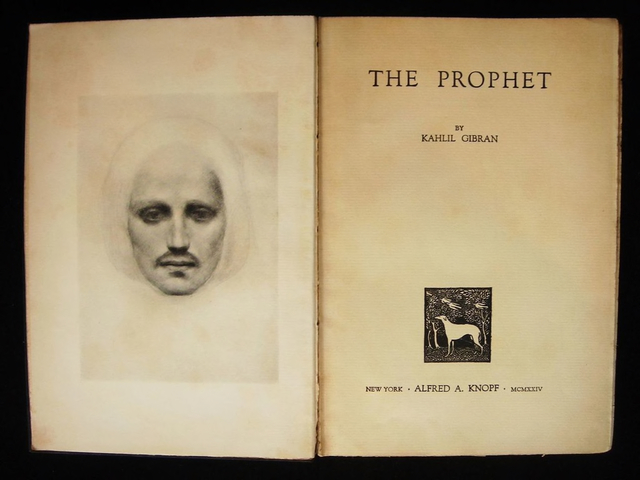
On 1 January 2019, after ninety-five years and 188 consecutive print runs — the longest unbroken run in publishing history — Kahlil Gibran's The Prophet entered the public domain.
By Glen Kalem-Habib
• ❧ KGC ❧ •
KAHLIL GIBRAN COLLECTIVE
By Glen Kalem-Habib · Kahlil Gibran Collective · 2019 · kahlilgibran.com
• ❧ KGC ❧ •
I
Just shy of twenty thousand words, philosophical in nature and mystical in tone, The Prophet was first published in September 1923 at $2.25 a copy and sold out its modest print run of 1,300 within the first month. The reception surprised even its publisher, Alfred A. Knopf, who reflected some years later that its readers must be "a cult, but I have never met any of its members. I haven't met five people who ever read Gibran." Today The Prophet is arguably one of the Western world's first self-help books, with United States sales alone numbering over ten million copies, and it has inspired countless later works — among them M. Scott Peck's The Road Less Traveled and Paulo Coelho's The Alchemist.
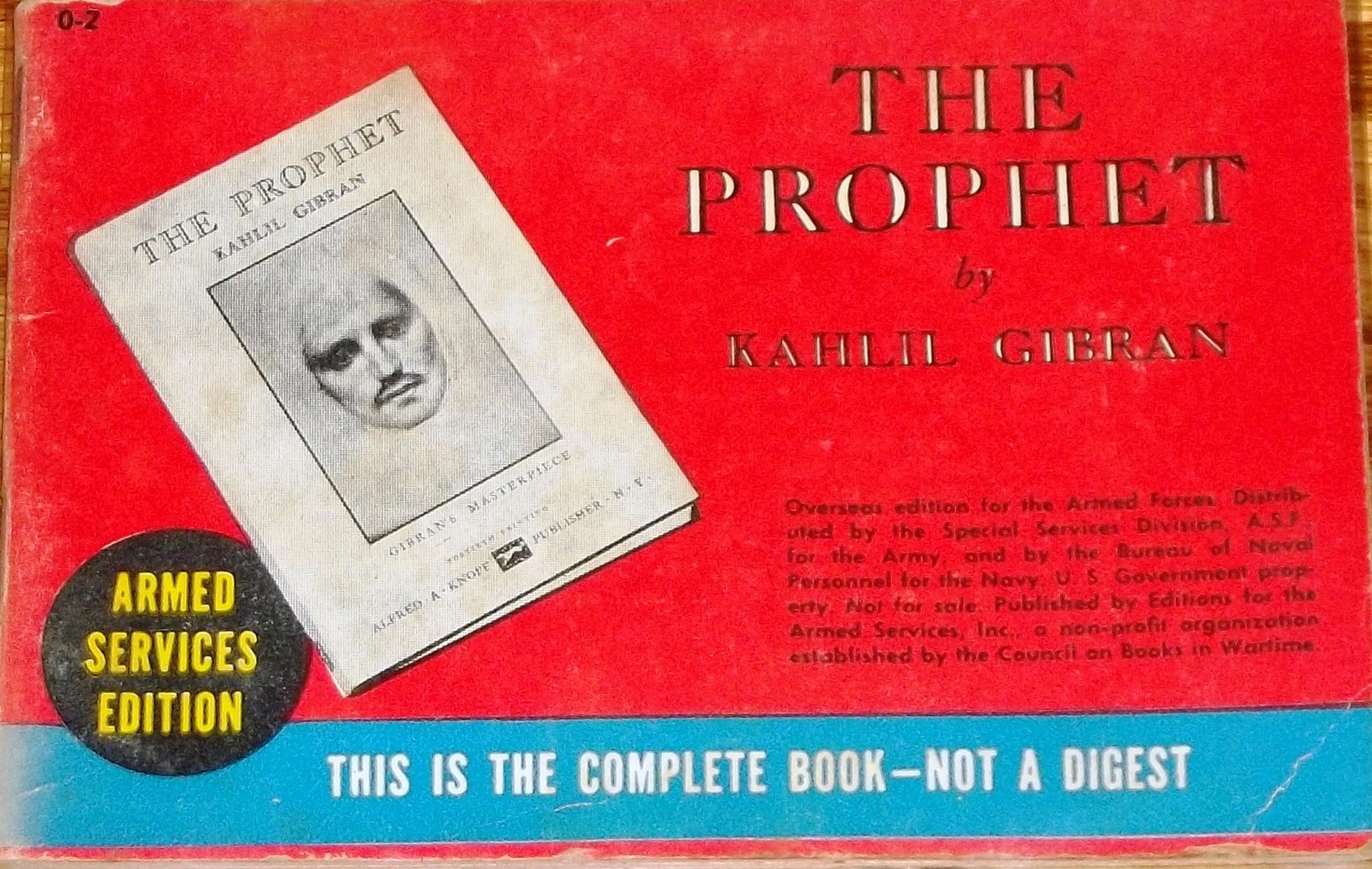
Released not long after the First World War, its message resonated quickly with a grieving world. Sales continued to climb, setting in motion a trend that has continued steadily to the present day and may well be maintained for years to come. By the end of December 1937 the book had sold 129,233 copies, and during the darkness of the Second World War demand for its life-affirming message increased — so much so that when the United States government created the Council on Books in Wartime and established the Armed Services Editions — pocket-sized books for soldiers on the front lines — The Prophet was included. Out of 1,322 titles it was the only book of poetry selected. By 1957 it had sold its millionth copy and been translated into twenty languages, and had become one of the most widely distributed books of the century.
A study by Francesco Medici and Glen Kalem-Habib has since found that The Prophet has been translated into more than a hundred languages in first editions alone, making it unofficially one of the most translated books of all time. As the study broadens to include subsequent editions, the estimated tally could run as high as three or four hundred.
• ❧ KGC ❧ •
II
Kahlil Gibran (1883–1931) was a native of Mount Lebanon who migrated to Boston with his mother and three siblings in 1895, aged twelve. With no formal education and no English, Gibran was fortunate to have the help and encouragement of a "she-angel" — the educator, philanthropist, and traveller Mary Haskell-Minis. It would be remiss not to mention Mary's role in bringing Gibran's magnum opus to fruition. Her devotion, care, and love for the bilingual artist she supported financially can be traced as far back as 1912, when he told her of his determination to write in English and of his plans for the yet untitled "my book," built around the teachings of an island god in exile. It would take a full eleven years more to become the work we now know as The Prophet.
From June 1914 he sought her comments on most of his English output as it was written and rewritten: first The Madman, then The Forerunner, and finally The Prophet. Of the corrections she made to the galley proofs, Gibran wrote:
Your blessed touch makes every page dear to me. The punctuations, the added spaces, the change of expressions in some places, the changing of "Buts" to "Ands" and the dropping of several "Ands" — all these things are just right.
— Chapel Hill Papers
• ❧ KGC ❧ •
III
The Prophet — inspired by the vision of Blake, the Bible, Buddhism, Hinduism, the Romantics, popular American schools of thought, Ralph Waldo Emerson, Walt Whitman, Friedrich Nietzsche, Ameen Rihani, and Christian and Sufi mysticism — holds a particular place on the mantle of world literature, being neither pure poetry nor simple philosophy. It has graced the bookshelves of people from every walk of life and is undoubtedly one of the most gifted books in the world today. Chances are you will find a pre-loved copy in bookshops across the globe, and a quick search online will turn up thousands of second-hand copies, some carrying heartfelt dedications meant to inspire the next reader.
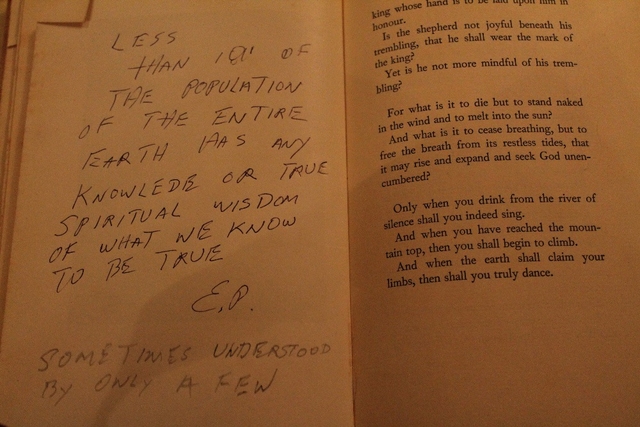
As a research historian of Gibran's life and legacy, I have for a number of years documented some of the more notable readers of The Prophet. A few years ago I had the opportunity to acquire Elvis Presley's first copy, inscribed with philosophical notes and reflections in the King's own hand. We also know that Eleanor Roosevelt, Johnny Cash, and Walt Disney made room on their shelves for Gibran — and so did figures as different as Aleister Crowley, Elijah Muhammad, Colin Powell, and Heath Ledger. Even prisoners at Guantanamo Bay were fond of the book; it was among the most frequently requested titles in the camp library.
Just why The Prophet has enjoyed such popularity is one of its beautiful mysteries. The late biographer and Gibran scholar Professor Suheil Bushrui, who founded the Kahlil Gibran Chair for Values and Peace at the University of Maryland, captured some of it:
In truth, The Prophet is a work of such universal appeal… For Gibran's purpose was a lofty one, and his belief in the "unity of being," which led him to call for universal fellowship and the unification of the human race, is a message which retains its potency today as do the messages of all great poets. Inspired by his experiences in a country far from the land of his origins, he strove to resolve cultural and human conflict, in the process developing a unique genre of writing, and transcending the barriers of East and West as few have done before or since. He became not only Gibran of Lebanon, but Gibran of America, indeed Gibran the voice of global consciousness: a voice which increasingly demands to be heard in the continuing Age of Anxiety.
Its vision, though, is best described by his she-angel, Mary Haskell-Minis, who on receiving her copy wrote to Gibran and — perhaps prophesying — captured what we now know to be its reality:
Beloved Kahlil, The Prophet came today… And the text is more beautiful, nearer, more revealing, more marvellous in conveying reality and in sweetening consciousness — than ever… The English, the style, the wording, the music — is exquisite, Kahlil — just sheerly beautiful… This book will be held as one of the treasures of English literature. And in our darkness, we will open it to find ourselves again and the heaven and earth within ourselves. Generations will not exhaust it, but instead, generation after generation will find in the book what they would fain be — and it will be better loved as men grow riper and riper. It is the most loving book ever written.
• ❧ KGC ❧ •
IV
Although today marks the end of the copyright road for The Prophet, its message still has a way to go. Even Gibran knew he had written only the "first letter" in a continuing story. Some publishers have already seen the new horizon, with houses such as Penguin describing "a tremendous opportunity to reintroduce old works." The former schoolteacher Helen Chiha and illustrator Yi Giang have collaborated to publish, as of today, the world's first Prophet for children: The Little Prophet — an attempt to bring in a younger readership, and to encourage parents to introduce the core values the older Prophet has carried for nearly a century.
❁
Glen Kalem-Habib is an international Kahlil Gibran research historian and filmmaker. Working closely with Gibran scholars and researchers globally, his aim is to establish and promote intercultural and interreligious dialogue, particularly in academia.
All Rights Reserved © Copyright Glen Kalem-Habib and kahlilgibran.com 2019