At the top of page 10 of the first edition of The Prophet, the sea is a "sleeping mother." In later printings she is "sleepless." Philippe Maryssael sets out to date the change, find its cause, and trace how a century of translators have handled it.
By Philippe Maryssael · Arlon, Belgium, 2 November 2019
• ❧ KGC ❧ •
KAHLIL GIBRAN COLLECTIVE
By Philippe Maryssael · Kahlil Gibran Collective · 2019 · kahlilgibran.com
Abstract
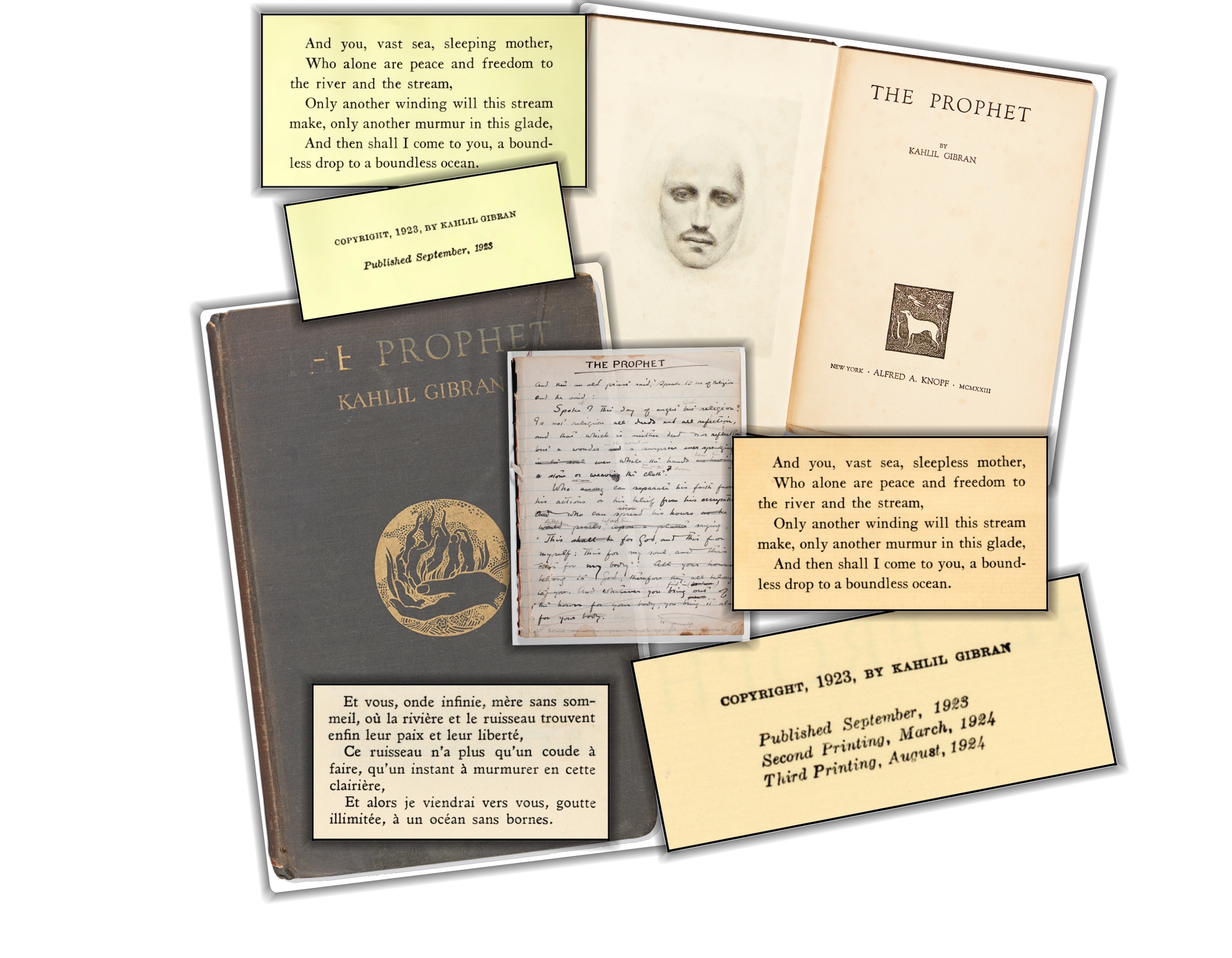
"And you, vast sea, sleeping mother": a six-word sentence at the top of page 10 of the first edition of Kahlil Gibran's The Prophet, published in 1923, was later changed to "And you, vast sea, sleepless mother."
The aim of this paper is to answer three questions: when did the change occur? Why did Gibran ask his publisher, Alfred Knopf, to change his text? And who could have influenced him to change it?
Also considered is which versions of the text were used by the men and women who, over time, translated Gibran's masterpiece into French — and into Dutch, Afrikaans and Italian.
• ❧ KGC ❧ •
I
On 23 September 1923, the New York publishing house founded in 1915 by Alfred Abraham Knopf and his wife Blanche published The Prophet, Gibran's third book in English. That book became his true masterpiece. In the ninety-five years between September 1923 and the end of 2018, Knopf — and subsequently Penguin Random House, which acquired the firm — released no fewer than 188 uninterrupted printings. According to some sources a mere 1,159 copies sold in the first year. Sales then doubled with every subsequent year, eventually reaching 240,000 in 1965. The Prophet became one of Knopf's most successful books,1 with total sales for the English text estimated at over ten million copies in the United States alone.
Working together for several years, Francesco Medici — the Italianist who translated several of Gibran's works into Italian, including Il Profeta in 2005 — and Glen Kalem-Habib, the Australian filmmaker and Gibran scholar who maintains the Kahlil Gibran Collective website,2 have established that Gibran's masterpiece has received no fewer than a hundred and eleven translations into different languages and countries.3 On 1 January 2019, after ninety-five years of copyright protection under United States law, the text entered the public domain.4
But back on 23 September 1923 Gibran held the first copy of his third English book in his hands, and a few days later, on 2 October, Mary Haskell — his closest friend and benefactress, who meticulously helped him correct and improve his text — received her own copy by post. That day she wrote to him:
Clarkesville, Georgia, October 2, 1923
Beloved Kahlil,
The Prophet came today, and it did more than realize my hopes. For it seemed in its compacted form to open further new doors of desire and imagination in me, and to create about itself the universe in nimbus, so that I read it as at the centre of all things. The format is excellent, and lets the ideas and the verse flow quite unhampered. The pictures make my heart jump when I see them. They are beautifully done. I like the book altogether in style.
And the text is more beautiful, nearer, more revealing, more marvellous in conveying Reality and in sweetening consciousness — than ever. The English, the style, the wording, the music — is exquisite, Kahlil — just sheerly beautiful. Bless you, bless you, bless you, for saying it all, and for being such a worker that you bring that inner life into form and expression — for having the energy and the patience of fire and air and water and rock.
This book will be held as one of the treasures of English literature. And in our darkness we will open it to find ourselves again and the heaven and earth within ourselves. Generations will not exhaust it, but instead, generation after generation will find in the book what they would fain be — and it will be better loved as men grow riper and riper.
It is the most loving book ever written. And it is because you are the greatest lover, who ever wrote… Goodbye, and God bless you most dearly, beloved Kahlil, and sing through your mouth more and more of his songs and yours. Love from Mary5
In Gibran's lifetime, twenty-five printings of the standard edition appeared: 23 September 1923; March and August 1924; January, May, September and December 1925; February, October and December 1926; April, July and December 1927; January, March, October and December 1928; February, July, September and December 1929; March, July and October 1930; and February 1931. A twenty-sixth followed in October 1931, the first posthumous printing.
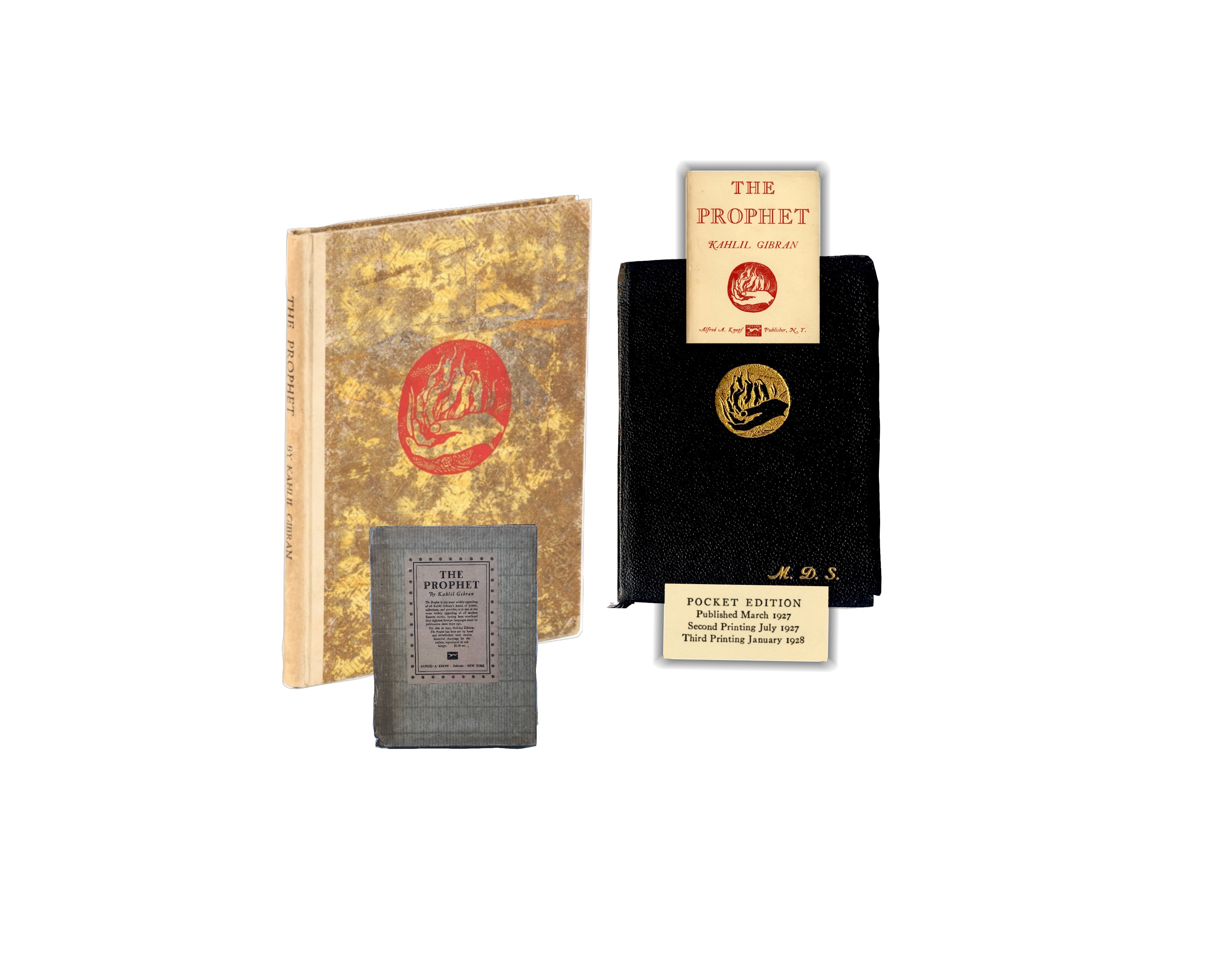
Besides the standard edition (15.5 × 22 cm), Knopf published two other formats: a holiday deluxe edition in a slipcase (21 × 27.5 cm) and a pocket edition (11.5 × 14.5 cm). Only one deluxe printing appeared in Gibran's lifetime, in November 1926, the second posthumously in October 1938. Seven pocket printings appeared in his lifetime, from March 1927 to September 1930, with an eighth in July 1931.
• ❧ KGC ❧ •
II
The very first foreign-language version of The Prophet was published in Munich in 1925 as Der Prophet, translated by Baron Georg-Eduard von Stietencron (1888–1974). Only 800 numbered copies are known to have been printed.6
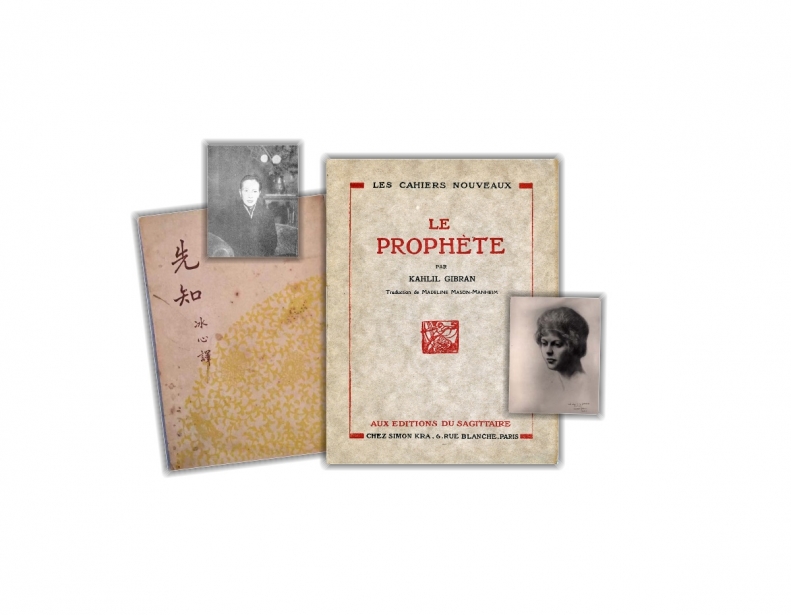
In 1926 two more appeared. The first was in Arabic, by the young Lebanese-born clergyman Antonios Bashir (1889–1966), later Orthodox Archbishop of New York and Metropolitan of All North America; his al-Nabī was published in Cairo. The second was in French, as Le Prophète, translated by a young American poet, then eighteen years old, named Madeline Mason (1908–1990). Only 750 numbered copies were printed — twenty-five on Japon paper and 725 on Vélin de Rives. Mason spent much of her childhood and adolescence in England and France, where her parents had homes, hence her excellent French. In the early 1920s Gibran drew a pencil portrait of her and they became close friends. A year before Le Prophète appeared in Paris, Mason published her first collection of poems in London, Hill Fragments, with reproductions of five drawings by Gibran.
The fourth translation was Dutch: De Profeet, published in The Hague in 1927, translated by Liesbeth Christina Valckenier-Suringar (1901–1956), a social worker and teacher from Amsterdam. Later came Yiddish — Der novi by Isaac Horowitz in 1929 — Chinese, Xiānzhī by Bing Xin in 1931, and Italian, Il Profeta by Eirene Niosi-Risos in 1936.
• ❧ KGC ❧ •
III
From the first printing up to the third, the sentence at the top of page 10 reads: "And you, vast sea, sleeping mother." When we acquired the twelfth printing we came upon the same sentence — and realised it was not the same sentence at all: it had become "And you, vast sea, sleepless mother." The first deluxe edition of November 1926 and the first pocket edition of March 1927 both carry the updated line.
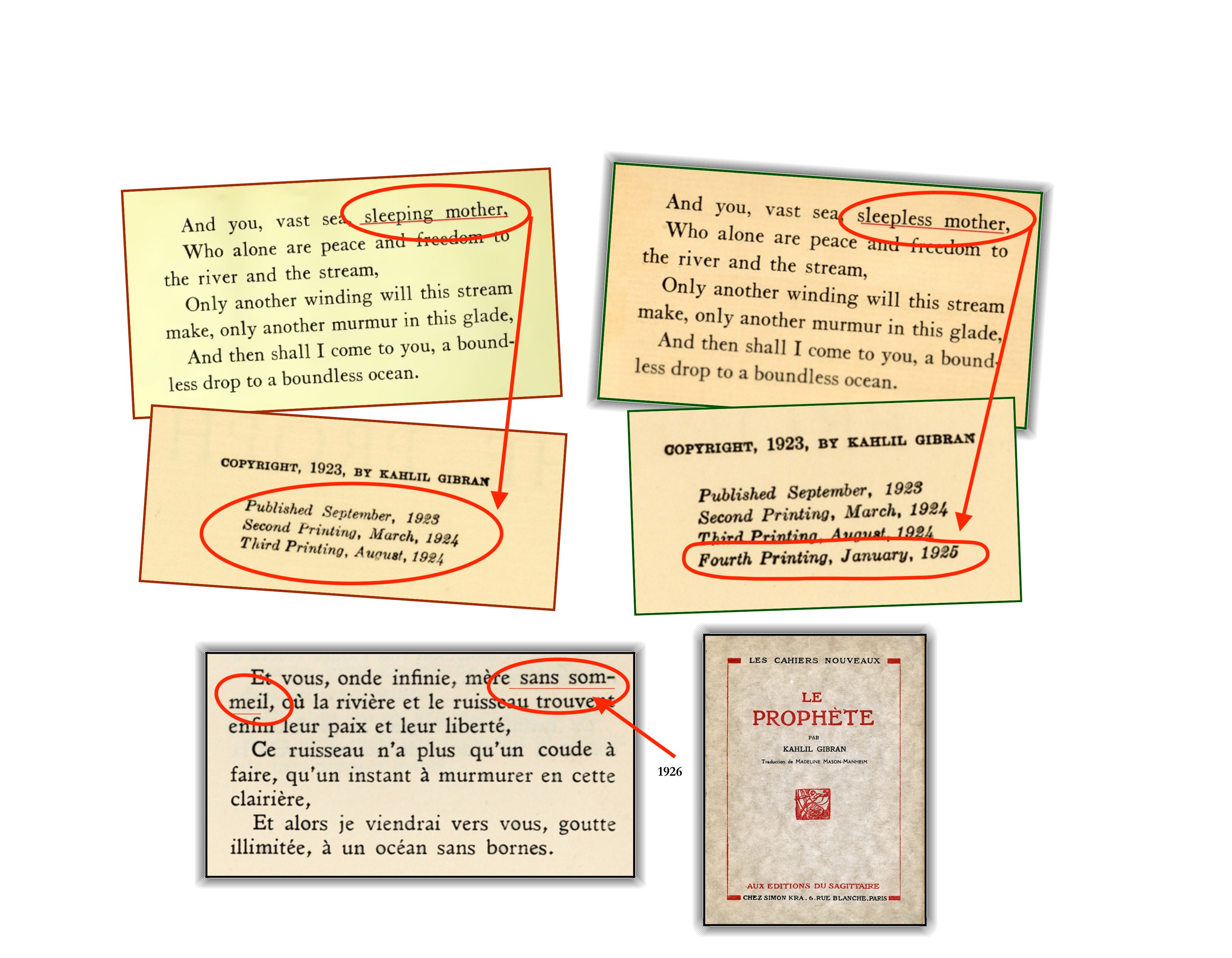
So between August 1924 (third printing of the standard edition) and November 1926 (deluxe edition), something happened that made Gibran want to change that sentence. Madeline Mason's Le Prophète of 1926 gives "Et vous, onde infinie, mère sans sommeil" — literally, "And you, boundless waters, sleepless mother." Considering that Madeline and Gibran were close friends, and that he was proficient in French, we may assume with fair certainty that the two of them reviewed her translation together. Most probably she translated the book in the course of 1924 and 1925, the same period in which her own collection was completed and prepared for publication, and during which she must have worked closely with Gibran on the drawings he let her use in Hill Fragments.
Could one of Madeline's poems have triggered in Gibran's mind the change from sleeping to sleepless? It is a hypothesis we believe highly plausible, though it cannot be confirmed, since neither of the protagonists is alive. One poem from Hill Fragments is titled "The Ocean," and it refers clearly to a restlessness that knows no pause.
THE OCEAN
O thou restless one,
What mighty urge is in thy bosom
That nor night nor day
Thy striving knoweth pause?
Thou toilest ever to outreach thy bounds;
Thou movest onward,
Though the shroud of Night
Lie heavy on thy breast;
And in the golden sun
Thou leapest merrily
To distant goals.
Earth fain would stay thee.
O, thou art merciless:
Thou woundest her
Until the bonds are rent
That hold thee.
And yet thou lovest her well.
But in thy longing for thine own fulfilment
Is thy passion,
And though thou bringest treasures
And with tender sighing
Layest them before her,
Yet art thou ever distant,
Lonely, unapproachable.
O thou restless one,
What mighty urge is in thy bosom
As down the timeless aisles of Space
Thou criest evermore: “Beyond! Beyond!”13
We have since acquired the fourth printing of the standard edition, and the sentence at the top of page 10 reads "And you, vast sea, sleepless mother." We can now narrow the period during which Gibran decided on the change: between August 1924, the third printing, and January 1925, the fourth — that is, during the second half of 1924, a year after first publication.
• ❧ KGC ❧ •
IV
In Gibran's body of writing we have identified two texts that refer to a restless or sleepless sea. The first, "Revelation," is from Prose Poems, published by Knopf in 1934 with a foreword by Barbara Young and translated from the Arabic by Andrew Ghareeb. The Arabic version first appeared in Al-Funoon in March 1916; the English in The Syrian World in June 1931. It opens:
When the night waxed deep and slumber cast its cloak upon the face of the earth,
I left my bed and sought the sea, saying to myself:
“The sea never sleeps, and the wakefulness of the sea brings comfort to a sleepless soul.”
When I reached the shore, the mist had already descended from the mountain tops
And covered the world as a veil adorns the face of a maiden.14
The second is his epic poem The Earth Gods, published on 14 March 1931, a few weeks before he died on 10 April. The First God speaks:
Weary is my spirit of all there is.
I would not move a hand to create a world
Nor to erase one.
I would not live could I but die,
For the weight of æons is upon me,
And the ceaseless moan of the seas exhausts my sleep.15
• ❧ KGC ❧ •
V
Confusion also arose because the British publisher of The Prophet, the London house of William Heinemann Ltd, failed to align its printings with New York. Heinemann first published the book in January 1926, a full year after Knopf's fourth printing carried the updated line — and the Heinemann version kept the original "sleeping mother." The text remained unchanged for decades: their eighth printing of November 1935, their twenty-third of 1962, and the Penguin Books paperback of 1992 all carry it.
The situation was clarified at last in the worldwide Penguin Books edition of 2019, with a foreword by the Indian-born Canadian poet Rupi Kaur. At last, the sea-mother has become sleepless for good.
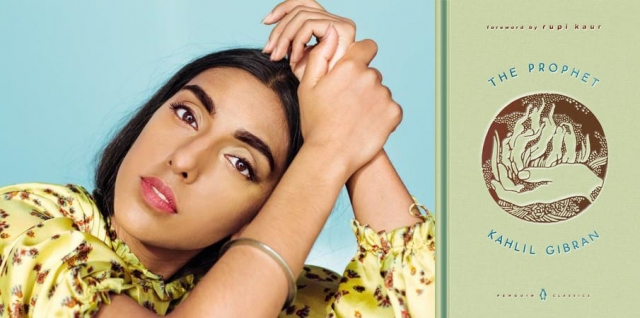
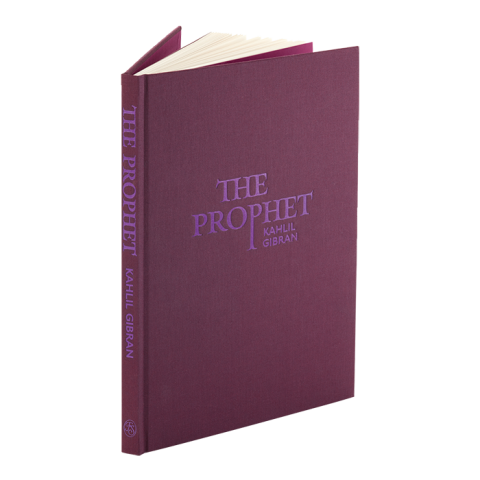
For good? Well, not exactly. In 2011 Macmillan Collector's Library published a gilt-edged pocket Prophet containing the original first-edition sentence. And in early 2019 a lavish, leather-clad, slipcased deluxe edition with high-quality colour reproductions of Gibran's drawings was published by the Folio Society in London — also reproducing the text in its original version, keeping "sleeping mother."
• ❧ KGC ❧ •
VI
Comparing translations into French, Dutch, Afrikaans and Italian shows that translators used either the original or the updated version as their reference. Twenty-three French translations were consulted, in chronological order:
1926 Madeline Mason — "Et vous, onde infinie, mère sans sommeil" (sleepless mother)
1956 Camille Aboussouan — "Et vous, étendue salée, mère toujours en éveil" (mother ever awake)
1982 Antoine Ghattas Karam — "Et vous, vaste mer, mère endormie" (sleeping mother)
1983 Paul Kinnet — "Et vous, vaste océan, mère qui veillez" (watchful mother)
1983 Janine Lévy — "Et toi, vaste océan, mère endormie" (sleeping mother)
1985 Michaël la Chance — "Et toi, mer immense, mère toujours en éveil" (mother ever awake)
1990 Marc de Smedt — "Et vous, vaste mer, mère endormie" (sleeping mother)
1992 Anne Wade Minkowski — "Et toi, vaste mer, mère endormie" (sleeping mother)
1992 Salah Stétié — "Et toi, vaste mer, mère endormie" (sleeping mother)
1993 Jean-Pierre Dahdah — "Et toi, mer immense, mère toujours en éveil" (mother ever awake)
1994 Guillaume Villeneuve — "Et toi, vaste mer, mère assoupie" (drowsy mother)
1995 Bernard Dubant — "Et toi, mer immense, mère que le sommeil ignore" (mother whom sleep knows not)
1998 Salah Stétié, revised — "mère endormie" (sleeping mother)
1999 Cécile Brunet-Mansour and Rania Mansour — "mère toujours en éveil" (mother ever awake)
2006 Pierre Ripert — "mère jamais endormie" (mother never asleep)
2008 Jean-Christophe Benoist — "mère endormie" (sleeping mother)
2008 Nicola Hahn — "mère sans sommeil" (sleepless mother)
2008 Omayma Arnouk el-Ayoubi — "[Qui vient rejoindre l'océan infini]"
2010 Philippe Morgaut — "génitrice endormie" (sleeping genetrix)
2012 Didier Sénécal — "mère endormie" (sleeping mother)
2012 Salah Stétié, definitive — "mère endormie" (sleeping mother)
2013 Anne Juni — "mère infatigable" (indefatigable mother)
2016 Philippe Morgaut, revised — "mère endormie" (sleeping mother)
For Dutch and Afrikaans:
1927 Liesbeth Valckenier, Dutch — "slapende moeder" (sleeping mother)
2004 Désanne van Brederode, Dutch — "jij slapeloze moeder" (sleepless mother)
2008 Wilma Paalman, Dutch — "slapeloze moeder" (sleepless mother)
1955 Louis Fourie, Afrikaans — "slapende moeder" (sleeping mother)
And for Italian:
1966 Salvatore Cossú — "madre sempre in guardia" (ever-watchful mother)
1976 Giampiero Bona — "E tu materno e insonne, o vasto mare" (motherly and sleepless)
1989 Paolo Ruffilli — "madre insonne" (sleepless mother)
1993 Ariodante Marianni — "madre insonne" (sleepless mother)
2005 Francesco Medici — "madre insonne" (sleepless mother)
2009 Magda Indiveri — "madre dormiente" (sleeping mother)
2015 Andrea Montemagni — "vasto, materno e insonne mare" (vast, motherly and sleepless sea)
• ❧ KGC ❧ •
VII
We have established beyond doubt that the original text at the top of page 10 of The Prophet, as first published in New York on 23 September 1923, was changed from "sleeping mother" to "sleepless mother" from the fourth printing of January 1925 onwards; and that, unlike the American text, the British text was not updated until fairly recently.
On that basis the definitive version of Gibran's masterpiece should be the one carrying "And you, vast sea, sleepless mother" — irrespective of the fact that recent editions from other houses reproduce the original, non-updated version.
It can be assumed fairly reasonably, though not proven with certainty, that the change may have been influenced by a poem from Hill Fragments, in the course of Madeline Mason and Gibran's work together on her French translation and on the drawings for her own collection. But two texts from Gibran's own body of work also speak of the sea as restless, sleepless, or ceaseless in its moaning — one of them dating, in the original Arabic, from years before The Prophet was published.
Further research could be conducted internationally, on a much larger scale, to identify for all available translations of The Prophet the versions on which the translators based their work.
❁
About the author — Philippe Maryssael was born in Brussels in 1962 and studied translation there in the early 1980s, later studying terminology and terminotics. He worked as a translator and terminology pioneer in the insurance and financial sectors before joining a European financial institution in Luxembourg as translator-reviser, terminologist and computer-aided translation specialist, and later as a business process manager. He retired in July 2017 and turned to his lifelong interest in Gibran, collecting first editions and comparing the many French translations. His first published translation, Le Fol — a bilingual presentation of The Madman with an analysis of Gibran's English — appeared at the end of 2018. More at maryssael.eu.
1 On the Knopf publishing house, see its Wikipedia entry. ↩
2 The Kahlil Gibran Collective — founded and managed by researchers, scholars and biographers of Kahlil Gibran and Mary Haskell — exists to further the scholarship of Gibran's life, work and legacy through international programmes, events and publications, and serves as a resource for researchers and readers. ↩
3 Glen Kalem-Habib, "The Prophet, Translated," The Kahlil Gibran Collective, and subsequent articles. ↩
4 Glen Kalem-Habib, "End of the Copyright Road for The Prophet," The Kahlil Gibran Collective. ↩
5 Virginia Hilu, Beloved Prophet, pp. 416–417.
6 Francesco Medici, "Gibran's The Prophet in All the Languages of the World," 5th International Gibran Conference, Institut du Monde Arabe, Paris, 3 October 2019. ↩
13 Madeline Mason-Manheim, Hill Fragments (London: Cecil Palmer, 1925), p. 14. 14 Kahlil Gibran, Prose Poems, pp. 12–15. 15 Kahlil Gibran, The Earth Gods, pp. 3, 5–6.
All Rights Reserved © Copyright Philippe Maryssael 2019